After this, when Jesus knew that all was now finished, he said (in order to fulfil the scripture), ‘I am thirsty.’ A jar full of sour wine was standing there. So they put a sponge full of the wine on a branch of hyssop and held it to his mouth. When Jesus had received the wine, he said, ‘It is finished.’ Then he bowed his head and gave up his spirit. John 19.28-30, NRSV
Good Friday – talk about a dark day in the history of the world! Crucified on Golgotha Hill, everyone thought Jesus was a complete failure. Just another flash in the pan of wanna-be’s. His disciples, who had given up everything to follow him three years before, felt cheated, bitter, and depressed and they had abandoned him. Of course, things didn’t end there. Friday’s failure had turned to glory on Sunday morning. The Cross emerged triumphant from the empty tomb. What seemed like sure-fire failure Friday afternoon became on Sunday the greatest historical event the world has ever known: the Lord is risen, indeed! There is no stone strong enough, no tomb deep enough, no death deadly enough, to keep Christ and his believers entombed.
It’s something we seem to easily forget though. I don’t think a single one of us has escaped a sense of devastation or failure at some point in our lives and sadly, many folks never get over it. They dwell on problems instead of solutions, death instead of life, tragedy instead of triumph. The power of the resurrection has escaped them and they never experience the life intended by their creator.
“Failure” is a horribly debilitating word. If it were left up to me, I’d re-jigger things in our world that would make church something no one wanted to do without, take all of the calories out of pecan pie and put them in turnips, and erase “failure” from every language under the sun.
If you find yourself feeling demoralized by your apparent failures, take heart in knowing that there is no such thing in God’s sight if you have done your best to turn to him. I’m not invoking a Pelagianistic heresy – that if you do your best, God will do the rest. That denies everything Paul said about grace alone. When you turn to God with your heart and soul, your imperfect life will reflect the light of success that Good Friday’s failure created, even though you may trip and fall along the way.
Don’t let Friday failures cripple you. The incarnation and finally, the resurrection, affirmed that we humans are good, warts and all. A sincere faith in the triumph of the cross on a dark Friday afternoon may be the very thing which sets you off in a thrilling fresh direction tomorrow. God didn’t come in the flesh to love the loveable or to improve the improvable. God has a greater plan for you that you can ever imagine. He came to raise the dead. “For surely I know the plans I have for you, says the Lord, plans for your welfare and not for harm, to give you a future with hope.” Jeremiah 29.11, NRSV
The greatest among you will be your servant.All who exalt themselves will be humbled, and all who humble themselves will be exalted. Matthew 23.11-12, NRSV
Servanthood – such a beautiful ideal, such a lofty goal. Jesus exemplified the life of servanthood and he calls us to live as he did. I pretty sure that all of us agree with the principle of servanthood, but when push comes to shove and it gets down to the specifics, I wonder how many of us take it seriously? Servanthood – oh that’s for the other guy; that’s for the minister, as if there is some kind of exception for the laity. “You mean, with my position, my salary, my skill set, I have to be a servant to that so-and-so? You mean I have to wait upon others when it should be me that is waited on? I have to pick up after everybody?” Yup! That’s what Jesus means and he means what he says, whether we like it or not. Make no mistake – Jesus is not talking about high-flying, glamorous, prestigious jobs. He’s talking about jobs that are as menial as they come – sometimes messy, sometimes thankless – like washing a shopping cart person’s filthy feet.
Pride is usually what gets in the way – it’s the huge barrier reef with the great white sharks of our egos swimming around it, ready at all times to devour any notion of seeing others as worthy at our expense. Our human nature makes us think we are just a little bit above everyone else and we should be treated that way. Instead of seeing what we can do for others, we expect others to do things for us. Scripture has lots of warnings that pride is deceptive and dangerous: for those who exult themselves will be humbled by God himself. I love the way Obadiah says it: “Your proud heart has deceived you, you that live in the clefts of the rock, whose dwelling is in the heights. You say in your heart, ‘Who will bring me down to the ground?’ Though you soar aloft like the eagle, though your nest is set among the stars, from there I will bring you down, says the Lord.” (Obadiah, 3,4, NRSV) If you think you are high above everyone else, invincible, set among the stars and too good for servanthood – watch out!
Greatness in the Kingdom comes in serving, so check your ego and choose to live as a humble servant of Jesus Christ. As Jesus said, he came not to be served, but to serve. He means it! And if it’s good enough for God, it’s certainly more than good enough for you.
Short people got no reason to live// They got little hands// And little eyes// And they walk around// Tellin’ great big lies// They got little noses// And tiny little teeth// They wear platform shoes// On their nasty little feet// Well, I don’t want no short people// Don’t want no short people// Don’t want no short people ‘Round here…
From the song “Short People” by Randy Newman, 1977
Short people – short on tolerance; short on humility; short in sight; short on love of neighbor. Bigotry, racism, hateful ignorance. Randy Newman’s ironic poke at racism and bigotry reminded me of another person persecuted for difference. I want to peek inside a story from Luke 19, verses 1-10 that most probably first heard about in a Sunday school song:
Zacchaeus was a wee, little man // And a wee, little man was he.// He climbed up in a sycamore tree // For the Lord he wanted to see.
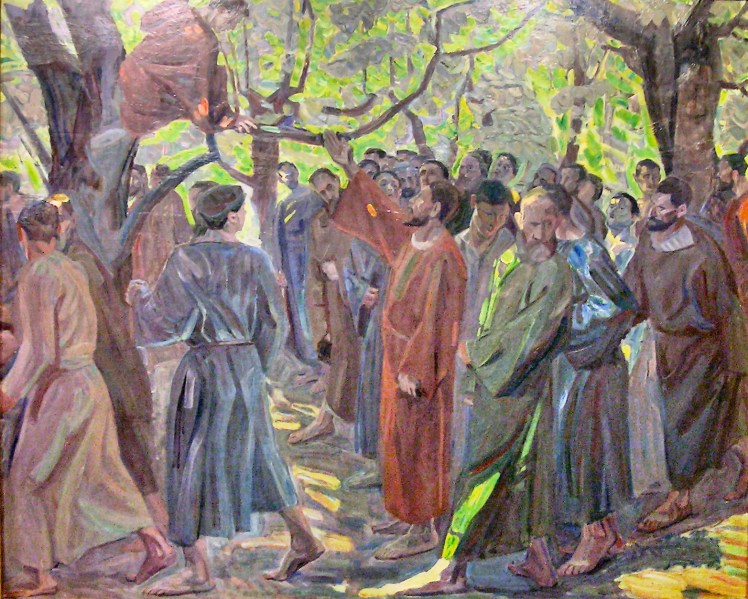
Jesus is on the road at Jericho, a wealthy city in the foothills leading to Jerusalem – it is the last leg of his journey to the temple, when he encounters Zacchaeus, the lead tax collector, a man universally despised, short in stature, which may very well be referring to his communal status as well as his height. Poor guy – he’s the one in the room everyone hates and he knows it. He has to run along the parade route behind the crowds in front of him – crowds that tighten their positions to keep him out. And there is little Zacchaeus, jumping up and down, trying to get a glimpse of Jesus, when he comes to the sycamore tree: a tree with low branches that made climbing easy and a tree loaded with large leaves that would hinder his presence from being detected by the crowd. A wealthy, grown man, clambering up a tree. What made him throw embarrassment, shame, and ridicule aside, not caring what people thought and what they might possibly see of his more private affairs?
He simply wanted to get a look at Jesus. After all, Jesus was a man that welcomed people like Zacchaeus. Jesus even has one of the guys from the Brotherhood of Tax Collectors local 106 in Galilee as one of his disciples. He must be an okay guy.
But Jesus spots him instead and tells him to come down.
The marginalized, the people on the wrong side of the crowds, the ones pushed off to the shoulder of the road, the ones blocked from participating in the community, the ones forced to climb a tree, are the ones who see most clearly. The blind beggar at the end of Luke 18 sees without eyes and Zacchaeus sees with his heart. And yet, the insiders, the disciples, the good white, evangelicals lining the roads telling others to go away, are the real blind ones. They don’t want those short people hanging around. The light of salvation is standing right in front of them and all they can see are their earthly expectations; all they can see is their own self-worth; all they can see are those who think and act like they do; all that they can see are their self-serving restrictions on who is in and who is out; all they see is a riddle; all they see is that they want to remain blind. It’s more comfortable and they grumble at anything that challenges them otherwise. Fake news.
The irony in all of this is that this is our story as well. This passage is not just some far removed happenstance on a dusty road in Palestine 2,000 years ago. It’s a story we continue to enact in varying degrees today, day after day. Zacchaeus was stereotyped and stigmatized by the blindness of the crowds much the same way we do grumbling about all of them: the opposite political party, immigrants, Muslims and their burquas, Jews and their yarmulkes, Hindus and their bindis, atheists, straight, the ‘nones’, the gay couple that just moved into the neighborhood, the transgender boy that wants to join the scouts and those Asian, black, and Hispanic people that seem to be everywhere and now the neighborhood just isn’t the same. We whisper about the couple getting divorced, the family dealing with an addicted member. We condemn the poor as lazy and self-seeking in their charity or the felon who must check a box for the rest of his or her life, condemning far too many to underemployment and marginality. Worse yet, we proclaim prisons as houses of correction where there is no effort to do so, insuring the condemnation of many to an endless cycle of poverty and prison. After all, I’m not like you: I must deserve it.
We stereotype and stigmatize all day long. The disciples did it when they failed to understand the plain language of Jesus, remaining in their stereotyped expectations of messianic deliverance, not bothering to lift the veils from their eyes to truly see what scripture and Jesus had been saying all along. And when we revel in our attitudes of exclusion and self-righteousness, we, like the disciples, miss the message of Jesus and the cross. The kingdoms of our making, the kingdoms of racial division, white privilege, political tribalism, violence, materialistic greed are antithetical to the kingdom of God, but we continue to build them because we are just too willingly blind to accept the hard truth of Christ and the cross.
Jesus emphatically states: “Zacchaeus, today salvation has come to your house, and I am coming over for dinner.” This is the nub of the scandal of Zacchaeus’s story: Jesus was coming over for dinner. It’s at the heart of the problem the crowds are having as they grumble – he eats with sinners and tax collectors! Dinner parties in the Greco-Roman era were the society balls and political fund raising dinners of their time. It was the place to see and be seen, to affirm at the very least, to promote at its best, or to diminish at its worst, the social standing of anyone. To be invited to a dinner party means you are part of the ‘in’ crowd, you are part of the family.
Yet, here’s the beautiful thing. You don’t go looking for Jesus, Jesus comes looking for you. And that’s the good news for you and I, the blind and the lost. The good news is that today salvation has come to all of us because the Human One has come to seek us out. Jesus says to all who believe in him, that today, he is coming into our houses, coming to we who are what we stereotype and stigmatize, we who are “them” – he is coming to have dinner with us. Jesus call us to the table – all of us – the sinner and tax collectors, the blind and the broken, to affirm our place as children of the living God, spared certain destruction by the unmerited gift of the cross, to sit as one family gathered around the gifts of God for the people of God.
Late in his song, Newman sings: Short People are just the same as you and I. All men are brothers until the day they die.Imago dei – we are all made in the image of God. Go into the world today and every day with unyielding gratitude and the overflowing joy of a people found with sight restored – one family – not white, black, brown yellow, red, not Republican or Democrat, straight, gay or in-between, – one blessed family that has room for all: a family invited to the greatest dinner party of all time. Thanks be to God – Amen.
During this time of pandemic, many of us have been confronted by a range of emotions that have been a tough challenge as we have endured isolation, economic duress and much uncertainty. We have many, many questions and very, very, few answers. Who was the author when asked if, in spite of his atheism, he met God and what he might say? Bernard Shaw? Whoever it was, his answer was along the lines of ‘why did you provide so little evidence of your existence?’ At times like this, I have heard several people voice that very lament. I can relate…far too easily. I have been guilty of the same sentiment until I discovered my humanity and with it, humility.
Before…
Job is my buddy – the Job of the Bible, that is. What is likely the oldest text in our bible, the book of Job is part of the wisdom literature and it is a text that has stood me well over the years. If you have never read it, this is as good a time as any and if you have some trouble with biblical language, try the Common English Bible or Eugene Peterson’s take in The Message.
For those that have read it, I don’t know about you, but I have always thought that the opening to the book of Job was a bit odd. The first verse: “There was once a man in the land of Uz whose name was Job”[1] has a Grimm Brothers fairy tale ring to it à la ‘once upon a time.’ And right from this curious opening, we are told that Job “was blameless and upright, one who feared God and turned away from evil.” [2]Blameless and upright? Who can possible be blameless? Maybe the author hadn’t read Paul or their Augustine yet. And then again….
A key to understanding this characterization of Job rests with the Hebrew translated as blameless, the word tam. It is not describing someone that is sinless, but rather one who is morally whole or complete, integrity. Being “upright” implies a sense of straightness or directness in Job’s affairs with God and neighbor; that is, Job would embody the virtues of love for neighbor, care for the poor and a concern with justice. Job exemplifies religious, moral, and ethical integrity that stems from “scrupulous habits of sacrifice combined with a genuinely righteous character;” [3] a manifestation witnessed in Job’s compulsive and meticulous attention to religious detail in the care and concern for his children’s well-being: “And when the feast days had run their course, Job would send and sanctify them, and he would rise early in the morning and offer burnt-offerings according to the number of them all; for Job said, ‘It may be that my children have sinned, and cursed God in their hearts.’ This is what Job always did.” [4]Job is faithful then, in God’s way of life to which God himself testifies on two distinct occasions.[5]
Coupled with his bountiful offspring [6]and wealth, Job “was the greatest of all the people of the east.” [7] Yet when all was lost in disasters that would fell any other person, Job’s initial response to the news was remarkable: “Then Job arose, tore his robe, shaved his head, and fell on the ground and worshipped. He said, ‘Naked I came from my mother’s womb, and naked shall I return there; the Lord gave, and the Lord has taken away; blessed be the name of the Lord.’[8] Job’s rejection of his wife’s seemingly sane conclusion to curse God and die, speaks volumes to the depth of his faith and his integrity:“But he said to her, “You speak as any foolish woman would speak. Shall we receive the good at the hand of God, and not receive the bad?” In all this Job did not sin with his lips.”[9] He is quite confident about the meaning of life and his relationship with God, while all the while, unaware of how much he does not know.
Yet, sitting on the ash heap in the days of silence that follow, suffering has overtaken Job. In chapter three, we encounter a man that is suddenly questioning the value of a life that is filled with dread, confusion and alienation. If life is ultimately to be one of suffering, why “is light given to one in misery, and life to the bitter in soul?” [10]Although he persistently refuses to abandon his faith in the face of his friends repeated and insulting entreaties to do so, Job’s question, and his dawning fear of the enmity of God, cause him not to let go of God, but form the beginning for letting go his understanding of God, himself and life: the necessary step leading to the transformed Job we meet in the epilogue.
After…
The turn comes after God’s first speech from the whirlwind as Job admits to a respectful silence: “Then Job answered the Lord: ‘See, I am of small account; what shall I answer you? I lay my hand on my mouth.’[11] In verse 40.8, [12] God confronts Job’s limited ‘either/or’ worldview head on with a previously unthinkable challenge of ‘both/and’: that Job can be innocent and God can be just, a perspective that impels Job to a deeper grasp of reality now fully accepted after God’s second speech: Job, stripped of his ego, recants and reconsiders what being human means: “I had heard of you by hearsay, but now my eye has seen you. Therefore, I recant and change my mind concerning dust and ashes.”[13] Ellen Davis argues, “Job’s final words indicate that he accepts correction implicit in the vision and at last claims his integrity of God’s terms, surrendering to a wholeness that he can never comprehend.”[14]The voice from the center of the whirlwind clearly demonstrates to Job that he is not at the center of the universe.
It is a transforming surrender that secures the courage for Job to claim this new integrity and identity with forgiveness, joy and lightheartedness, knowing that things are not at all the same. He can pray for his tormenting ‘friends,’ and perhaps most telling of all, he has the courage to once again have children: to reinvest in family and life with full knowledge of the uncertainties that life entails. The change in Job from a fearful and circumspect man, anxious about the possible sins of his children, to a forgiving, carefree, parent that can name his daughters Dove, Cinnamon, and Eye of Horn Shadow, as well as breaking with all social norms by leaving them an inheritance, shows just how far Job’s character has been changed by his inspirational model, God.
In many ways, the book of Job is posing the great question – Is there a living God beyond what we can imagine? Is there a Being independent of us, beyond the boundaries of earthly life and earthly struggle? Is there a God who speaks with a voice that is not simply projected out of our own human consciousness? Is there a God that can deliver us from the dust? In a word, yes.
Job teaches several faithful responses: speak to God honestly and directly, trusting that God will answer; risk living and loving, even after great pain; and delight in a world that is wild and beautiful and risky, trusting in the faithful God who created and still sustains that world. Job’s willingness to once again embrace life, fully and joyously, is at the very heart of what it means to be human and to engage in faithful living – even when it appears that there is nothing in it for us. Life within the limits of human wisdom is a life of radical faith – to borrow a phrase – it is a free fall into the arms of what our hope tells us are the outstretched arms of God. It is a life that sees the truth of the cross and embraces it.
I can personally testify to the dilemma Job faced. What I once treasured was taken from me when we lost our daughter Sarah. What I once worshipped proved to be a golden calf. Blinded by the greed of wealth, I did not see that my two business partners were stealing from our company and our investors. What I valued turned to dust as our house and cars were repossessed and my freedom was taken from me. In the midst of great pain, I too cried out and like Job, I was changed.
Job was with me at my wife’s bedside when I broke the news of Sarah; Job was at my side as we endured five miscarriages until the gift of Skylar. Job was at my side as we faced living on the streets; Job was at my side all throughout separation from my family while I was imprisoned. Job was at my side in the midst of my deepest darkness and greatest pain and ultimately taught me to see things from God’s perspective; I began to live in joy with my wife and daughter, the greatest gift from God second only to his son: my life was more than restored.
The fear of the Lord, says scripture, is the beginning of wisdom and the lesson that I am continually learning is that through Job and all of scripture, the living God of infinite power, yet infinite mercy, speaks to all of us that have the ears to listen. However much the storms of this life may batter me within and without, I know that I can put my hand in the hand of the man from Galilee. Perhaps you will too.
[3] Carol M. Bechtel, ed., Touching the Altar: The Old Testament for Christian Worship, The Calvin Institute of Christian Worship Liturgical Studies Series (Grand Rapids, Mich: William B. Eerdmans Pub, 2008), 183.
[6] He is blessed with seven sons and three daughters, the perfect complement of children. See Gerald Henry Wilson, Job, New International Biblical Commentary Old Testament Series 10 (Peabody, Mass: Hendrickson Publishers [u.a.], 2007), 19.
[12] “Will you even put me in the wrong? Will you condemn me that you may be justified?” NRSV.
[13] Job 42.5-6. I find agreement here with the arguments for the translation offered by Ellen Davis in Ellen F. Davis, Getting Involved with God: Rediscovering the Old Testament (Cambridge, Mass: Cowley Publications, 2001), 141.
[14] As found in Carol M Bechtel, Job and the Life of Faith: Wisdom for Today’s World (Pittsburgh, PA: Kerygma Program, 2004), 52.



 A Prodigal's Periodical