After this, when Jesus knew that all was now finished, he said (in order to fulfil the scripture), ‘I am thirsty.’ A jar full of sour wine was standing there. So they put a sponge full of the wine on a branch of hyssop and held it to his mouth. When Jesus had received the wine, he said, ‘It is finished.’ Then he bowed his head and gave up his spirit. John 19.28-30, NRSV
Good Friday – talk about a dark day in the history of the world! Crucified on Golgotha Hill, everyone thought Jesus was a complete failure. Just another flash in the pan of wanna-be’s. His disciples, who had given up everything to follow him three years before, felt cheated, bitter, and depressed and they had abandoned him. Of course, things didn’t end there. Friday’s failure had turned to glory on Sunday morning. The Cross emerged triumphant from the empty tomb. What seemed like sure-fire failure Friday afternoon became on Sunday the greatest historical event the world has ever known: the Lord is risen, indeed! There is no stone strong enough, no tomb deep enough, no death deadly enough, to keep Christ and his believers entombed.
It’s something we seem to easily forget though. I don’t think a single one of us has escaped a sense of devastation or failure at some point in our lives and sadly, many folks never get over it. They dwell on problems instead of solutions, death instead of life, tragedy instead of triumph. The power of the resurrection has escaped them and they never experience the life intended by their creator.
“Failure” is a horribly debilitating word. If it were left up to me, I’d re-jigger things in our world that would make church something no one wanted to do without, take all of the calories out of pecan pie and put them in turnips, and erase “failure” from every language under the sun.
If you find yourself feeling demoralized by your apparent failures, take heart in knowing that there is no such thing in God’s sight if you have done your best to turn to him. I’m not invoking a Pelagianistic heresy – that if you do your best, God will do the rest. That denies everything Paul said about grace alone. When you turn to God with your heart and soul, your imperfect life will reflect the light of success that Good Friday’s failure created, even though you may trip and fall along the way.
Don’t let Friday failures cripple you. The incarnation and finally, the resurrection, affirmed that we humans are good, warts and all. A sincere faith in the triumph of the cross on a dark Friday afternoon may be the very thing which sets you off in a thrilling fresh direction tomorrow. God didn’t come in the flesh to love the loveable or to improve the improvable. God has a greater plan for you that you can ever imagine. He came to raise the dead. “For surely I know the plans I have for you, says the Lord, plans for your welfare and not for harm, to give you a future with hope.” Jeremiah 29.11, NRSV
When you're down and troubled // And you need some loving care // And nothing, nothing is going right // Close your eyes and think of me // And soon I will be there // To brighten up even your darkest night. // You just call out my name // and you know wherever I am // I'll come running // To see you again // Winter, spring, summer or fall // All you have to do is call // And I'll be there // You've got a friend.
“You’ve Got a Friend” by Carol King, 1971
The Book of Jonah is a whale of a tale – pun intended. Sometimes though, we get so caught up in the details of the fish that we miss the meat of the message. Jesus spoke of Jonah as a real person, and I think this reluctant Old Testament preacher has a couple of things to teach us.
We cannot hide from God. It is possible to run from God – I did it for 40 plus years. It is impossible to outrun him though. Jonah didn’t fool God for a New York minute by boarding that ship to Tarshish and hiding in its lowest levels. God was right there. In trying to escape his calling, Jonah brought trouble upon himself and others. Those poor sailors were thrown into a monstruous storm and while they valiantly fought to save him, they probably were still burdened by guilt when they had to toss Jonah overboard.
God gives second chances. If we ask for forgiveness, God will give us another shot at things. Jonah was saved when he called for help – “Waters have grasped me to the point of death; the deep surrounds me. Seaweed is wrapped around my head at the base of the undersea mountains. I have sunk down to the underworld; its bars held me with no end in sight. But you brought me out of the pit.” (2.5-6, CEB) That was a pretty deep place to be drowning in and yet, God rescued him. We are never beyond the hope of a new start with God’s help.
We may be unhappy with God’s will. Jonah preached an eight word sermon: “Forty days more and Nineveh will be overthrown.” His sermon worked! The entire city of 120,000 people repented. Yet, Jonah had the chutzpah to be disappointed and unhappy. He got angry! Many of us pray for God’s will expecting to be thrilled about it, but danger, danger, Will Robinson. Where did we ever get that idea from? God’s will is unlikely to make us happy, because to obey God’s will requires us sacrifice our will and that is never easy to do.
We all have a bit of Jonah in us – some more than others – but at the end of the day, we are Jonah on more occasions than we might care to admit. Like Jonah, we often find out the hard way that we can never get away from God, no matter how long, how hard, and how fast we run trying to escape the calling and responsibility that he places on us. Save your energy instead for doing God’s will, whether you like it or not at the moment. In the end, you’ll be glad that you did.
Just as Jonah was in the whale’s belly for three days and three nights, so the Human One will be in the heart of the earth for three days and three nights. (Matthew 12.40, CEB)
Artwork: Jonah, lunette painting in the Cybo-Soderini Chapel in Santa Maria del Popolo by Pieter van Lint, c. 1636. Inscription on the tablet: “Tollite me, et [mittite in mare]” which means “Pick me up and throw me into the sea”
If there’s one thing I want you to do especially for me // Then it’s something that everybody needs…// Each night before you go to bed, my baby, // Whisper a little prayer for me, my baby,And tell all the stars above – This is dedicated to the one I love.
Dedicated to the One I Love, written by Lowman Pauling and Ralp Bass, 1957
I haven’t posted in what seems like forever – I think September of 2021 was the last time. Taking a stab at self-defense, the fall of 2021 into the spring of 2022 was a whirlwind of busyness and distraction as I was juggling three jobs – property manager for my home church, managing our food panty and serving, albeit part time, the good people of a local church as their interim minister. It was crazy, exhausting, and at times, maddeningly frustrating, as I struggled to write a sermon on Saturday, lead worship on Sunday, spend that afternoon writing next Sunday’s service – it was due Monday to meet bulletin production deadlines imposed by the administrative requirements dictated by a limited budget. Then Monday morning rolled around and…well, I hope you get the picture. It was a blessed time. No, really….it truly was.
But that is all changing. I have resigned from my role as a sexton and food pantry director to accept a full time position as the interim minister of a church around the corner from my home. God has asked me to help a congregation whose long time pastor recently departed. It is a congregation in mourning and one that is very anxious as it navigates the uncertainties that comes from transition. I am excited to embrace the tasks that await and I am under no illusion that the challenges are very real and very difficult. But since it is God that has asked, then I know that God is in this and that’s the only comfort I need.
I suspect that too many of us often lose sight of God’s presence as we struggle with the uncertainties and pain that is part of our daily lives. The pandemic has been a very difficult period for all of us and the clergy have not gone unscathed: the pastorate is hurting as well. It was in that context that I delivered the homily that follows to a gathering of the ministers and elders from a group of churches in my neck of the woods. And while my audience may have been the ordained, in a manner of speaking, all disciples of Christ are “ordained,” so I thought I’d share with all of you what I had to offer to them…
~
At a recent ordination service, while we were waiting for things to get underway, one of our pastors shared a story with a few of us from his ordination. As hands were laid on him, the minister at the time kept pressing down on his shoulders to impress upon him the weight of what being ordained felt like – the understanding that we are being, like the sailors of old, tied to the mast, so as not to be washed overboard by the raging seas of life in which we pastors embark daily.
And those seas are raging. Eugene Peterson, in Working the Angles, describes this in terms of wreckage – wrecked bodies, wrecked families, wrecked marriages, wrecked friendships and so on. It is into and through that wreckage that our ordination calls us to step – to walk into the ruins and witness to the gospel of Jesus Christ.
I might be the newbie on the block, but I have lived in the back stair cases of the house long enough to appreciate how difficult and exhausting this work can be. Pastoral burnout is at record levels. If I remember correctly, it was in acknowledgement of this, that the Lilly folks created grants that underwrote sabbaticals this past year.
Jeremiah knew fatigue. Jeremiah knew burnout. Early in his career, he wants to throw in the towel and walk away from the wreckage that surrounded him and the persecutions that challenged him: Lord, he prays- “So drag them away, and butcher them like sheep. Prepare them for the slaughterhouse” (12:3, CEB). That is one tired, angry and burned out dude!
Hey Jeremiah, I ordained you, the Lord tells him. Before I created you in the womb, I picked you out, set you apart as a prophet to the nations. I anointed you to run with horses, and you are tired out by the foot runners? Are you going to quit when you discover that there is more to this work than a 9-5, dinner and television life style? It’s tough stuff that I ordained you to do, but do not forget you are an iron pillar and bronze wall because I am with you. You can do it with me at your side.
I have no idea how long it took Jeremiah to respond, but we know he did – “From the thirteenth year of Judah’s King Josiah, Amon’s son, to this very day—twenty-three years—the Lord’s word has come to me. I have delivered it to you repeatedly, although you wouldn’t listen” (25:3, CEB). He sticks to it – he is still at it for 23 years, in spite of death threats, moments of despair and discouragement, being whipped in a stockade, thrown into a well, and daily ridiculed, his message ignored because he doesn’t buy into the lifestyle, the fads and whims of the secular life that was rotting away around him.
How did he find the courage? How did he find the deep abiding faith to live fully into what God was calling him to do? How did he meet the challenge to run with horses? Persistence. Every morning, every afternoon, every evening he awaited to hear the word of the Lord. He prayed.
Prayer was the action that Jeremiah rooted his entire day with. For 23 years he prayed to hear the word of the Lord and for 23 years, he heard it. He heard it because for Jeremiah, it wasn’t faith in prayer – it was faith in God. It wasn’t a technique that he used as a way to get things done: his were not prayers of oops, wow, gimme and thanks. Prayer for Jeremiah was a way of coming to God in faith and trust. Scared, worn out, lonely, hurt angry, discouraged, Jeremiah came to prayer with the desire to listen to God firsthand, to speak to God first hand because God had primacy in and over his life.
But what did Jeremiah’s prayer look like? How did he pray? I am indebted to a section from Peterson’s work, Run with the Horses, for his terrific exposition of chapter 15 of Jeremiah for the following.
Jeremiah prays his fear – You understand, Lord! Remember me and act on my behalf…(15:15, CEB) You got me into this stuff and I’m counting on you to see me through it.
He prays his loneliness – When your words turned up, I feasted on them; and they became my joy, the delight of my heart, because I belong to you, Lord God of heavenly forces. I didn’t join the festive occasions; I took no delight in them. I sat alone because your hand was upon me (15:16-17, CEB). Jeremiah lived the truth – he delighted in receiving God’s word but when he turned around, no one else was there – they were on the golf course, at the shopping mall, watching television.
He prays his hurt – Why am I always in pain? Why is my wound incurable, so far beyond healing? (15:18a, CEB) He hurts because he cares – he cares about the flock that God has charged him with and their refusal to listen to the love of God that he preaches every Sunday, hurts.
He prays his anger – You have become for me as unreliable as a spring gone dry! (15:18b, CEB) The man who once preached that God was “the spring of living water” (2.13, CEB), now accuses him of deceit. You didn’t walk the talk, God.
We all have our moments of doubt, when the pits of despair seem insurmountable, when the dark nights of the soul is so black we can’t see our own fingers in front of us. Dealing with Peterson’s wreckage day after day is not an easy thing – we are only human. Pray your anger, pray your fear, pray your hurt, pray your loneliness. Pray your love. We need to hear and rehear God’s promises, made to us in our ordinations, over and over again. Simply carrying around some memory verses in our pockets isn’t enough. We need that daily encounter that comes in prayer. The world is changing all around us – changing faster and faster it seems – but God’s word never changes. In prayer, we encounter the word that renews and reaffirms and my prayer tonight is that Jeremiah’s example may be one that guides all of us as we try to run with the horses. Pray.
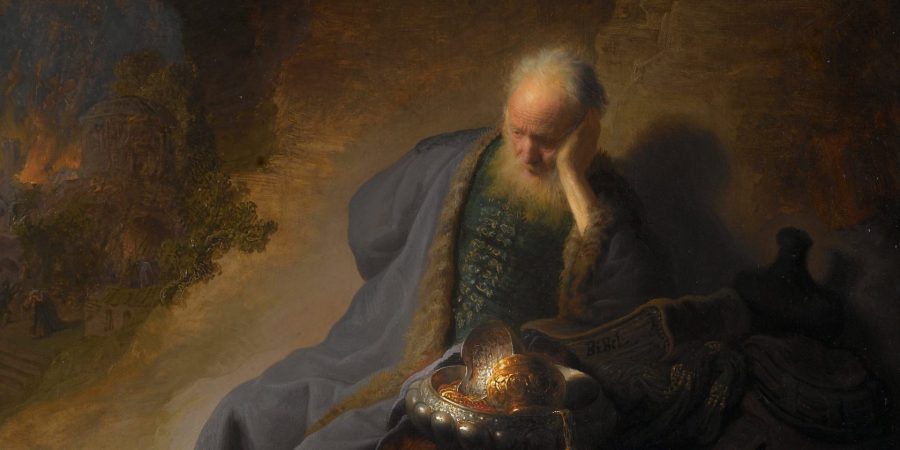
Artwork: “Jeremiah Lamenting the Destruction of Jerusalem,” Rembrandt, 1603, Public Domain
1When Israel went out from Egypt, the house of Jacob from a people of strange language, 2Judah became God’s sanctuary, Israel his dominion. 3The sea looked and fled; Jordan turned back. 4The mountains skipped like rams, the hills like lambs. 5Why is it, O sea, that you flee? O Jordan, that you turn back? 6O mountains, that you skip like rams? O hills, like lambs? 7Tremble, O earth, at the presence of the Lord, at the presence of the God of Jacob, 8who turns the rock into a pool of water, the flint into a spring of water. (NRSV)
God holds nothing back when God wants to do something significant for us. No mountain, no barrier, no human can get in the way of God’s plans for you, just as nothing was able to get in the way of delivering God’s people from Egypt.
I call them holy happenings. God involves people in their unfolding, but God is in control and cannot be stopped. God can do it anytime, anywhere and in any place: from safe passage through the Red Sea, to the resurrection of Jesus, the conversion of Paul and the visions of John. Holy happenings are beyond human comprehension, definition, and explanation.
Recognizing holy happenings requires a sense of awe and wonder, and the eyesight of faith. Real power is unseen. The real power of a home depends on love and respect, not the size of the house. The real power of electricity is in the current, not the cable. So it is with God.
The power of God is not experienced face-to-face, but through God’s many manifestations in the world. Accept the mystery; don’t let fear or doubt settle in your mind and get in the way. God produces holy happenings to reassure us of God’s presence, power and love, not to terrify us. Remember, Scripture shows that peace always comes out of confusion.
Holy happenings change history. Holy happenings change the world. A holy happening could change your life, so look around. There are holy happenings in your life right now: family gathered around the dinner table; staycations and more time at home being a neighbor with those you might have never met otherwise; being free to teach your child how to ride a bike; learning to bake bread; savoring the scent of honeysuckle on a summer morning; doing the evening dishes with your spouse. Look around, inhale the beauty of God’s good creation: you have the time. The mountains and hills could be skipping like rams and lambs.
“The world that we all knew before, could wake up in feeling safe... now it seems that everything has been turned upside down.” Tori Amos
Upside down indeed! An unknown virus goes around the world faster than Phileas Fogg and Passepartout, murdering hundreds of thousands and devastating national economies, creating further madness and mayhem for those still living. Dreams are shattered, lives are placed on indefinite hold by an unseen, capricious, biological mutation arbitrarily making the difference between life and death. We define ourselves by our careers and the virus has created an existential crisis of identity made more acute by our very real physical isolation. It is not surprising to see the selfishness of the “I, Me, Mine” culture we inhabit on vivid display. As David Brooks has noted, we are a “morally inarticulate culture,”[1] adrift at the very time when the most fundamental moral questions should be front and center.
Wisdom cries out in the street; in the squares she raises her voice. At the busiest corner she cries out; at the entrance of the city gates she speaks: ‘How long, O simple ones, will you love being simple? How long will scoffers delight in their scoffing and fools hate knowledge? (Proverbs 1.20-22, NRSV).
Listening to Lady Wisdom has never been more important as now.
I savor the book of Proverbs: a poetic compilation of the roadmap to how God has designed the world to work. The proverbs of “Solomon son of David, king of Israel” illuminates the ways of godly living and the means by which to reflect kingdom work and God’s glory in the details of life and relationships. They are ancient anchors of wisdom that keep us steady and focused on Christ during times of transition and uncertainty: a crucial distinction between reading Proverbs for advice and going to it for wisdom.[2] And, in today’s upside down climate, it is a distinction that is all the more compelling.
As a young father, I used to bristle at Proverbs that appeared to condone corporal punishment: “Those who spare the rod hate their children, but those who love them are diligent to discipline them’(13.24, NRSV); and “Do not withhold discipline from your children; if you beat them with a rod, they will not die. If you beat them with the rod, you will save their lives from Sheol”(23.13-14, NRSV). Sounds like a good way to get arrested today. However, what I have since learned, is that the sages of Proverbs had a more nuanced idea about discipline. In the second verse of the book’s opening act, the Hebrew word, mûsar, (which many translate as “instruction”), is better translated as “discipline.” The noted theologian Ellen Davis writes that mûsar “…always denotes authoritative instruction or correction from God or God’s agent, personified Wisdom, or from a teacher or a parent.”[3] Discipline, in this sense, should be seen in the positive context of setting boundaries; a prescriptive hermeneutical lens of instruction for how to live life, rather than to describe how life is: an understanding of discipline that is well captured by a verse from the Thomas Troeger hymn, “God Marked a Line and Told the Sea.” From verse 5: “We are not free when we’re confined//to every wish that sweeps the mind, //but free when freely we accept//the sacred bounds that must be kept.”[4] As I look at my flourishing twenty-one year old daughter, I can clearly see the living results.
Discipline and boundaries driven by sacred love is a wise teaching indeed, especially for a society that is captivated by every individualistic wish and whim: a society deeply polarized by those whims. “The one who lives alone is self-indulgent, showing contempt for all who have sound judgement. A fool takes no pleasure in understanding, but only in expressing personal opinion” (18.1-2). The Hebrew translated as “lives alone” literally means to separate oneself: it is an ‘us versus them’ way of life that has become our cultural norm, constituting a very positive danger that rejects the importance and value of community. The price of abandoning community is more than personal isolation or lack of fulfillment: it is anarchy, personal chaos and too often, open and frequently violent hostility toward others. Nowhere is this more clearly on display than with the “my body, my freedom” assertion against the wearing of masks in our struggle to combat the horror of Covid-19.
As we continue to face the bitter divisiveness and uncertainties of our time, the sages offer a way forward, urging us to dive deeply into our faith, an immersion that leads to an internal disposition of stability: “No one finds security by wickedness, but the root of the righteous will never be moved…The wicked covet the proceeds of wickedness, but the root of the righteous bears fruit” (12.3, 12). This is not merely psychological stability, but something deeper than any psychologist could validate. The root of the righteous will never be moved because the righteous are rooted in God: “…their delight is in the law of the Lord, and on his law they meditate day and night. They are like trees planted by streams of water, which yield their fruit in its season, and their leaves do not wither. In all that they do, they prosper” (Psalm 1.2-3, NRSV). This is stability that stands at the foot of the cross and laments with a God that knows our pain and weeps with us. It is a stability whose foundation is predicated on the knowledge that God is not elsewhere and confers the hope to accept the present situation, with all of its limitations as providing all the necessary conditions for faithful living: to ask what, not why; to ask how, and for whom.
“The root of the righteous bears fruit.” Thomas Aquinas echoed this proverb when he taught that justice is the responsibility that we owe one another as fellow creatures of the One God. Yet, too frequently, we fail to act justly toward others and in the process, we do not do the kingdom work Christ calls us to do. So many of our acts of injustice (economic and personal) stem from a vain pursuit of our “real self” which more money, a more exciting marriage, more prestigious friends and another shopping spree will surely enable us to find and let Covid-19 take the hindmost. We should be fixed, not in that which is blown like chaff in the wind, but in the rootedness of God: “My heart is steadfast, O God, my heart is steadfast. I will sing and make melody” (Psalm 57.7, NRSV). As we move forward, we need to rethink our understanding of the kind of knowledge that comprises wisdom to include an awareness of the political and scientific realities of our world and the necessary responses that promote justice in the social arena. I’ll let Jesus have the last word. “But to what will I compare this generation? It is like children sitting in the market-places and calling to one another, “We played the flute for you, and you did not dance; we wailed, and you did not mourn”… Yet wisdom is vindicated by her deeds’ (Matthew 11.16-17,19b).
[2] John 1.1-3 is a clear echo of Proverbs 8.22-32. Paul picks up on this theme in his letter to the church in Corinth: “For Jews demand signs and Greeks desire wisdom, but we proclaim Christ crucified, a stumbling-block to Jews and foolishness to Gentiles, but to those who are the called, both Jews and Greeks, Christ the power of God and the wisdom of God” (1 Corinthians 1.22-24, NRSV).
[3] Ellen F. Davis, Proverbs, Ecclesiastes, and the Song of Songs, 1st ed, Westminster Bible Companion (Louisville, Ky: Westminster John Knox Press, 2000), 25.
[4]God Marked a Line and Told the Sea, by Thomas Troeger as found in Lift up Your Hearts: Psalms, Hymns, and Spiritual Songs (Grand Rapids, Mich.: Faith Alive Christian Resources, 2013), Hymn #28, verse 5.
During this time of pandemic, many of us have been confronted by a range of emotions that have been a tough challenge as we have endured isolation, economic duress and much uncertainty. We have many, many questions and very, very, few answers. Who was the author when asked if, in spite of his atheism, he met God and what he might say? Bernard Shaw? Whoever it was, his answer was along the lines of ‘why did you provide so little evidence of your existence?’ At times like this, I have heard several people voice that very lament. I can relate…far too easily. I have been guilty of the same sentiment until I discovered my humanity and with it, humility.
Before…
Job is my buddy – the Job of the Bible, that is. What is likely the oldest text in our bible, the book of Job is part of the wisdom literature and it is a text that has stood me well over the years. If you have never read it, this is as good a time as any and if you have some trouble with biblical language, try the Common English Bible or Eugene Peterson’s take in The Message.
For those that have read it, I don’t know about you, but I have always thought that the opening to the book of Job was a bit odd. The first verse: “There was once a man in the land of Uz whose name was Job”[1] has a Grimm Brothers fairy tale ring to it à la ‘once upon a time.’ And right from this curious opening, we are told that Job “was blameless and upright, one who feared God and turned away from evil.” [2]Blameless and upright? Who can possible be blameless? Maybe the author hadn’t read Paul or their Augustine yet. And then again….
A key to understanding this characterization of Job rests with the Hebrew translated as blameless, the word tam. It is not describing someone that is sinless, but rather one who is morally whole or complete, integrity. Being “upright” implies a sense of straightness or directness in Job’s affairs with God and neighbor; that is, Job would embody the virtues of love for neighbor, care for the poor and a concern with justice. Job exemplifies religious, moral, and ethical integrity that stems from “scrupulous habits of sacrifice combined with a genuinely righteous character;” [3] a manifestation witnessed in Job’s compulsive and meticulous attention to religious detail in the care and concern for his children’s well-being: “And when the feast days had run their course, Job would send and sanctify them, and he would rise early in the morning and offer burnt-offerings according to the number of them all; for Job said, ‘It may be that my children have sinned, and cursed God in their hearts.’ This is what Job always did.” [4]Job is faithful then, in God’s way of life to which God himself testifies on two distinct occasions.[5]
Coupled with his bountiful offspring [6]and wealth, Job “was the greatest of all the people of the east.” [7] Yet when all was lost in disasters that would fell any other person, Job’s initial response to the news was remarkable: “Then Job arose, tore his robe, shaved his head, and fell on the ground and worshipped. He said, ‘Naked I came from my mother’s womb, and naked shall I return there; the Lord gave, and the Lord has taken away; blessed be the name of the Lord.’[8] Job’s rejection of his wife’s seemingly sane conclusion to curse God and die, speaks volumes to the depth of his faith and his integrity:“But he said to her, “You speak as any foolish woman would speak. Shall we receive the good at the hand of God, and not receive the bad?” In all this Job did not sin with his lips.”[9] He is quite confident about the meaning of life and his relationship with God, while all the while, unaware of how much he does not know.
Yet, sitting on the ash heap in the days of silence that follow, suffering has overtaken Job. In chapter three, we encounter a man that is suddenly questioning the value of a life that is filled with dread, confusion and alienation. If life is ultimately to be one of suffering, why “is light given to one in misery, and life to the bitter in soul?” [10]Although he persistently refuses to abandon his faith in the face of his friends repeated and insulting entreaties to do so, Job’s question, and his dawning fear of the enmity of God, cause him not to let go of God, but form the beginning for letting go his understanding of God, himself and life: the necessary step leading to the transformed Job we meet in the epilogue.
After…
The turn comes after God’s first speech from the whirlwind as Job admits to a respectful silence: “Then Job answered the Lord: ‘See, I am of small account; what shall I answer you? I lay my hand on my mouth.’[11] In verse 40.8, [12] God confronts Job’s limited ‘either/or’ worldview head on with a previously unthinkable challenge of ‘both/and’: that Job can be innocent and God can be just, a perspective that impels Job to a deeper grasp of reality now fully accepted after God’s second speech: Job, stripped of his ego, recants and reconsiders what being human means: “I had heard of you by hearsay, but now my eye has seen you. Therefore, I recant and change my mind concerning dust and ashes.”[13] Ellen Davis argues, “Job’s final words indicate that he accepts correction implicit in the vision and at last claims his integrity of God’s terms, surrendering to a wholeness that he can never comprehend.”[14]The voice from the center of the whirlwind clearly demonstrates to Job that he is not at the center of the universe.
It is a transforming surrender that secures the courage for Job to claim this new integrity and identity with forgiveness, joy and lightheartedness, knowing that things are not at all the same. He can pray for his tormenting ‘friends,’ and perhaps most telling of all, he has the courage to once again have children: to reinvest in family and life with full knowledge of the uncertainties that life entails. The change in Job from a fearful and circumspect man, anxious about the possible sins of his children, to a forgiving, carefree, parent that can name his daughters Dove, Cinnamon, and Eye of Horn Shadow, as well as breaking with all social norms by leaving them an inheritance, shows just how far Job’s character has been changed by his inspirational model, God.
In many ways, the book of Job is posing the great question – Is there a living God beyond what we can imagine? Is there a Being independent of us, beyond the boundaries of earthly life and earthly struggle? Is there a God who speaks with a voice that is not simply projected out of our own human consciousness? Is there a God that can deliver us from the dust? In a word, yes.
Job teaches several faithful responses: speak to God honestly and directly, trusting that God will answer; risk living and loving, even after great pain; and delight in a world that is wild and beautiful and risky, trusting in the faithful God who created and still sustains that world. Job’s willingness to once again embrace life, fully and joyously, is at the very heart of what it means to be human and to engage in faithful living – even when it appears that there is nothing in it for us. Life within the limits of human wisdom is a life of radical faith – to borrow a phrase – it is a free fall into the arms of what our hope tells us are the outstretched arms of God. It is a life that sees the truth of the cross and embraces it.
I can personally testify to the dilemma Job faced. What I once treasured was taken from me when we lost our daughter Sarah. What I once worshipped proved to be a golden calf. Blinded by the greed of wealth, I did not see that my two business partners were stealing from our company and our investors. What I valued turned to dust as our house and cars were repossessed and my freedom was taken from me. In the midst of great pain, I too cried out and like Job, I was changed.
Job was with me at my wife’s bedside when I broke the news of Sarah; Job was at my side as we endured five miscarriages until the gift of Skylar. Job was at my side as we faced living on the streets; Job was at my side all throughout separation from my family while I was imprisoned. Job was at my side in the midst of my deepest darkness and greatest pain and ultimately taught me to see things from God’s perspective; I began to live in joy with my wife and daughter, the greatest gift from God second only to his son: my life was more than restored.
The fear of the Lord, says scripture, is the beginning of wisdom and the lesson that I am continually learning is that through Job and all of scripture, the living God of infinite power, yet infinite mercy, speaks to all of us that have the ears to listen. However much the storms of this life may batter me within and without, I know that I can put my hand in the hand of the man from Galilee. Perhaps you will too.
[3] Carol M. Bechtel, ed., Touching the Altar: The Old Testament for Christian Worship, The Calvin Institute of Christian Worship Liturgical Studies Series (Grand Rapids, Mich: William B. Eerdmans Pub, 2008), 183.
[6] He is blessed with seven sons and three daughters, the perfect complement of children. See Gerald Henry Wilson, Job, New International Biblical Commentary Old Testament Series 10 (Peabody, Mass: Hendrickson Publishers [u.a.], 2007), 19.
[12] “Will you even put me in the wrong? Will you condemn me that you may be justified?” NRSV.
[13] Job 42.5-6. I find agreement here with the arguments for the translation offered by Ellen Davis in Ellen F. Davis, Getting Involved with God: Rediscovering the Old Testament (Cambridge, Mass: Cowley Publications, 2001), 141.
[14] As found in Carol M Bechtel, Job and the Life of Faith: Wisdom for Today’s World (Pittsburgh, PA: Kerygma Program, 2004), 52.



 A Prodigal's Periodical