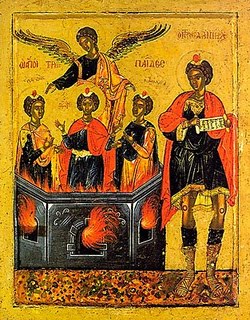
Icon of Daniel and the Three Holy Youths Circa 16th -18th Author unknown
Daniel decided that he wouldn’t pollute himself with the king’s rations or the royal wine, and he appealed to the chief official in hopes that he wouldn’t have to do so…Daniel 1.12, CEB
I suspect that we are all familiar with the expression “when in Rome, do as the Romans do…” in other words, when you are wherever you are, you should follow the customs and traditions of the local people to avoid offending anyone. Certainly in many contexts that can be good advice. There are many things that we have to do to keep our jobs, to make sure that we can live to see another day, but they are often at odds with our Christian faith. The things that mark us as the people of God are fine for Sundays, for dealing with each other, for charitable causes, but the rest of the time we have to survive at work, we have to survive at school, we have to survive in a world that has its own set of rules that have little or nothing to do with Sunday. The truth is, if we are in Jerusalem, we can do it God’s way, but we don’t live in Jerusalem.
Which is where we find Daniel in chapter one of the book that bears his name. Daniel is living far away from Jerusalem and he had to find ways to survive in a world that that was at odds with his faith in more ways than you can count. When asked to take on a new name, he did not protest. When he was offered a free ride to the University of Babylon and indoctrinated with the language and literature of the Chaldeans, he did not refuse. When he was pruned for a life of service in the court of a foreign king, he did not reject the opportunity. In an ideal world, Daniel, would likely have refused these things. But Daniel did not live in an ideal world. He was in Babylon–not Zion.
Daniel insists that, even in Babylon, God is still God, and he and his friends are still His people. They declare where they stand when they refuse to eat the food from the King’s table because eating food from the kings table would have been a public declaration of entering into a covenant with him. Daniel knew that the way to survive in Babylon isn’t to be partners with Nebuchadnezzar; it’s to remain part of the people of the God of Abraham and Jacob and Isaac, the God of Daniel, the God of us all.
“And Daniel continued there until the first year of King Cyrus…” It’s the last verse in the chapter and seems a bit odd because it has jumped 70 years ahead to the end of the exile. However, it tell us that Daniel will outlast the exile. He will be there when a new king comes to power and the Jews will go home. God’s people will outlast Nebuchadnezzar; they will survive pretenders to the throne. Today, living in the Babylon of the now not yet of Christ’s return, we also have that promise of survival, that we will live until the year of the King – the time when at long last we will be released from the bondage of exile, but like Daniel, we must make a choice as to which table we feed from – Nebuchadnezzar’s or the table of King Jesus.