Darkness

What if God was one of us? // Just a slob like one of us // Just a stranger on the bus // Tryin’ to make his way home? // If God had a face what would it look like? // And would you want to see if, seeing meant // That you would have to believe in things like heaven // And in Jesus and the saints, and all the prophets?

“What if God was One of Us,” written by Eric Bazilian, 1995, recorded by Joan Osborne.

We live in a world that is in constant search for love and wholeness in the things that are not; a fruitless search whose result is despair, isolation – an isolation now intensified by Covid-19. The silent darkness that has enshrouded many of our lives may seem overwhelming, the storms and trials all-consuming. I have heard many in recent days question, lament really, at their inability to find Jesus in their lives: a lament that makes the darkness all the darker. Given the tribal warfare of our time, it is quite plausible that we wouldn’t recognize Jesus if we stepped over him, let alone recognize him when we do pass on to glory.

Yes, yes, you say, we know that Jesus reveals himself in the Word and in creation, but if we listen a bit more closely, we find that Jesus is telling us to look elsewhere for his presence: “Then the king will reply to them, ‘I assure you that when you have done it for one of the least of these brothers and sisters of mine, you have done it for me.’ (Matt. 25.40).

When we learn to look for Christ in other people, we learn to recognize him and when we learn to recognize him, we find the light for our dark moments.

Photo by Cameron Casey on Pexels.com

Look for Jesus in the poor that populate our food pantry lines. Look for Jesus in the lonesome and embittered that need a kind word. Look for Jesus in those who have lost jobs in businesses that Covid has destroyed and desperately plea for help. Look for Jesus in those that need  medicines we don’t have to cure the disease we do not yet understand. Look for Jesus in the sick and dying as they pray for healing and comfort. Look for Jesus in the homeless, the lost and the addicted that need new direction. Look for Jesus in the essential workers that are not paid like ones that are essential. Look for Jesus in those that provide food for the pantries. Look for Jesus in the grocery store clerk. Look for Jesus in the first repsonders and frontline workers that risk their own lives for others. Look for Jesus in those that give you the kind word. Look for Jesus in those who seek to comfort you and give you new direction. Look for Jesus in school teachers that instill knowledge in our children. Look for Jesus in the one who simply listens, giving space for the pain and lament in your life. Look for Jesus – he is in that person in the mirror.

Jesus is everywhere: in his Word, in creation, in other people and in you as well. When the gloom descends upon you, when the chaos of life in the age of Covid overwhelms you, when you think you are simply done, remember Jesus words to his frightened disciples that thought they were about to drown:  “Just then he spoke to them, “Be encouraged! It’s me. Don’t be afraid.” (Mark 6.50). Jesus, in good times and the bad, is always present. When you learn to see him, you will find the light that the darkness will not and cannot ever overcome.

Don’t fear, for I have redeemed you; I have called you by name; you are mine. When you pass through the waters, I will be with you; when through the rivers, they won’t sweep over you.When you walk through the fire, you won’t be scorched and flame won’t burn you. I am the Lord your God, the holy one of Israel, your savior.

Isaiah 43.1-3

Standing on One Foot

I, I’m a new day rising // I’m a brand new sky // To hang the stars upon tonight // I am a little divided// Do I stay or run away// And leave it all behind? // It’s times like these you learn to live again// It’s times like these you give and give again // It’s times like these you learn to love again// It’s times like these time and time again.

Times Like These, Foo Fighters, (songwriters: Nate Mendel, Dave Grohl, Taylor Hawkins, Chris Shiflett), 2002.

Times like these. Indeed. I recently came across some notes from a series of lectures on the Babylonian exile and in them, Edwin Muir’s poem, One Foot in Eden (1956). It had been a while since I last read it and as I did so again, I found it striking many chords.

One foot in Eden still, I stand
And look across the other land.
The world's great day is growing late,
Yet strange these fields that we have planted
So long with crops of love and hate.
Time's handiworks by time are haunted,
And nothing now can separate
The corn and tares compactly grown.
The armorial weed in stillness bound
About the stalk; these are our own.
Evil and good stand thick around
In fields of charity and sin
Where we shall lead our harvest in.

Yet still from Eden springs the root
As clean as on the starting day.
Time takes the foliage and the fruit
And burns the archetypal leaf
To shapes of terror and of grief
Scattered along the winter way.
But famished field and blackened tree
Bear flowers in Eden never known.
Blossoms of grief and charity
Bloom in these darkened fields alone.
What had Eden ever to say
Of hope and faith and pity and love
Until was buried all its day
And memory found its treasure trove?
Strange blessings never in Paradise
Fall from these beclouded skies.
 

One Foot in Eden, Edwin Muir, 1956

I have written many times about the darkness that envelopes our lives – racism, violence, feckless politicians, ravaging unemployment and rising food insecurities paint a picture of bleakness and despair that we may be hard stretched to find a comparative experience.

And equally hard stretched to deal with.

It’s what makes me appreciate the story of the Babylonian exile all the more. You can get a good idea of it’s devastation in the book of Lamentations where you will read some of the most brutal and compelling writing about human pain and suffering that emerged from the ashes and ruins of Jerusalem. The psalms are no slouch in this department either.  Daughter Babylon, you destroyer, a blessing on the one who pays you back the very deed you did to us! A blessing on the one who seizes your children and smashes them against the rock! (Psalm137.8-9). That is deep anger born of a cavernous despair.

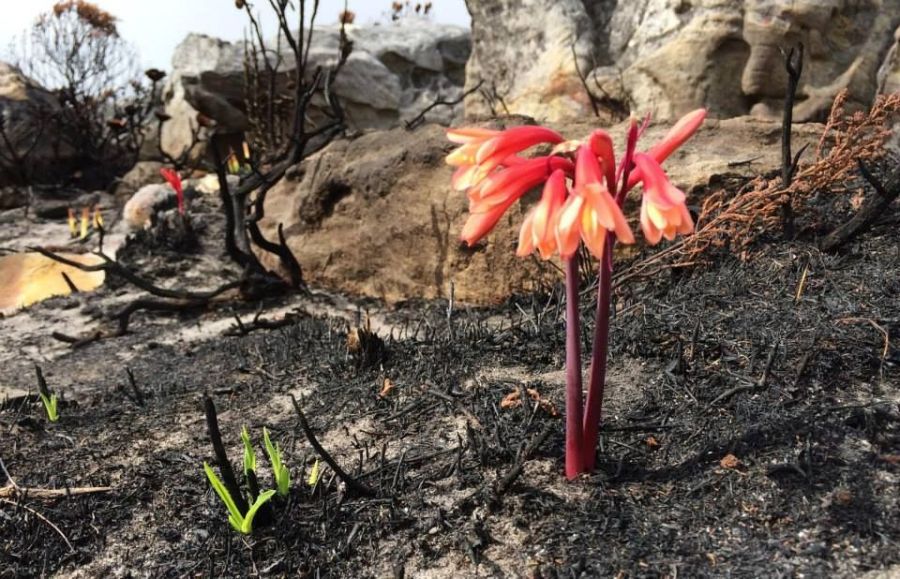
Israel’s story became especially poignant as I read through the horrors of the darkness and despair of the exile only to see hope and faith spring out of the ashes of destruction. If there was ever a time for Israel to not hope, it had to be then. Yet, the exiles did return and laid the foundation for a new temple and renewed life. The flowers of hope and faith, like the fire poppies that spring up after a wild fire, blossomed in dark valleys and burned fields.

As I witness a world that seems to be falling apart in madness with each passing day of violence and ever growing fear mongering, I am reminded by these horrors that we, like Israel, are in exile still, angry and isolated.

But yet, hope blossoms.

From Muir – “One foot in Eden still, I stand // And look across the other land. The world’s great day is growing late // Yet strange these fields that we have planted// So long with crops of love and hate // Time’s handiworks by time are haunted, // And nothing now can separate // The corn and tares compactly grown.”

Crops of love and hate tightly interwoven. Joy and tears coexisting. We have glimpses of how things ought to be only to have to struggle with the way things are. It’s no wonder that our feet stumble and slip.

But like our returning exiles, we too have seen the foundation of the new temple laid. Unlike the exiles though, our foundation is built in, on, and with material against which the gates of hell cannot prevail – Jesus Christ. Muir speaks to our hope in Christ, of the now but not yet: But famished field and blackened tree //Bear flowers in Eden never known.// Blossoms of grief and charity // Bloom in these darkened fields alone.// What had Eden ever to say // Of hope and faith and pity and love // Until was buried all its day// And memory found its treasure trove? // Strange blessings never in Paradise// Fall from these beclouded skies.”

As Easter people, we stand with one foot in Eden: the dawning kingdom of God. We are filled with enduring hope for the return of the greatest gift that ever was. We stand and blossom, fed and supported by our faith in that hope. Strange blessings? Perhaps. But blessings that call for singing a new song.

I waited patiently for the Lord // He inclined and heard my cry// He brought me up out of the pit // Out of the mire and clay// I will sing, sing a new song // I will sing, sing a new song // How long to sing this song // How long to sing this song // How long, how long, how long // How long, to sing this song// He set my feet upon a rock // And made my footsteps firm // Many will see // Many will see and fear // I will sing, sing a new song // I will sing, sing a new song.

40, U2 (songwriters: Adam Clayton, David Evans, Laurence Mullen, Paul David Hewson), 1983

The Irony of Blindness

Short people got no reason to live// They got little hands// And little eyes// And they walk around// Tellin’ great big lies// They got little noses// And tiny little teeth// They wear platform shoes// On their nasty little feet// Well, I don’t want no short people// Don’t want no short people// Don’t want no short people ‘Round here…

From the song “Short People” by Randy Newman, 1977

Short people – short on tolerance; short on humility; short in sight; short on love of neighbor. Bigotry, racism, hateful ignorance. Randy Newman’s ironic poke at racism and bigotry reminded me of another person persecuted for difference. I want to peek inside a story from Luke 19, verses 1-10 that most probably first heard about in a Sunday school song:

Zacchaeus was a wee, little man // And a wee, little man was he.// He climbed up in a sycamore tree // For the Lord he wanted to see.

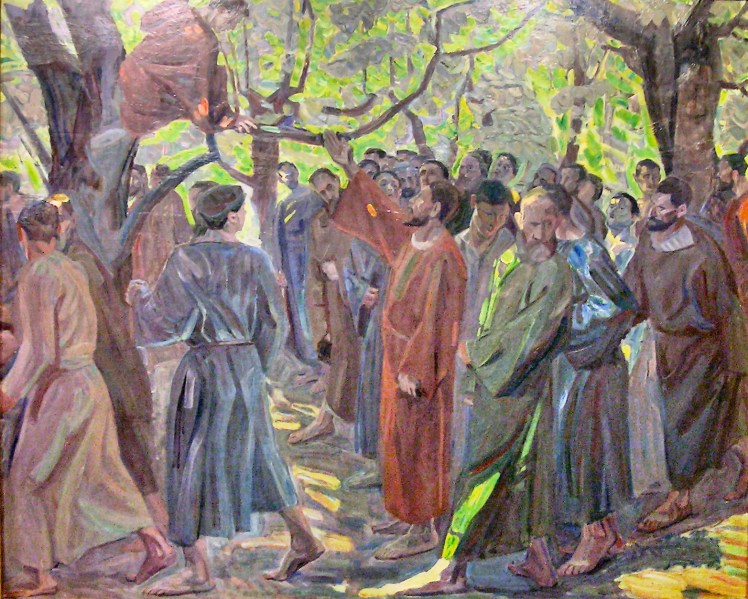
Jesus is on the road at Jericho, a wealthy city in the foothills leading to Jerusalem – it is the last leg of his journey to the temple, when he encounters Zacchaeus, the lead tax collector, a man universally despised, short in stature, which may very well be referring to his communal status as well as his height. Poor guy – he’s the one in the room everyone hates and he knows it. He has to run along the parade route behind the crowds in front of him – crowds that tighten their positions to keep him out. And there is little Zacchaeus, jumping up and down, trying to get a glimpse of Jesus, when he comes to the sycamore tree: a tree with low branches that made climbing easy and a tree loaded with large leaves that would hinder his presence from being detected by the crowd. A wealthy, grown man, clambering up a tree. What made him throw embarrassment, shame, and ridicule aside, not caring what people thought and what they might possibly see of his more private affairs?

He simply wanted to get a look at Jesus. After all, Jesus was a man that welcomed people like Zacchaeus. Jesus even has one of the guys from the Brotherhood of Tax Collectors local 106 in Galilee as one of his disciples. He must be an okay guy.

But Jesus spots him instead and tells him to come down.

The marginalized, the people on the wrong side of the crowds, the ones pushed off to the shoulder of the road, the ones blocked from participating in the community, the ones forced to climb a tree, are the ones who see most clearly. The blind beggar at the end of Luke 18 sees without eyes and Zacchaeus sees with his heart. And yet, the insiders, the disciples, the good white, evangelicals lining the roads telling others to go away, are the real blind ones. They don’t want those short people hanging around. The light of salvation is standing right in front of them and all they can see are their earthly expectations; all they can see is their own self-worth; all they can see are those who think and act like they do; all that they can see are their self-serving restrictions on who is in and who is out; all they see is a riddle; all they see is that they want to remain blind. It’s more comfortable and they grumble at anything that challenges them otherwise. Fake news.

The irony in all of this is that this is our story as well. This passage is not just some far removed happenstance on a dusty road in Palestine 2,000 years ago. It’s a story we continue to enact in varying degrees today, day after day. Zacchaeus was stereotyped and stigmatized by the blindness of the crowds much the same way we do grumbling about all of them: the opposite political party, immigrants, Muslims and their burquas, Jews and their yarmulkes, Hindus and their bindis, atheists, straight, the ‘nones’, the gay couple that just moved into the neighborhood, the transgender boy that wants to join the scouts and those Asian, black, and Hispanic people that seem to be everywhere and now the neighborhood just isn’t the same. We whisper about the couple getting divorced, the family dealing with an addicted member. We condemn the poor as lazy and self-seeking in their charity or the felon who must check a box for the rest of his or her life, condemning far too many to underemployment and marginality. Worse yet, we proclaim prisons as houses of correction where there is no effort to do so, insuring the condemnation of many to an endless cycle of poverty and prison. After all, I’m not like you: I must deserve it.

We stereotype and stigmatize all day long. The disciples did it when they failed to understand the plain language of Jesus, remaining in their stereotyped expectations of messianic deliverance, not bothering to lift the veils from their eyes to truly see what scripture and Jesus had been saying all along. And when we revel in our attitudes of exclusion and self-righteousness, we, like the disciples, miss the message of Jesus and the cross. The kingdoms of our making, the kingdoms of racial division, white privilege, political tribalism, violence, materialistic greed are antithetical to the kingdom of God, but we continue to build them because we are just too willingly blind to accept the hard truth of Christ and the cross.

Jesus emphatically states: “Zacchaeus, today salvation has come to your house, and I am coming over for dinner.” This is the nub of the scandal of Zacchaeus’s story: Jesus was coming over for dinner. It’s at the heart of the problem the crowds are having as they grumble – he eats with sinners and tax collectors! Dinner parties in the Greco-Roman era were the society balls and political fund raising dinners of their time. It was the place to see and be seen, to affirm at the very least, to promote at its best, or to diminish at its worst, the social standing of anyone. To be invited to a dinner party means you are part of the ‘in’ crowd, you are part of the family.

Yet, here’s the beautiful thing. You don’t go looking for Jesus, Jesus comes looking for you. And that’s the good news for you and I, the blind and the lost. The good news is that today salvation has come to all of us because the Human One has come to seek us out. Jesus says to all who believe in him, that today, he is coming into our houses, coming to we who are what we stereotype and stigmatize, we who are “them” – he is coming to have dinner with us. Jesus call us to the table – all of us – the sinner and tax collectors, the blind and the broken, to affirm our place as children of the living God, spared certain destruction by the unmerited gift of the cross, to sit as one family gathered around the gifts of God for the people of God.

Late in his song, Newman sings: Short People are just the same as you and I. All men are brothers until the day they die. Imago dei – we are all made in the image of God. Go into the world today and every day with unyielding gratitude and the overflowing joy of a people found with sight restored – one family –  not white, black, brown yellow, red, not Republican or Democrat, straight, gay or in-between, – one blessed family that has room for all: a family invited to the greatest dinner party of all time. Thanks be to God – Amen.

Masthead Artwork: By Niels Larsen Stevns – Own work (photo: Gunnar Bach Pedersen) (Randers Museum of Art, Randers, Denmark), Public Domain, https://commons.wikimedia.org/w/index.php?curid=1428023

Christian Assumptions

Surely his salvation is at hand for those who fear him, that his glory may dwell in our land. Steadfast love and faithfulness will meet; righteousness and peace will kiss each other. Faithfulness will spring up from the ground, and righteousness will look down from the sky. The Lord will give what is good, and our land will yield its increase.

Psalm 85.9-12

We all know what assume means…the old saw about making an ass out of u and me. There are many times we experience the truth of that as it really means to act on something as if it were fact when indeed it isn’t. But the flip side may be equally true and one that does not have such embedded cynicism. Yes, there are times when we must assume that something is true and allow that assumption to guide our actions. As a Christian, I believe that the Bible provides us with many things on which we can make assumptions; good, healthy, life giving assumptions that shape our walk today and tomorrow.

Assume God is working in your life right now.

God has created a unique plan for each one of our lives. By the power of the Spirit, God works in a particular fashion in particular people for God’s particular purposes. Bless the God and Father of our Lord Jesus Christ! He has blessed us in Christ with every spiritual blessing that comes from heaven… God destined us to be his adopted children through Jesus Christ because of his love. This was according to his goodwill and plan and to honor his glorious grace that he has given to us freely through the Son whom he loves…We have also received an inheritance in Christ. We were destined by the plan of God, who accomplishes everything according to his design. Ephesians 1.3, 5-6, 11

Assume the Lord has great things in store for you.

All of creation is groaning and suffering labor pains and, as the bumper sticker says, ‘stinky tuff happens.’ But with the resurrection, a cosmic shockwave has occurred. Death has been the tyrant, but in Christ, something new has happened: the good news of the created order being restored and all of us along with it. We cannot fathom God’s time or timing, but it is never too early or too late: It is always the right time. Have patience because endurance produces character and character produces hope: Then he looked up at his disciples and said: “Blessed are you who are poor, for yours is the kingdom of God. “Blessed are you who are hungry now, for you will be filled. “Blessed are you who weep now, for you will laugh.” Luke 6.20-12

Assume people love you.

Hah, you might be tempted to cry! I was born at night, but not last night! It’s easy to be cynical but, “I say unto you,” look upon everyone as made in the image. Expect good things from others. Be kind, honest, forgiving, and loving your neighbor as yourself. The people you meet could be new friends and not adversaries. I was hungry and you gave me food to eat. I was thirsty and you gave me a drink. I was a stranger and you welcomed me.I was naked and you gave me clothes to wear. I was sick and you took care of me. I was in prison and you visited me.’ “Then those who are righteous will reply to him, ‘Lord, when did we see you hungry and feed you, or thirsty and give you a drink?When did we see you as a stranger and welcome you, or naked and give you clothes to wear? When did we see you sick or in prison and visit you?’“Then the king will reply to them, ‘I assure you that when you have done it for one of the least of these brothers and sisters of mine, you have done it for me.’ Matthew 25.35-40

Assume your ideas come from the indwelling of Christ through whom you can do anything.

You can’t prove it, but you can believe it. Stop procrastinating – move forward with your inklings and discover the potential Christ has birthed within you. Take chances, go out on a limb. Be all you can be. Embrace kingdom work. Therefore, my beloved, be steadfast, immovable, always excelling in the work of the Lord, because you know that in the Lord your labor is not in vain (1 Corinthians 15.58). You are never more alive than when you run risks for the Lord of lords. Stop wasting time and energy on negativity and negative assumptions. It does nothing but fill you with hate, envy, anger, and disappointment. It is sad and depressing for you and everyone around you. The Bible proclaims a living God of steadfast love and faithfulness, of righteousness and peace, a God that will give you what is good. Believe this and give God a chance in your life and your outlook on life. God loves you. God gave his only Son for you. Cherish that love and assume that you are a special, beloved child of the King of kings and you will come to assume you are a fortunate, blessed person in God’s world.

See what love the Father has given us, that we should be called children of God; and that is what we are. 1 John 3.1

Photo by Nishant Das on Pexels.com

Holy Happenings

Photo by Tatiana Syrikova on Pexels.com

Psalm 114

1When Israel went out from Egypt, the house of Jacob from a people of strange language, 2Judah became God’s sanctuary, Israel his dominion. 3The sea looked and fled; Jordan turned back. 4The mountains skipped like rams, the hills like lambs. 5Why is it, O sea, that you flee? O Jordan, that you turn back? 6O mountains, that you skip like rams? O hills, like lambs? 7Tremble, O earth, at the presence of the Lord, at the presence of the God of Jacob, 8who turns the rock into a pool of water, the flint into a spring of water. (NRSV)


God holds nothing back when God wants to do something significant for us. No mountain, no barrier, no human can get in the way of God’s plans for you, just as nothing was able to get in the way of delivering God’s people from Egypt.

I call them holy happenings. God involves people in their unfolding, but God is in control and cannot be stopped. God can do it anytime, anywhere and in any place: from safe passage through the Red Sea, to the resurrection of Jesus, the conversion of Paul and the visions of John.  Holy happenings are beyond human comprehension, definition, and explanation.

Recognizing holy happenings requires a sense of awe and wonder, and the eyesight of faith.  Real power is unseen. The real power of a home depends on love and respect, not the size of the house. The real power of electricity is in the current, not the cable. So it is with God.

The power of God is not experienced face-to-face, but through God’s many manifestations in the world. Accept the mystery; don’t let fear or doubt settle in your mind and get in the way. God produces holy happenings to reassure us of God’s presence, power and love, not to terrify us. Remember, Scripture shows that peace always comes out of confusion.

Holy happenings change history. Holy happenings change the world. A holy happening could change your life, so look around. There are holy happenings in your life right now: family gathered around the dinner table; staycations and more time at home being a neighbor with those you might have never met otherwise; being free to teach your child how to ride a bike; learning to bake bread; savoring the scent of honeysuckle on a summer morning; doing the evening dishes with your spouse. Look around, inhale the beauty of God’s good creation: you have the time. The mountains and hills could be skipping like rams and lambs.

Chasing After Wind -Hevel

Photo by Pedro Figueras on Pexels.com

Life was so beautiful // Then we all got locked down// Feel a like ghost // Living in a ghost town.. yeah…I'm a ghost// Living in a ghost town // I'm going nowhere //
 Shut up all alone// So much time to lose // Just staring at my phone...
Mick Jagger and Keith Richards, "Living in a Ghost Town," Polydor, 2020

It does feel like a ghostly time. While some ‘normalcy’ to life has returned to my part of the country for now, much of life yet remains in a weird fog of uncertainty made all the more so by the made for TV fascism produced by the apprentice of the Oval Office. It’s an atmosphere that makes you wonder what really matters anymore. It is an ambience well captured by my one of my favorite Hebrew words: hevel. It means breath, vapor, fog, a fleeting ephemerality, the notion of a transitory existence. A ghost. It is the root for the name Able, a man of transitory existence par excellence. I have often likened hevel to be something akin to nailing jello to a tree and in these times, trying to grab hold of the touchstones that gave our lives a sense of stability and direction too often feels like an exercise in that kind of futility. Hevel – vanity, one of the central threads woven throughout the book we know as Ecclesiastes. Hevel – the word appears 38 times, beginning in verse 2: hevel hakkōl hevelim – vanity of vanities.

I do not like the Latin transliteration of the Greek translation of the Hebrew title, Koheleth. In Greek, Ekklēsiastḗs, means ‘of an assembly’ or ‘one who calls an assembly,’ perhaps a preacher. It’s a title that I think obfuscates. The Hebrew title of the book, as with all Hebrew names for the books of the Bible, comes from the first verse: “The words of the Teacher,” Koheleth. It is plain to see what things are all about for that which follows: the words of a teacher who has much to teach us. Koheleth.

While Proverbs presumes the existence of a moral order instilled and maintained by the divine creator that purports wisdom’s function was to ensure success, and long, prosperous lives surrounded by our children and admiring friends, Koheleth paints quite a different and humbling picture more akin to the realities of a broken world: a book that at its core, teaches humility.

If you haven’t yet, or perhaps haven’t in a while, there is no better time like now to dive into this selection from the wisdom literature of the Bible. Martin Luther felt that Koheleth should be read daily by Christians and it was, according to a Vietnam war chaplain, a book that the soldiers welcomed hearing from most often. I have heard others liken reading Koheleth to slipping into a warm bath. Interesting comparison. In this post, I would like to share some of my thoughts about slipping into this warm bath from the word of God.

Koheleth doesn’t ‘speak into my life’ as much as it speaks about my life. It is a beautifully crafted, artistic reflection and interpretation of life that experience has shown to be compelling and persuasive. The Teacher writes in a manner that that imitates life itself, posing life’s perplexing questions and meaning without giving a direct answer: “For who knows what is good for mortals while they live the few days of their vain life, which they pass like a shadow? For who can tell them what will be after them under the sun? (6.12). We can speak of the mundane clearly enough, but ultimate truth is the slippery eel that escapes our mortal limits of understanding if we are humble enough to admit it.

The obsession with materiality that devours so many lives, my own past included, is on point, especially the futility of it: “What do people gain from all the toil at which they toil under the sun?” (1.3). As a teenager, I heard a call from God to the pastorate that I diligently ignored for the better part of forty-five years, chasing the almighty dollar with great ‘success’ as an investment broker. That is if you measure success by your bank account balance and the size of your home. I was one of those that indulged in the ‘total work’ culture we inhabit, valuing myself by the ninety hour plus weeks that I put in, blind to the beauty and joy found in the gifts of my wife and daughter. What I discovered in the humiliating process of losing money, house, cars, fancy suits and temporarily, my freedom, was that none of it had mattered in the first place: “Then I saw that all toil and all skill in work come from one person’s envy of another. This also is vanity and a chasing after wind” (4.4). Hevel indeed.

In the process, I came to grips with Koheleth’s observation to not romanticize the past: “Do not say, ‘Why were the former days better than these?’ For it is not from wisdom that you ask this” (7.10) The nostalgic valuation of the past negates any possibility of present joy and less obviously, dismisses present responsibilities.  It is conceivably easy to look back and relish the six-bedroom home over against the small apartment we now occupy, but to do so would be to forget that our current home was a gift from God at a time of imminent homelessness: a negligence which could readily contribute to reestablishing the mindset that created the problems in the first place – ignoring the Lord’s call and presence in my life while chasing the hevel of materiality. Hevel hakkōl hevelim – vanity of vanities.

Where Koheleth speaks most profoundly for me is with our fleeting lifespans. As I pass my ‘best used by date,’ I clearly understand how quickly time passes and that every moment is to be savored. In verse 9.4 we read: “But whoever is joined with all the living has hope, for a living dog is better than a dead lion.”  The only ‘security’ ; a better translation than ‘hope,’ anchors the living with the knowledge that we all die. It is a sobering thought, but an essential one, as it is far too easy to be caught up chasing after the wind of excess materiality or deep depression. Koheleth exhorts:

“Go, eat your bread with enjoyment, and drink your wine with a merry heart; for God has long ago approved what you do. Let your garments always be white; do not let oil be lacking on your head. Enjoy life with the wife whom you love, all the days of your vain life that are given you under the sun, because that is your portion in life and in your toil at which you toil under the sun. Whatever your hand finds to do, do with your might; for there is no work or thought or knowledge or wisdom in Sheol, to which you are going because that is your portion in life and in your toil at which you toil under the sun” (9.7-10). 

Given the fleetingness of my ‘hevel’ life, this serves as a reminder to enjoy the gifts of God that matter. The ups and downs, the good, the bad and the ugly, find their ways into everyone’s life at some point or another. Adhering to the commands of God is the only intelligent and faithful response to the essential fact that ‘all is hevel’.

In many ways, my favorite poet from the tidewater of Virginia captured my experience with the words of the Teacher:

“When I was younger I saw things in black and white, // Now all I see is a sad, hazy gray. Sometimes I see a narrow flash of light, // Sometimes I look and you show me the way. No matter what else happens, //What the future will be, in a world so uncertain, // Through the clouds it’s hard to see. I will grab you and carry you, // Calm your fears if you’re afraid, We’ll go walking, // Across the fields of gray.” (Bruce Hornsby, Fields of Gray, Harbor Lights, RCA, 1993.)

In the fields and times of the gray of life, Koheleth is truly a jewel of revelation to keep to the course of our faith: “The end of the matter; all has been heard. Fear God, and keep his commandments; for that is the whole duty of everyone. For God will bring every deed into judgement, including every secret thing, whether good or evil” (12.12-14). Focus, the Teacher implores, on the constancy of the promise of God in Christ as a lamp unto my feet. Light that shines in the darkness of hevel and the darkness cannot, and will not, ever overcome it.