To the Ends of the Earth

“Imagine no possessions// I wonder if you can// No need for greed or hunger// A brotherhood of man// Imagine all the people sharing all the world, you// You may say I’m a dreamer// But I’m not the only one// I hope someday you’ll join us// And the world will be as one.”

Imagine, John Lennon

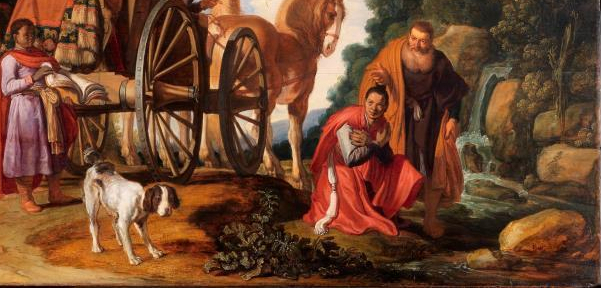
Cover art: Baptism of the Eunuch, Pieter Lastman, 1623

Then an angel of the Lord spoke to Philip saying: “Rise up and go along south on the way going down from Jerusalem to Gaza.” This is a desert. 27 And rising up he went. And behold a man, an Ethiopian eunuch, a power of [the] Candace, queen of the Ethiopians, in charge of all her treasure. He had come to Jerusalem to worship  28 and he was returning; sitting in his chariot, he was reading the prophet Isaiah.29Then the Spirit said to Philip, “Go up and join this chariot” 30 Philip ran up and heard him reading the prophet Isaiah. He asked, “Do you understand what you are reading?” 31And he said, “How can I, unless someone guides me?” And he invited Philip to come up and sit with him.’ 32 Now the passage of the scripture which he was reading was this: “As a sheep led to the slaughter or a lamb before its shearer is dumb, so he opens not his mouth: 33 In his humiliation justice was denied him. Who can describe his generation? For his life is taken up from the earth.” 34 And the eunuch said to Philip, “About whom, pray, does the prophet say this, about himself or about someone else?”35 Then Philip opened his mouth, and beginning with this scripture he told him the good news of Jesus.36 And as they went along the road they came to some water, and the eunuch said, “See, here is water! What is to prevent my being baptized?”  38 And he commanded the chariot to stop, and they both went down into the water, Philip and the eunuch, and he baptized him. 39 And when they came up out of the water, the Spirit of the Lord caught up Philip; and the eunuch saw him no more, and went on his way rejoicing. 40 But Philip was found at Azotus, and passing on he preached the gospel to all the towns till he came to Caesarea. (Acts 8.26-40, translation is by the author)

Philip and the Ethiopian eunuch is one of my favorites from the book of the Acts of the Apostles. It is a rich story of a biblical character that embodies the multifaceted differences of race, class, gender, religion and sexuality: differences that are the source of a great deal of discomfort, division and debate 2,000 years after Luke wrote about them.

I believe it was Rev. Dr. Martin Luther King Jr. who noted that Sunday morning is the most segregated hour in America. We are Easter people, yet we have given in to the seductions all around us to create a reduced community customized to our preferences, retreating into the gated community of sectarianism: a society of bigotry, discrimination, and hatred arising from attaching importance to perceived differences between ourselves in race, religion, economic status, and politics and so on.

Looking through the lens of strife and tension created by an insidious and ignorant insistence on sectarianism, it strikes me that as Christians, we have not done a very good job of living into the community of Christ that we proclaim we are baptized into. John tells us that Word was made flesh – the Greek word is ‘sarx’ –  human flesh, no mention of color or race – human, like you and I. There is no distinction. There is no longer Jew or Greek; no distinctions based upon race, color or creed. There is one new humanity.

Yet we seem as far as the east is from the west from truly embodying what Luke is showing us here. Why should any of us care about a eunuch from 2,000 years ago? Why should we people of God care about divisions based on race, gender, sexual orientation and class in our church and society? Why do I care- and I do care very deeply. Because God has told us that He cares. The crucifixion shows just how much.

Our pericope is a reminder to us today that we are to live in community. But how to define that community is the challenge in front of us. Our Ethiopian is a very different man. He is black, of questionable theology and an ambiguous gender and sexual orientation. He is, however an earnest seeker who reaches out and is graciously included into the actions of God. Philip’s courage to heed the Holy Spirit is something that our church needs as the debate surrounding homosexual marriage, insidious racism and the inclusion of the LBGT community rages on.

The parallels are all too obvious as Luke has shown in Philip’s challenge to the guardians of right religion in Jerusalem. When we give a banquet, Christ tells us to invite the poor, the crippled, the lame, and the blind: the types of people that the Pharisees considered “unclean” and under God’s curse; the types of people we Pharisee’s of today call gay, lesbian, transgender, bisexual, Black, Hispanic, Hindu, Asian and whatever other judgment a label can make. Empowered by the Spirit, the gospel message draws us in to send us out with the good news for all nations. As with the entire book of Acts, the purpose of this story is about carrying the gospel to all nations, carrying the gospel to the ends of the earth and Luke leaves no doubt as to who is directing Philip and his evangelism. My question for the church, for all of us that claim the label Christian, are we following what the Spirit showed us so long ago? Who are we inviting to the banquet? We are being challenged in this story to rethink many parameters, to rethink what community means, to rethink what the ends of the earth may look like. I suggest that Luke gave us a pretty good idea in Philip and the Eunuch. Sadly, we still have a long way to go.
The Irony of Blindness

Short people got no reason to live// They got little hands// And little eyes// And they walk around// Tellin’ great big lies// They got little noses// And tiny little teeth// They wear platform shoes// On their nasty little feet// Well, I don’t want no short people// Don’t want no short people// Don’t want no short people ‘Round here…

From the song “Short People” by Randy Newman, 1977

Short people – short on tolerance; short on humility; short in sight; short on love of neighbor. Bigotry, racism, hateful ignorance. Randy Newman’s ironic poke at racism and bigotry reminded me of another person persecuted for difference. I want to peek inside a story from Luke 19, verses 1-10 that most probably first heard about in a Sunday school song:

Zacchaeus was a wee, little man // And a wee, little man was he.// He climbed up in a sycamore tree // For the Lord he wanted to see.

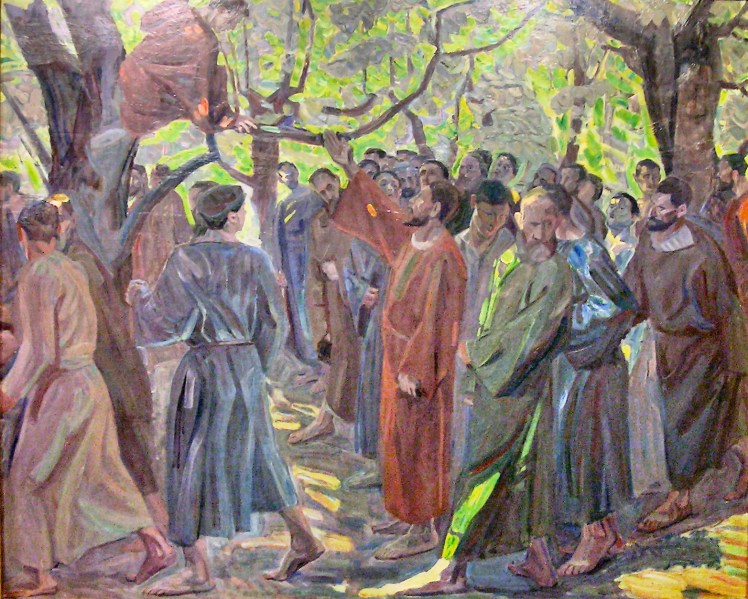
Jesus is on the road at Jericho, a wealthy city in the foothills leading to Jerusalem – it is the last leg of his journey to the temple, when he encounters Zacchaeus, the lead tax collector, a man universally despised, short in stature, which may very well be referring to his communal status as well as his height. Poor guy – he’s the one in the room everyone hates and he knows it. He has to run along the parade route behind the crowds in front of him – crowds that tighten their positions to keep him out. And there is little Zacchaeus, jumping up and down, trying to get a glimpse of Jesus, when he comes to the sycamore tree: a tree with low branches that made climbing easy and a tree loaded with large leaves that would hinder his presence from being detected by the crowd. A wealthy, grown man, clambering up a tree. What made him throw embarrassment, shame, and ridicule aside, not caring what people thought and what they might possibly see of his more private affairs?

He simply wanted to get a look at Jesus. After all, Jesus was a man that welcomed people like Zacchaeus. Jesus even has one of the guys from the Brotherhood of Tax Collectors local 106 in Galilee as one of his disciples. He must be an okay guy.

But Jesus spots him instead and tells him to come down.

The marginalized, the people on the wrong side of the crowds, the ones pushed off to the shoulder of the road, the ones blocked from participating in the community, the ones forced to climb a tree, are the ones who see most clearly. The blind beggar at the end of Luke 18 sees without eyes and Zacchaeus sees with his heart. And yet, the insiders, the disciples, the good white, evangelicals lining the roads telling others to go away, are the real blind ones. They don’t want those short people hanging around. The light of salvation is standing right in front of them and all they can see are their earthly expectations; all they can see is their own self-worth; all they can see are those who think and act like they do; all that they can see are their self-serving restrictions on who is in and who is out; all they see is a riddle; all they see is that they want to remain blind. It’s more comfortable and they grumble at anything that challenges them otherwise. Fake news.

The irony in all of this is that this is our story as well. This passage is not just some far removed happenstance on a dusty road in Palestine 2,000 years ago. It’s a story we continue to enact in varying degrees today, day after day. Zacchaeus was stereotyped and stigmatized by the blindness of the crowds much the same way we do grumbling about all of them: the opposite political party, immigrants, Muslims and their burquas, Jews and their yarmulkes, Hindus and their bindis, atheists, straight, the ‘nones’, the gay couple that just moved into the neighborhood, the transgender boy that wants to join the scouts and those Asian, black, and Hispanic people that seem to be everywhere and now the neighborhood just isn’t the same. We whisper about the couple getting divorced, the family dealing with an addicted member. We condemn the poor as lazy and self-seeking in their charity or the felon who must check a box for the rest of his or her life, condemning far too many to underemployment and marginality. Worse yet, we proclaim prisons as houses of correction where there is no effort to do so, insuring the condemnation of many to an endless cycle of poverty and prison. After all, I’m not like you: I must deserve it.

We stereotype and stigmatize all day long. The disciples did it when they failed to understand the plain language of Jesus, remaining in their stereotyped expectations of messianic deliverance, not bothering to lift the veils from their eyes to truly see what scripture and Jesus had been saying all along. And when we revel in our attitudes of exclusion and self-righteousness, we, like the disciples, miss the message of Jesus and the cross. The kingdoms of our making, the kingdoms of racial division, white privilege, political tribalism, violence, materialistic greed are antithetical to the kingdom of God, but we continue to build them because we are just too willingly blind to accept the hard truth of Christ and the cross.

Jesus emphatically states: “Zacchaeus, today salvation has come to your house, and I am coming over for dinner.” This is the nub of the scandal of Zacchaeus’s story: Jesus was coming over for dinner. It’s at the heart of the problem the crowds are having as they grumble – he eats with sinners and tax collectors! Dinner parties in the Greco-Roman era were the society balls and political fund raising dinners of their time. It was the place to see and be seen, to affirm at the very least, to promote at its best, or to diminish at its worst, the social standing of anyone. To be invited to a dinner party means you are part of the ‘in’ crowd, you are part of the family.

Yet, here’s the beautiful thing. You don’t go looking for Jesus, Jesus comes looking for you. And that’s the good news for you and I, the blind and the lost. The good news is that today salvation has come to all of us because the Human One has come to seek us out. Jesus says to all who believe in him, that today, he is coming into our houses, coming to we who are what we stereotype and stigmatize, we who are “them” – he is coming to have dinner with us. Jesus call us to the table – all of us – the sinner and tax collectors, the blind and the broken, to affirm our place as children of the living God, spared certain destruction by the unmerited gift of the cross, to sit as one family gathered around the gifts of God for the people of God.

Late in his song, Newman sings: Short People are just the same as you and I. All men are brothers until the day they die. Imago dei – we are all made in the image of God. Go into the world today and every day with unyielding gratitude and the overflowing joy of a people found with sight restored – one family –  not white, black, brown yellow, red, not Republican or Democrat, straight, gay or in-between, – one blessed family that has room for all: a family invited to the greatest dinner party of all time. Thanks be to God – Amen.

Masthead Artwork: By Niels Larsen Stevns – Own work (photo: Gunnar Bach Pedersen) (Randers Museum of Art, Randers, Denmark), Public Domain, https://commons.wikimedia.org/w/index.php?curid=1428023