Healing Helpers

I want to know did you get the feelin’ // Did you get it down in your soul // I want to know did you get the feelin’ // Oh did ye get healed //I begin to realize // Magic in my life // See it manifest in oh, so many ways // Every day is gettin’ better and better // I want to be daily walking close // It gets stronger when you get the feelin’ // When you get it down in your soul // And it makes you feel good // And it makes you feel whole // When the spirit moves you // And it fills you through and through // Every morning and at the break of day // Did ye get healed?

Van Morrison, Did Ye Get Healed, 1987

We are rapidly closing in on Ash Wednesday and the beginning of Lent. This is the season when Christians take the time for introspection – a time to slow down and take a good, long, hard look at ourselves to see where we are, and importantly, where we are not, in our walk with Christ. Sometimes, what we find can be downright scary, perhaps so much that we ignore at best or deny at worst, just how far astray we have become: that there are more instances of “not” than “are.”

I can’t speak for you, but I can speak for myself when I see that I need healing. I have my share of demons that rage and rant, keeping me on the wrong path. How do I rid myself of these evils? In the following passage from the Gospel of Mark, Jesus shows us how.

 Jesus and his followers went into Capernaum. Immediately on the Sabbath Jesus entered the synagogue and started teaching. The people were amazed by his teaching, for he was teaching them with authority, not like the legal experts. Suddenly, there in the synagogue, a person with an evil spirit screamed, “What have you to do with us, Jesus of Nazareth? Have you come to destroy us? I know who you are. You are the holy one from God.”
 “Silence!” Jesus said, speaking harshly to the demon. “Come out of him!” The unclean spirit shook him and screamed, then it came out.
 Everyone was shaken and questioned among themselves, “What’s this? A new teaching with authority! He even commands unclean spirits and they obey him!”Right away the news about him spread throughout the entire region of Galilee. (Mark 1.21-28, CEB) 

Consider how the sick man went about.

He sought to be taught. The man had an “evil spirit” – demon possession, epilepsy, alcoholism, drug addiction, some form of nervous disorder – we don’t know for sure. Whatever the nature of his illness was, he knew things were not right and he wasn’t shy about it. He had made the effort to reach for somebody to teach him, guide him, to heal him; and he went to the right place, the right house and met Jesus.

He fought with a new thought. He was willing to struggle. Healing is never easy and changing is even less so, even when we know it’s the necessary thing to do. We tend to fight against new ideas and new ways of being. An old friend called this the IRS system – no not that IRS – but Intimidation, Rebellion, and Screams. Sometimes, when we get closer to a life changing breakthrough, the reactions can be all the more passionate. The demoniac found the courage to struggle and wrestle with Jesus’ words in spite of his hostility, anger and turmoil.

He caught what Christ had. After he sought, and after he fought, the demoniac caught what Jesus had to offer: healing. He did not know how and he did not ask. He accepted. Everyone else may have been shocked: “What is this?” Not the healed man: he was just grateful to be well.

If you are hurting today, Jesus came for you. “Healthy people don’t need a doctor, but sick people do. I didn’t come to call righteous people but sinners to change their hearts and lives” (Luke 5.31-32, CEB). God wants you to be healthy and whole in body, mind and spirit. As you journey through Lent, take up those demons and turn to Christ. The psalmist said it this way: “But look here: God is my helper; my Lord sustains my life” (Psalm 54.4, CEB). Trust Jesus to heal you, to help you and to change your life. It might be a bit messy, it might get a bit loud, but the peace is well worth the noise and the trip. Get the feelin’!


Artwork: Romanesque painter, 12th century. St. Martin’s Church, Zillis, Graubünden, Switzerland
To the Ends of the Earth

“Imagine no possessions// I wonder if you can// No need for greed or hunger// A brotherhood of man// Imagine all the people sharing all the world, you// You may say I’m a dreamer// But I’m not the only one// I hope someday you’ll join us// And the world will be as one.”

Imagine, John Lennon

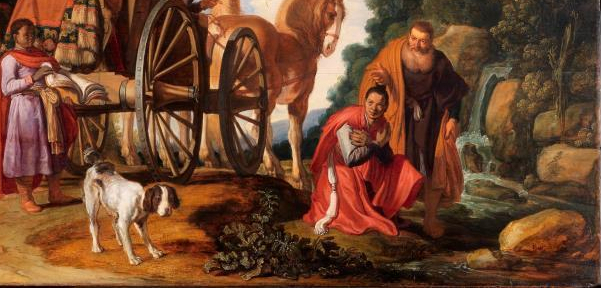
Cover art: Baptism of the Eunuch, Pieter Lastman, 1623

Then an angel of the Lord spoke to Philip saying: “Rise up and go along south on the way going down from Jerusalem to Gaza.” This is a desert. 27 And rising up he went. And behold a man, an Ethiopian eunuch, a power of [the] Candace, queen of the Ethiopians, in charge of all her treasure. He had come to Jerusalem to worship  28 and he was returning; sitting in his chariot, he was reading the prophet Isaiah.29Then the Spirit said to Philip, “Go up and join this chariot” 30 Philip ran up and heard him reading the prophet Isaiah. He asked, “Do you understand what you are reading?” 31And he said, “How can I, unless someone guides me?” And he invited Philip to come up and sit with him.’ 32 Now the passage of the scripture which he was reading was this: “As a sheep led to the slaughter or a lamb before its shearer is dumb, so he opens not his mouth: 33 In his humiliation justice was denied him. Who can describe his generation? For his life is taken up from the earth.” 34 And the eunuch said to Philip, “About whom, pray, does the prophet say this, about himself or about someone else?”35 Then Philip opened his mouth, and beginning with this scripture he told him the good news of Jesus.36 And as they went along the road they came to some water, and the eunuch said, “See, here is water! What is to prevent my being baptized?”  38 And he commanded the chariot to stop, and they both went down into the water, Philip and the eunuch, and he baptized him. 39 And when they came up out of the water, the Spirit of the Lord caught up Philip; and the eunuch saw him no more, and went on his way rejoicing. 40 But Philip was found at Azotus, and passing on he preached the gospel to all the towns till he came to Caesarea. (Acts 8.26-40, translation is by the author)

Philip and the Ethiopian eunuch is one of my favorites from the book of the Acts of the Apostles. It is a rich story of a biblical character that embodies the multifaceted differences of race, class, gender, religion and sexuality: differences that are the source of a great deal of discomfort, division and debate 2,000 years after Luke wrote about them.

I believe it was Rev. Dr. Martin Luther King Jr. who noted that Sunday morning is the most segregated hour in America. We are Easter people, yet we have given in to the seductions all around us to create a reduced community customized to our preferences, retreating into the gated community of sectarianism: a society of bigotry, discrimination, and hatred arising from attaching importance to perceived differences between ourselves in race, religion, economic status, and politics and so on.

Looking through the lens of strife and tension created by an insidious and ignorant insistence on sectarianism, it strikes me that as Christians, we have not done a very good job of living into the community of Christ that we proclaim we are baptized into. John tells us that Word was made flesh – the Greek word is ‘sarx’ –  human flesh, no mention of color or race – human, like you and I. There is no distinction. There is no longer Jew or Greek; no distinctions based upon race, color or creed. There is one new humanity.

Yet we seem as far as the east is from the west from truly embodying what Luke is showing us here. Why should any of us care about a eunuch from 2,000 years ago? Why should we people of God care about divisions based on race, gender, sexual orientation and class in our church and society? Why do I care- and I do care very deeply. Because God has told us that He cares. The crucifixion shows just how much.

Our pericope is a reminder to us today that we are to live in community. But how to define that community is the challenge in front of us. Our Ethiopian is a very different man. He is black, of questionable theology and an ambiguous gender and sexual orientation. He is, however an earnest seeker who reaches out and is graciously included into the actions of God. Philip’s courage to heed the Holy Spirit is something that our church needs as the debate surrounding homosexual marriage, insidious racism and the inclusion of the LBGT community rages on.

The parallels are all too obvious as Luke has shown in Philip’s challenge to the guardians of right religion in Jerusalem. When we give a banquet, Christ tells us to invite the poor, the crippled, the lame, and the blind: the types of people that the Pharisees considered “unclean” and under God’s curse; the types of people we Pharisee’s of today call gay, lesbian, transgender, bisexual, Black, Hispanic, Hindu, Asian and whatever other judgment a label can make. Empowered by the Spirit, the gospel message draws us in to send us out with the good news for all nations. As with the entire book of Acts, the purpose of this story is about carrying the gospel to all nations, carrying the gospel to the ends of the earth and Luke leaves no doubt as to who is directing Philip and his evangelism. My question for the church, for all of us that claim the label Christian, are we following what the Spirit showed us so long ago? Who are we inviting to the banquet? We are being challenged in this story to rethink many parameters, to rethink what community means, to rethink what the ends of the earth may look like. I suggest that Luke gave us a pretty good idea in Philip and the Eunuch. Sadly, we still have a long way to go.

Patience

To touch is to heal // To hurt is to steal // If you want to kiss the sky //Better learn how to kneel (on your knees boy!)

from Mysterious Ways by U2, 1991
artwork – “The Patient Job,” by Gerard Seghers, Public domain, via Wikimedia Commons

Therefore, brothers and sisters, you must be patient as you wait for the coming of the Lord. Consider the farmer who waits patiently for the coming of rain in the fall and spring, looking forward to the precious fruit of the earth. You also must wait patiently, strengthening your resolve, because the coming of the Lord is near. Don’t complain about each other, brothers and sisters, so that you won’t be judged. Look! The judge is standing at the door!” James 5.7-9 CEB

I had my tonsils removed at the age of nine. It had been a long, miserable winter of measles, chicken pox, strep throat and measles again. Laying in my hospital bed, I was in a lot of pain and I couldn’t wait for mom to arrive and take me home. I kept seeing reflections of people coming down the hallway in the glass on the open door, each time hoping it was her. As the minutes turned into hours, the disappointment mounted along with the anxiety. What if she wasn’t coming? What if something happened? What if she forgot? Well, she did arrive and at the time that was appointed, though it wasn’t soon enough for me. If only I had known more patience. Of course she was coming: moms do not forget.

As we get the season of Advent underway, we join with our sisters and brothers in Christ that have been praying for centuries for the promised return of Jesus. And like them, we need to learn the valuable lesson of patience. Easier said than done when the curse of Amazon Prime has done a pretty good job of eliminating any need of it. A hasty, impatient spirit is simply another form of pride, another form of human arrogance that presumes it knows God’s timetable better than God. James knows that and he is imploring us to do otherwise. That we are being commanded to be patient and that patience is one of the important aspects of the work of the spirit in our lives, tells us just how precious this gift is for us.

This is not an easy time for something that does not come easily to us. Like the nine year old boy anxiously waiting in his hospital room, I suspect that many Christians may share similar anxieties. We live in a world that too often seems broken beyond our capacity to understand, and now,  during this time of Covid, when we are far too isolated from friends, family and community, those anxieties are all the more acute. Fear and anxiety are the breeding ground for the arguments and polarization with which we are sadly too familiar. Be patient. Patience with the “other” is the hallmark of humility and a fruit of the spirit. Be patient, James writes. “You have heard of the endurance of Job. And you have seen what the Lord has accomplished, for the Lord is full of compassion and mercy” (5.11, CEB). Be patient. The Lord has promised, the Lord is coming and the Lord does not forget.

Darkness

What if God was one of us? // Just a slob like one of us // Just a stranger on the bus // Tryin’ to make his way home? // If God had a face what would it look like? // And would you want to see if, seeing meant // That you would have to believe in things like heaven // And in Jesus and the saints, and all the prophets?

“What if God was One of Us,” written by Eric Bazilian, 1995, recorded by Joan Osborne.

We live in a world that is in constant search for love and wholeness in the things that are not; a fruitless search whose result is despair, isolation – an isolation now intensified by Covid-19. The silent darkness that has enshrouded many of our lives may seem overwhelming, the storms and trials all-consuming. I have heard many in recent days question, lament really, at their inability to find Jesus in their lives: a lament that makes the darkness all the darker. Given the tribal warfare of our time, it is quite plausible that we wouldn’t recognize Jesus if we stepped over him, let alone recognize him when we do pass on to glory.

Yes, yes, you say, we know that Jesus reveals himself in the Word and in creation, but if we listen a bit more closely, we find that Jesus is telling us to look elsewhere for his presence: “Then the king will reply to them, ‘I assure you that when you have done it for one of the least of these brothers and sisters of mine, you have done it for me.’ (Matt. 25.40).

When we learn to look for Christ in other people, we learn to recognize him and when we learn to recognize him, we find the light for our dark moments.

Photo by Cameron Casey on Pexels.com

Look for Jesus in the poor that populate our food pantry lines. Look for Jesus in the lonesome and embittered that need a kind word. Look for Jesus in those who have lost jobs in businesses that Covid has destroyed and desperately plea for help. Look for Jesus in those that need  medicines we don’t have to cure the disease we do not yet understand. Look for Jesus in the sick and dying as they pray for healing and comfort. Look for Jesus in the homeless, the lost and the addicted that need new direction. Look for Jesus in the essential workers that are not paid like ones that are essential. Look for Jesus in those that provide food for the pantries. Look for Jesus in the grocery store clerk. Look for Jesus in the first repsonders and frontline workers that risk their own lives for others. Look for Jesus in those that give you the kind word. Look for Jesus in those who seek to comfort you and give you new direction. Look for Jesus in school teachers that instill knowledge in our children. Look for Jesus in the one who simply listens, giving space for the pain and lament in your life. Look for Jesus – he is in that person in the mirror.

Jesus is everywhere: in his Word, in creation, in other people and in you as well. When the gloom descends upon you, when the chaos of life in the age of Covid overwhelms you, when you think you are simply done, remember Jesus words to his frightened disciples that thought they were about to drown:  “Just then he spoke to them, “Be encouraged! It’s me. Don’t be afraid.” (Mark 6.50). Jesus, in good times and the bad, is always present. When you learn to see him, you will find the light that the darkness will not and cannot ever overcome.

Don’t fear, for I have redeemed you; I have called you by name; you are mine. When you pass through the waters, I will be with you; when through the rivers, they won’t sweep over you.When you walk through the fire, you won’t be scorched and flame won’t burn you. I am the Lord your God, the holy one of Israel, your savior.

Isaiah 43.1-3

DONE?

I waited patiently for the Lord// He inclined and heard my cry// He brought me up out of the pit// Out of the mire and clay// I will sing, sing a new song// I will sing, sing a new song

“40”, by U2. (Songwriters Adam Clayton, David Evans, Laurence Mullen, Paul David Hewson)

A very dear, dear friend recently checked in to lament the fatigue of Covid and our tribal politics. She was done. Done. The lament of Psalm 13: “How long O Lord?” The psalms are a great tonic any day, but very much so this day. Done.

As the songbook of the Bible, the Psalter is the grammar that forms our faithful speech for worship and prayer which then sets the pattern for how we interact with all of life. Calvin, as he so often does, said it best: “Moreover although The Psalms are replete with all the precepts which serve to frame our life to every part of holiness, piety, and righteousness, yet they will principally teach and train us to bear the cross; and the bearing of the cross is a genuine proof of our obedience, since by doing this, we renounce the guidance of our own affections and submit ourselves entirely to God, leaving him to govern us, and to dispose of our life according to his will, so that the afflictions which are the bitterest and most severe to our nature, become sweet to us, because they proceed from him.” (from John Calvin, “Commentary on Psalms – Volume 1). Indeed.

A couple of years ago, my pastor was preaching through the Psalter, teaching and leading the congregation into a deeper, transformative experience with God’s prayer book. He sought out stories from his flock to bring understanding and tangibility to words that might seem distant and abstract. I was one he asked to reflect upon Psalm 30 and I thought that I would share those comments with you in prayerful hope that if you are also “done,” you may turn to the psalms for the renewal and the hope that lays within.

~

Psalm 30

A psalm. A song for the temple dedication. Of David.

I exalt you, Lord, because you pulled me up; you didn’t let my enemies celebrate over me. Lord, my God, I cried out to you for help, and you healed me. Lord, you brought me up from the grave, brought me back to life from among those going down to the pit.

You who are faithful to the Lord, sing praises to him; give thanks to his holy name! His anger lasts for only a second, but his favor lasts a lifetime. Weeping may stay all night, but by morning, joy!

When I was comfortable, I said, “I will never stumble.”  Because it pleased you, Lord, you made me a strong mountain.

But then you hid your presence. I was terrified. I cried out to you, Lord. I begged my Lord for mercy: “What is to be gained by my spilled blood, by my going down into the pit? Does dust thank you? Does it proclaim your faithfulness? Lord, listen and have mercy on me! Lord, be my helper!”

You changed my mourning into dancing. You took off my funeral clothes         and dressed me up in joy so that my whole being might sing praises to you and never stop. Lord, my God, I will give thanks to you forever.

~

“This morning I can stand here and sincerely proclaim these verses from the 30th psalm:

I exalt you, Lord, because you pulled me up; you didn’t let my enemies celebrate over me. Lord, my God, I cried out to you for help, and you healed me. Lord, you brought me up from the grave, brought me back to life from among those going down to the pit.

That has not always been the case. As a young lad of nine, I remember being mesmerized by the preaching of Rev. Dick Morledge, Senior Pastor of the 1st Presbyterian Church of Bakerstown, Pennsylvania and I found myself thinking – that’s what I want to do: it’s where I want to stand. Roughly ten years later during my junior year at NYU, my father was passing through the city on his way to business in some far eastern destination and we had the chance to grab a steak in the Oak Room Bar at the Plaza Hotel. Our conversation danced around lots of things (I hadn’t been home in almost a year), but at one point he kept saying I belonged in ministry, meaning the pulpit. Instead, in the words of one my favorite modern psalmists, Joni Mitchell, I chose to go chasing after golden Reggie with the apple of temptation and a diamond snake wrapped around my arm.

When I was comfortable, I said, “I will never stumble.” And when you fast forward 20+ years from that dinner, I was indeed standing very comfortably, but not on a strong mountain built by the Lord. It was on a mountain of self-righteousness, greed and pride: a mountain of quicksand.

But then you hid your presence. I was terrified. The sands of that mountain began to crumble and wash away with the miscarriage of twins, the death of our daughter Sarah and several more miscarriages. The blessing of Skylar was followed by another miscarriage and then the miscarriage of career judgment and the miscarriage of my soul. I didn’t simply stumble: it was a full-fledged face plant onto the sidewalk of hell. The Lord finally got the attention of this thick headed Swede via the Honorable DeBevoise.

I cried out to you, Lord. I begged my Lord for mercy:“What is to be gained by my spilled blood, by my going down into the pit? I cried out –  turning to the psalms in particular for words in prayer that I could not form. From Psalm 3: “Lord I have so many enemies” to Psalm 13, “How long will you forget me Lord” to Psalm 23 and Psalm 46’s sense of presence and reassurance; to Psalm 64’s call for the destruction of those many enemies. I prayed the psalms of lament and despair – 17, 28, 31, 59, 61, 77, 102 as well as Psalms 25, 86, 119 and 123, asking for guidance and instruction. In Psalms 62, and the psalms of ascents, I prayed for a desire to trust the Lord more. And I prayed for restoration in Psalms 85, 106, 107 and 137. I prayed as our psalmist does this morning: “Lord listen and have mercy on me! Lord be my helper”

And he did – His anger lasts for only a second, but his favor lasts a lifetime. Weeping may stay all night, but by morning, joy! Our Lord God answered those prayers sending Beth and Skylar and I many angels – several saints individually from this church and all of you sitting here this morning, as well as many who are no longer with us. Our chapter of the body of Christ reached out and because it pleased you, Lord, you made me a strong mountain. His sheepdogs – you know those two from Psalm 23  – goodness and mercy – nipped at my heels hard enough to get me to turn around and gave me a second chance to listen to the voice that has been calling me for more than 50 years.

I have been restored and now stand on a strong mountain. I have been restored to community and restored in my soul; called now to seminary and a life of witness to God’s great mercy and power. I was given the chance to taste and see God’s bounty: blessings that money and materiality will never accomplish. They are blessings that are true and available to all that call his name. They are blessings that we share with our community at large when we go out from here and be the light in everything we say, in everything we do and in everything that we are. Love is not a program and it is not a duty: it is the food and drink of resurrection people and as resurrection people, when we share that food with all we meet, great things happen. As someone that has been fed in this way, I can testify as our psalmist does –   You have changed my mourning into dancing; you took off my funeral clothes and dressed me up in joy so that my soul may praise you and not be silent.  O Lord my God, I will give thanks to you forever. You who are faithful to the Lord sing praises to him and give thanks to his holy name.

Done. Amen.

“Whenever the Psalter is abandoned, an incomparable treasure is lost for the Christian church. With its recovery will come unexpected power –

Dietrich Bonhoeffer

Travel Plans?

Grace// She takes the blame// She covers the shame// Removes the stain// It could be her name// Grace// It’s the name for a girl// It’s also a thought that// Changed the world// And when she walks on the street// You can hear the strings// Grace finds goodness// In everything

Grace, from the album All That You Can’t Leave Behind, U2

The book of Jonah is perhaps one of the most familiar books of the minor prophets – after all, any Sunday school worth its salt includes the story of the great fish as part of its’ lesson plan at some point. The number of children’s books about the tale with the whale is countless, but I think too often, the lesson of Jonah is often missed and like the book of Job, this story is one that ends in a bit of a puzzle for many because of that.

Jonah is commanded by God to go to Nineveh, the ancient version of the ISIS caliphate, and warn them of their impending destruction unless they repent. Jonah would rather drink bleach and takes off in the other direction. It’s a downward spiral of futility that puts Jonah in a very precarious position. After all, I can’t think any place much darker and viler than the belly of a great fish – or the ISIS caliphate.

But to say this is a whale of a tale of a whale misses the point. While there may be some reason to commend the traditional view of equating Jonah and Jewish exclusivism, I believe that it is not the real point – it’s like the great fish – another red herring, no pun intended. After all, Jonah is not given a Jewish message of Yawehism – perhaps simply understood as the belief that ‘He Brings into Existence whatever Exists.’  Nor was Jonah’s message about Torah or monotheism for the pagan Ninevites. God commanded him to go and simply cry out “Forty days more, and Nineveh shall be overthrown!” (Verse 3.2). We need to look a little bit deeper. I hope that you come to see that Jonah is first and foremost a book about God’s love and care for his creation, his freedom to act graciously and the relationship between justice and mercy. It is a narrative that is clearly controlled by God with the intent of demonstrating these attributes.

Let’s look at an often very overlooked part of this story – the qiqayon, in Hebrew; the plant in English. I think it is the hinge on which this whole story turns. The plant is introduced in verse 4.6 and it is the use of the compound divine name that serves to signal that there is much more going on here.

The ‘Lord God’ is used to announce the presence and activity of the plant. The key to the plant’s significance lies in understanding its role in the two-fold function of ‘Lord’ – justice- and ‘God’- mercy: that is, to be a shade from adversity and to rescue Jonah from his morally wrong attitude as displayed in his anger. The plant serves to bring forth the overarching theme and purpose of the book of Jonah: God’s freedom to act graciously and the relationship between justice and mercy. Further, the plant, as demonstrated in the analogy that closes the book, serves to show that Jonah equates with Nineveh: God is putting Jonah in Nineveh’s shoes if you will.

Jonah has an impeding ‘evil’ just as Nineveh does. For Jonah, the evil comes in the form of the sun and the searing wind. In Nineveh’s case, it is their anticipated destruction as foretold by Jonah. Both Jonah and Nineveh embark on actions to prevent any evil from befalling them: Nineveh repents and Jonah builds a booth. An act of divine grace supplements both efforts: God changes his mind about Nineveh and he appoints, that is, he causes a plant to grow over Jonah for shade. The kicker is the worm and the gracious act of God being revoked: the plant dies. Jonah feels the full force of his evil and it brings to bear the futility of his own efforts to protect himself with the booth.

The point is that the plant serves, in this context, as an object lesson for Jonah. At the onset of chapter four, we see that Jonah is angry with God when he perceives that Nineveh’s repentance was not sufficiently sincere to warrant God’s grace. The Ninevites “believed God” but there was no sign of any real repentance such as a conversion to Judaism, perhaps. All that we see is that the Ninevites engaged in some superficial ritual and lamented. That was enough for God: God changed his mind about the calamity that he had said he would bring upon them; and he did not do it (3.10).

By putting Jonah in Nineveh’s shoes, God does to Jonah, what Jonah wanted God to do to Nineveh. Jonah’s anger in verse eight stems from God’s unmerited grace not working for him (Jonah) but it did work for Nineveh when it was also unmerited. The issue at hand was not what Jonah or Nineveh deserved or did not deserve, but more importantly whether Jonah’s efforts were capable of providing relief and we see that they were not. In his own mind, Jonah’s anger was warranted anger on deuteronomistic grounds -Nineveh deserved it. God had applied the verdict and Jonah delivered it. The function of the unpredictable plant served to show Jonah that his was a theology of selfishness. He did nothing to create the plant, grow it or otherwise. Likewise, his efforts with the booth were no more effective than the shallow acts of repentance made by Nineveh whose condition remained wretched. As the closing verses and analogy make very clear, God’s right to bestow grace cannot be limited by anyone’s narrow theology- it was about God’s sovereign right to do so. 

Jonah was never about unblemished, perfect faith, or a condemnation of the attitude of Jews toward Gentiles and Jewish exclusivism. If that were the case, then the book might very likely have been about urging Jews not to act like Jonah and respond as Nineveh responded.

Repentance is not capable of providing deliverance by its own virtue any more than Jonah’s booth being sufficient for relief. It can stir God’s compassion which Jonah realized and why he ran away in the first place.  In these acts of grace, God is not compromised because the sin is not forgiven: it is merely postponed. Forgiveness would come later.

So, as one of the gentlemen in my Saturday morning men’s bible study group inquired as we concluded our study of another book of scripture – what does all of this mean for John Doe? What do we see when we gaze into the mirror of the book of Jonah?

I would suggest that we see people of faith disgusted with the course of world history in many ways and bearing resentment against God’s seeming lack of activity and forbearance of the evil that the world is drowning in. So very often we witness ourselves expounding scripture and simultaneously throwing our hands up in despondent resignation – O Lord, please take my life from me, for it is better for me to die than to live (4.3). A few days of vacation -time in the pleasant shade – and all of our worries about the world and God drift away.  The joy of being under the unpredictable plant is witnessed in the new car, the pay raise, the shopping spree – that is until the worm attacks and the plant withers: the car breaks down, the children need new shoes, the rent is due and the pay check has been spent on food.

Do you have the right to be angry about the plant? (4.9).  Nineveh, like folks that love our new cars and vacations, is part of creation, the great city in which there are more than 120,000 people who cannot tell right from wrong and many animals are there also (4.11). God values all of his creation- just ask Job. As he tells Job,  “I can show you and I can explain it ad nauseum, but you’re not going to get it – just trust me.” Or in the question posed to Jonah: “Should I not be concerned for that great city Nineveh?” The open ended question at the close of Jonah is much like that of never directly addressing Job’s lament. While God does not answer or leaves us with a question, he is at the same time, seeking our trust and agreement to engage and further the journey from the now to the not yet of the kingdom. The worm induced loss of the shade of the plant is to awaken us to God’s compassion for his creation and our grasp of that. Jesus said as much about our loss induced anger, when he taught how the people of Nineveh would arise and condemn the current generation of Pharisees and Sadducees. God arrives at his goal to save “Nineveh” with the deliverance of Christ – a goal of compassion and mercy that conquers death. Grace. She walks the streets and finds beauty in everything. It is to this hope that we who claim to be Easter people, have been called. But whether or not the Lord arrives at his destination with us, depends on where we choose to travel – Tarshish or Nineveh.