To the Ends of the Earth

“Imagine no possessions// I wonder if you can// No need for greed or hunger// A brotherhood of man// Imagine all the people sharing all the world, you// You may say I’m a dreamer// But I’m not the only one// I hope someday you’ll join us// And the world will be as one.”

Imagine, John Lennon

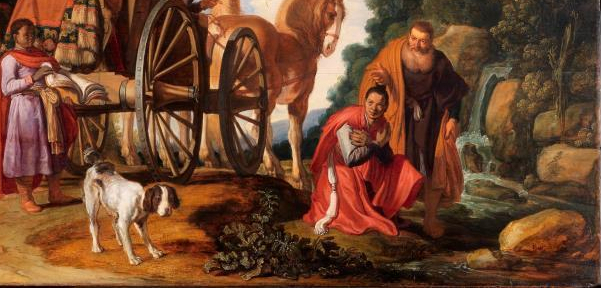
Cover art: Baptism of the Eunuch, Pieter Lastman, 1623

Then an angel of the Lord spoke to Philip saying: “Rise up and go along south on the way going down from Jerusalem to Gaza.” This is a desert. 27 And rising up he went. And behold a man, an Ethiopian eunuch, a power of [the] Candace, queen of the Ethiopians, in charge of all her treasure. He had come to Jerusalem to worship  28 and he was returning; sitting in his chariot, he was reading the prophet Isaiah.29Then the Spirit said to Philip, “Go up and join this chariot” 30 Philip ran up and heard him reading the prophet Isaiah. He asked, “Do you understand what you are reading?” 31And he said, “How can I, unless someone guides me?” And he invited Philip to come up and sit with him.’ 32 Now the passage of the scripture which he was reading was this: “As a sheep led to the slaughter or a lamb before its shearer is dumb, so he opens not his mouth: 33 In his humiliation justice was denied him. Who can describe his generation? For his life is taken up from the earth.” 34 And the eunuch said to Philip, “About whom, pray, does the prophet say this, about himself or about someone else?”35 Then Philip opened his mouth, and beginning with this scripture he told him the good news of Jesus.36 And as they went along the road they came to some water, and the eunuch said, “See, here is water! What is to prevent my being baptized?”  38 And he commanded the chariot to stop, and they both went down into the water, Philip and the eunuch, and he baptized him. 39 And when they came up out of the water, the Spirit of the Lord caught up Philip; and the eunuch saw him no more, and went on his way rejoicing. 40 But Philip was found at Azotus, and passing on he preached the gospel to all the towns till he came to Caesarea. (Acts 8.26-40, translation is by the author)

Philip and the Ethiopian eunuch is one of my favorites from the book of the Acts of the Apostles. It is a rich story of a biblical character that embodies the multifaceted differences of race, class, gender, religion and sexuality: differences that are the source of a great deal of discomfort, division and debate 2,000 years after Luke wrote about them.

I believe it was Rev. Dr. Martin Luther King Jr. who noted that Sunday morning is the most segregated hour in America. We are Easter people, yet we have given in to the seductions all around us to create a reduced community customized to our preferences, retreating into the gated community of sectarianism: a society of bigotry, discrimination, and hatred arising from attaching importance to perceived differences between ourselves in race, religion, economic status, and politics and so on.

Looking through the lens of strife and tension created by an insidious and ignorant insistence on sectarianism, it strikes me that as Christians, we have not done a very good job of living into the community of Christ that we proclaim we are baptized into. John tells us that Word was made flesh – the Greek word is ‘sarx’ –  human flesh, no mention of color or race – human, like you and I. There is no distinction. There is no longer Jew or Greek; no distinctions based upon race, color or creed. There is one new humanity.

Yet we seem as far as the east is from the west from truly embodying what Luke is showing us here. Why should any of us care about a eunuch from 2,000 years ago? Why should we people of God care about divisions based on race, gender, sexual orientation and class in our church and society? Why do I care- and I do care very deeply. Because God has told us that He cares. The crucifixion shows just how much.

Our pericope is a reminder to us today that we are to live in community. But how to define that community is the challenge in front of us. Our Ethiopian is a very different man. He is black, of questionable theology and an ambiguous gender and sexual orientation. He is, however an earnest seeker who reaches out and is graciously included into the actions of God. Philip’s courage to heed the Holy Spirit is something that our church needs as the debate surrounding homosexual marriage, insidious racism and the inclusion of the LBGT community rages on.

The parallels are all too obvious as Luke has shown in Philip’s challenge to the guardians of right religion in Jerusalem. When we give a banquet, Christ tells us to invite the poor, the crippled, the lame, and the blind: the types of people that the Pharisees considered “unclean” and under God’s curse; the types of people we Pharisee’s of today call gay, lesbian, transgender, bisexual, Black, Hispanic, Hindu, Asian and whatever other judgment a label can make. Empowered by the Spirit, the gospel message draws us in to send us out with the good news for all nations. As with the entire book of Acts, the purpose of this story is about carrying the gospel to all nations, carrying the gospel to the ends of the earth and Luke leaves no doubt as to who is directing Philip and his evangelism. My question for the church, for all of us that claim the label Christian, are we following what the Spirit showed us so long ago? Who are we inviting to the banquet? We are being challenged in this story to rethink many parameters, to rethink what community means, to rethink what the ends of the earth may look like. I suggest that Luke gave us a pretty good idea in Philip and the Eunuch. Sadly, we still have a long way to go.

Travel Plans?

Grace// She takes the blame// She covers the shame// Removes the stain// It could be her name// Grace// It’s the name for a girl// It’s also a thought that// Changed the world// And when she walks on the street// You can hear the strings// Grace finds goodness// In everything

Grace, from the album All That You Can’t Leave Behind, U2

The book of Jonah is perhaps one of the most familiar books of the minor prophets – after all, any Sunday school worth its salt includes the story of the great fish as part of its’ lesson plan at some point. The number of children’s books about the tale with the whale is countless, but I think too often, the lesson of Jonah is often missed and like the book of Job, this story is one that ends in a bit of a puzzle for many because of that.

Jonah is commanded by God to go to Nineveh, the ancient version of the ISIS caliphate, and warn them of their impending destruction unless they repent. Jonah would rather drink bleach and takes off in the other direction. It’s a downward spiral of futility that puts Jonah in a very precarious position. After all, I can’t think any place much darker and viler than the belly of a great fish – or the ISIS caliphate.

But to say this is a whale of a tale of a whale misses the point. While there may be some reason to commend the traditional view of equating Jonah and Jewish exclusivism, I believe that it is not the real point – it’s like the great fish – another red herring, no pun intended. After all, Jonah is not given a Jewish message of Yawehism – perhaps simply understood as the belief that ‘He Brings into Existence whatever Exists.’  Nor was Jonah’s message about Torah or monotheism for the pagan Ninevites. God commanded him to go and simply cry out “Forty days more, and Nineveh shall be overthrown!” (Verse 3.2). We need to look a little bit deeper. I hope that you come to see that Jonah is first and foremost a book about God’s love and care for his creation, his freedom to act graciously and the relationship between justice and mercy. It is a narrative that is clearly controlled by God with the intent of demonstrating these attributes.

Let’s look at an often very overlooked part of this story – the qiqayon, in Hebrew; the plant in English. I think it is the hinge on which this whole story turns. The plant is introduced in verse 4.6 and it is the use of the compound divine name that serves to signal that there is much more going on here.

The ‘Lord God’ is used to announce the presence and activity of the plant. The key to the plant’s significance lies in understanding its role in the two-fold function of ‘Lord’ – justice- and ‘God’- mercy: that is, to be a shade from adversity and to rescue Jonah from his morally wrong attitude as displayed in his anger. The plant serves to bring forth the overarching theme and purpose of the book of Jonah: God’s freedom to act graciously and the relationship between justice and mercy. Further, the plant, as demonstrated in the analogy that closes the book, serves to show that Jonah equates with Nineveh: God is putting Jonah in Nineveh’s shoes if you will.

Jonah has an impeding ‘evil’ just as Nineveh does. For Jonah, the evil comes in the form of the sun and the searing wind. In Nineveh’s case, it is their anticipated destruction as foretold by Jonah. Both Jonah and Nineveh embark on actions to prevent any evil from befalling them: Nineveh repents and Jonah builds a booth. An act of divine grace supplements both efforts: God changes his mind about Nineveh and he appoints, that is, he causes a plant to grow over Jonah for shade. The kicker is the worm and the gracious act of God being revoked: the plant dies. Jonah feels the full force of his evil and it brings to bear the futility of his own efforts to protect himself with the booth.

The point is that the plant serves, in this context, as an object lesson for Jonah. At the onset of chapter four, we see that Jonah is angry with God when he perceives that Nineveh’s repentance was not sufficiently sincere to warrant God’s grace. The Ninevites “believed God” but there was no sign of any real repentance such as a conversion to Judaism, perhaps. All that we see is that the Ninevites engaged in some superficial ritual and lamented. That was enough for God: God changed his mind about the calamity that he had said he would bring upon them; and he did not do it (3.10).

By putting Jonah in Nineveh’s shoes, God does to Jonah, what Jonah wanted God to do to Nineveh. Jonah’s anger in verse eight stems from God’s unmerited grace not working for him (Jonah) but it did work for Nineveh when it was also unmerited. The issue at hand was not what Jonah or Nineveh deserved or did not deserve, but more importantly whether Jonah’s efforts were capable of providing relief and we see that they were not. In his own mind, Jonah’s anger was warranted anger on deuteronomistic grounds -Nineveh deserved it. God had applied the verdict and Jonah delivered it. The function of the unpredictable plant served to show Jonah that his was a theology of selfishness. He did nothing to create the plant, grow it or otherwise. Likewise, his efforts with the booth were no more effective than the shallow acts of repentance made by Nineveh whose condition remained wretched. As the closing verses and analogy make very clear, God’s right to bestow grace cannot be limited by anyone’s narrow theology- it was about God’s sovereign right to do so. 

Jonah was never about unblemished, perfect faith, or a condemnation of the attitude of Jews toward Gentiles and Jewish exclusivism. If that were the case, then the book might very likely have been about urging Jews not to act like Jonah and respond as Nineveh responded.

Repentance is not capable of providing deliverance by its own virtue any more than Jonah’s booth being sufficient for relief. It can stir God’s compassion which Jonah realized and why he ran away in the first place.  In these acts of grace, God is not compromised because the sin is not forgiven: it is merely postponed. Forgiveness would come later.

So, as one of the gentlemen in my Saturday morning men’s bible study group inquired as we concluded our study of another book of scripture – what does all of this mean for John Doe? What do we see when we gaze into the mirror of the book of Jonah?

I would suggest that we see people of faith disgusted with the course of world history in many ways and bearing resentment against God’s seeming lack of activity and forbearance of the evil that the world is drowning in. So very often we witness ourselves expounding scripture and simultaneously throwing our hands up in despondent resignation – O Lord, please take my life from me, for it is better for me to die than to live (4.3). A few days of vacation -time in the pleasant shade – and all of our worries about the world and God drift away.  The joy of being under the unpredictable plant is witnessed in the new car, the pay raise, the shopping spree – that is until the worm attacks and the plant withers: the car breaks down, the children need new shoes, the rent is due and the pay check has been spent on food.

Do you have the right to be angry about the plant? (4.9).  Nineveh, like folks that love our new cars and vacations, is part of creation, the great city in which there are more than 120,000 people who cannot tell right from wrong and many animals are there also (4.11). God values all of his creation- just ask Job. As he tells Job,  “I can show you and I can explain it ad nauseum, but you’re not going to get it – just trust me.” Or in the question posed to Jonah: “Should I not be concerned for that great city Nineveh?” The open ended question at the close of Jonah is much like that of never directly addressing Job’s lament. While God does not answer or leaves us with a question, he is at the same time, seeking our trust and agreement to engage and further the journey from the now to the not yet of the kingdom. The worm induced loss of the shade of the plant is to awaken us to God’s compassion for his creation and our grasp of that. Jesus said as much about our loss induced anger, when he taught how the people of Nineveh would arise and condemn the current generation of Pharisees and Sadducees. God arrives at his goal to save “Nineveh” with the deliverance of Christ – a goal of compassion and mercy that conquers death. Grace. She walks the streets and finds beauty in everything. It is to this hope that we who claim to be Easter people, have been called. But whether or not the Lord arrives at his destination with us, depends on where we choose to travel – Tarshish or Nineveh.