PRE-RECORDED

I listen to the wind, To the wind of my soul // Where I’ll end up, well, I think // Only God really knows…

The Wind, Cat Stevens, 1971

Over the past few months, several readers have posed a variation on the following question: “I looked up ‘Reformed’ in the encyclopedia. It said it was a branch of Christianity that strongly emphasized predestination. If, as we read in Luke 14, that all are invited to the table, how can we believe in predestination?” As the old Saturday Night Live skit would say – discuss! So let me share with you a conversation that I had with my daughter on this often sticky wicket.

Well I must say Skylar, that you raise a question that many before you, and many that will come after you, have puzzled over as well. Admittedly, this can be a difficult doctrine to understand, perhaps even one that provokes anger in some, but the short answer to your question is yes, we do believe it. I hope that I can help you to understand why, by helping you better understand what it means. The term “predestination’ otherwise known as the doctrine of election, originates in the work of St. Augustine, who was the Bishop of Hippo in North Africa from 396 C.E. until his death in 430 C.E. It was John Calvin who more fully developed Augustine’s thoughts in his seminal work, The Institutes of the Christian Religion.We call predestination, God’s eternal decree, by which he compacted with himself what he willed to become of each man. For all are not in equal condtion; rather, eternal life is foreordained for some, eternal damnation for others. Therefore, as any man has been created to one or the other of these ends, we speak of him as predestined to life or death” (Institutes of Christian Religion :Two Volumes, ed. John Thomas MacNeill, trans. Ford Lewis Battles, II.21.5).

I will admit that the notion of election has always created some tension within me at times as well, and I know that it is one that continues to have its friction and tension points with our current culture that firmly believes, in Babel like fashion, that we can be whatever we decide to be. As Calvin says himself: “A baffling question this seems to many. For they think nothing more inconsistent than that out of the common multitude of men some should be predestined to salvation, others to destruction.” (Institutes, II.21.1) Baffling might be a bit of an understatement.

All of this is very interesting to consider given that the concept of election has its roots in scripture and is not new to Augustine or Calvin or anyone else, for that matter. Think of that foundational teaching that we in the Reformed tradition adhere to: ‘sola scriptura,’ by scripture alone. Augustine and Calvin did not simply dream this doctrine up in a self-righteous undertaking. There are countless places in scripture where we meet elements of election: Cain’s offering vs Abel’s; Isaac over Ishmael, Jacob and Esau; David over Saul and so forth. The psalms and the prophets are rfie with language noting God’s choice of some over others: e.g. 33.12; 65.4; 105.6, 42-43 to cite a few).

Perhaps the classic articulation of election is witnessed in the book of John, chapter six, when Jesus states “No one can come to me unless drawn by the Father who sent me; and I will raise that person up on the last day…” Skylar, please, please take note of what Jesus says – ‘‘unless drawn by the Father.” Because God loves us first, it is only through the grace of God that we are drawn to God to begin with. Paul makes note of this in his letter to the Ephesians: “…just as he chose us in Christ before the foundation of the world to be holy and blameless before him in love. He destined us for adoption as his children through Jesus Christ, according to the good pleasure of his will..” (Ephesians 1.4-5, NRSV). Our status before God and our relationship with God is utterly and completely dependent upon the grace of God and God’s pre-determining action. We have nothing whatsoever to do with it.

As children of the enlightenment, post enlightenment, modern, postmodern – whatever label you might want to place on the philosophical influences that have shaped our western culture and worldviews, we think and conclude that we are. The notion that the self cannot determine its fate, especially given said fate was set prior to being formed in the womb, is a concept that not only grates against everything we have been taught and indoctrinated with regarding merit and work, it is one that is impossible to get our limited capacities in a position to understand. In the 139th psalm, the writer sums this up pretty well for me and I hope this helps you as well:

…O Lord, you have searched me and known me. You know when I sit down and when I rise up; you discern my thoughts from far away. You search out my path and my lying down, and are acquainted with all my ways. Even before a word is on my tongue, O Lord, you know it completely. You hem me in, behind and before, and lay your hand upon me. Such knowledge is too wonderful for me; it is so high that I cannot attain it… For it was you who formed my inward parts; you knit me together in my mother’s womb…My frame was not hidden from you, when I was being made in secret, intricately woven in the depths of the earth. Your eyes beheld my unformed substance. In your book were written all the days that were formed for me, when none of them as yet existed. How weighty to me are your thoughts, O God! How vast is the sum of them!

Scripture is quite clear – God has known us before we are and written all of our days in God’s book before our days were upon us. Yes, we believe in predestination because God tells us that is it so.

Feet in Your Shoes

You have brains in your head// You have feet in your shoes// You can steer yourself any direction you choose// You’re on your own// And you know what you know// And YOU are the one who’ll decide where to go//…So…be your name Buxbaum or Bixby or Bray // or Mordecai Ali Van Allen O’Shea,// you’re off to Great Places // Today is your day// Your mountain is waiting // So…get on your way!

Oh The Places You Will Go, Dr. Seuss

I recently posted a piece regarding identity within the context of Matthew 28, aka, the Great Commision(See Route 66, March 7, 2021). I want to take another run at something else that I found arresting while dwelling in the words found there.

There is a question that  begins in nursery school and morphs into one that chases us almost all of our lives – “What do you do?” What do you do is one of the first questions that comes up at any cocktail or dinner party when we meet new folks. What do you do? Not who are you, but what do you do? I’m a lawyer, I’m a teacher, I’m dog catcher, a plumber, baker and a candle stick maker. We claim our identity and that of others in a job description as if that is the sum total of who we are.

Easter is upon us and as we prepare to bask in its glow, the question of what do we do and how that doing reflects who we are, become very critical questions for us to reconsider in the light of the risen Christ who has called us to follow him. The call of Christ is a call to be something more profound than what our secular career choices claim to say about our identity and it is a challenge to the subconscious desires that drive us to believe that the good life is found in another genuflection at the altar of the shopping mall.

We are called to an identity that is something far greater and enduring.  Jesus calls us to be the people of God.

Now the eleven disciples went to Galilee, to the mountain where Jesus told them to go. When they saw him, they worshipped him, but some doubted. Jesus came near and spoke to them, “I’ve received all authority in heaven and on earth. Therefore, go and make disciples of all nations, baptizing them in the name of the Father and of the Son and of the Holy Spirit, teaching them to obey everything that I’ve commanded you. Look, I myself will be with you every day until the end of this present age.”  

Perhaps you noticed this: Now the eleven disciples went to Galilee

Eleven is an odd number- odd literally and symbolically. It is not the perfect twelve, nor is it the typical biblical reference of seven for completion and or wholeness. It’s incomplete; it’s less than perfect; it’s flawed or blemished in some fashion. As my late father might say, there is a hitch in its giddy up. Eleven disciples – Matthew has Jesus sending an imperfect bunch into the world to do his perfect work.

But it gets more interesting…

They worshipped him, but some doubted – Some doubted. We really don’t know if they all doubted or just a few, the Greek is ambiguous at best. But how can they worship Christ if they have doubts? And how could any of these eleven, having just seen the risen Jesus, doubted at all? I find the notion that the disciples who worship and yet doubted as evangelical and deeply profound from a theological and spiritual level.

Just as Jesus was led up by the Spirit into the wilderness to be tempted by the devil, so we Christians live in a war between the spirit of worship and the spirit of doubt: the spirit of worship as God’s people and the spirit of the world’s people, Amazon Prime. Jesus doesn’t correct, exorcise or otherwise attack this doubt, choosing instead, to quietly ignore it as if it is normal. By his great commission, Jesus is teaching that the disciples will win their war on doubt by following his command. Albert Schweitzer once said – “Follow him and you will know Him.”  Doubt is part of our human imperfections this side of the resurrection and Matthew’s good news is that doubt and worship can, and do, coexist. Doubting worshippers are Jesus’ material in mission – Blessed are the poor in spirit, for theirs is the kingdom of heaven – blessed are those who worship the risen Lord and who still struggle with their doubt.

And it is these imperfect people – you and I – that Christ promises to always be with. The great commission – the great commission to be – to be disciples of Jesus, united to him in the waters of baptism by the power of the Spirit, making us the very people of God.

“You have feet in your shoes for the direction you choose.” So, whether you chose to be a teacher, a custodian, a butcher, a baker, or candle stick maker, do whatever it is that you chose to do as the person of God that you are. Bring the light, love and truth of Christ to everyone that you meet, in everything you say, and in everything that you are. Go and be.

Mirror, mirror, where's the crystal palace? 
But I only can see myself 
Skating around the truth who I am. 

Winter, Tori Amos

Heartburn

When we were strangers // I watched you from afar // When we were lovers // I loved you with all my heart // But now it’s gettin’ late // And the moon is climbin’ high // I want to celebrate // See it shinin’ in your eye // Because I’m still in love with you // I want to see you dance again // Because I’m still in love with you // On this harvest moon

Harvest Moon, Neil Young, 1992

Harvest moons. The moon that is so named for shining ever so brightly in the season of waning fertility, the crops have been harvested and the long, dark winter is about to set in. Neil Young has succinctly captured something about life, love, and marriage that resonates with me. It is a picture of mature love that can flourish in marriage. But more than half the time, those “I do’s” are lost in a sea of despair and recriminations that end in divorce. I was one.

1 Corinthians 7.10-16 gives me heartburn: and in varying degrees, so does Mark 10, Matthew 5 and 19, Luke 16, and Roman 7.1-3. To be condemned to a lifetime of misery that a wrong marriage brings strikes me as antithetical to our initial directive to be fruitful and multiply. The fact remains, that life in a marriage gone bad is anything but fruitful. It is a life that has died in more ways than one.   

Beth and I knew this first hand. We both were in hellish, dead end marriages when we met. We were blessed by God to have found each other after many years of near misses, and yet we seem to stand in condemnation of the gospel: “And I say to you, whoever divorces his wife, except for unchastity, and marries another commits adultery”(Matt. 19.9, NRSV). We are adulterers even though we never cheated in the conventional understanding of that word. As I said – heartburn.

In The Moral Vision of the New Testament, Richard Hays has done some notable work with this subject that has helped me a bit and for those that might be having a similar case of indigestion, I want to share what I found.

Hays speaks of marriage within the framework of cross, community and new creation, a perspective that brings the “logic of the New Testament’s rigorous teaching against divorce comes clearly into focus” (p. 376). The covenant of marriage is, as Hays points, one that is rooted in the love that goes beyond the “rush of mutual joy, beyond the romance of “warm spring evenings and roses,” and should be rooted rather, in the love of the cross” (p.375). He goes on to critique the ease with which divorce occurs in our individualistic and therapeutic culture. It is very serious business, this covenanting stuff and I think Hays’ critique is worthy. Yes, marriage is hard. Perhaps our premarital counseling skills need some improving. Just sayin’….

So while I stewed, and as the acid of guilt, anger and frustration was rising into my throat, I was grateful that Hays, citing the canonical witness – “I Paul, not the Lord” – notes this: “I would take the New Testament’s hermeneutical process of discerning exceptions to the rule of Jesus’ teaching to be instructive about the process of moral deliberation in the church on this matter” (p.372). Ok then…there’s hope?

As someone who escaped (and I mean that in every sense of the word) a 13 year marriage of physical abuse and psychological devastation, it’s good to see the possibility of a scripturally grounded hermeneutic which acknowledges circumstances that, at least in my limited view, are antithetical to love and life and the very objective of marriage. I cannot accept that ‘better or worse’ means putting your life at risk and if that’s what Jesus meant, then I want my “Job” hearing.

So, having risen from the smoky ruins of hell to now be in a marriage that is long past warm spring evenings; a marriage that loves nothing better than doing the evening dishes together; a marriage that has endured the loss of a child, the loss of our house, the loss of every penny, the loss of my freedom and then some; a marriage that has produced a beautiful daughter who is following the Lord’s footsteps as she blossoms into adulthood; a marriage rooted in the practice of love that testifies to the presence and love of God. If that is a marriage that makes me an adulterer, then guilty as charged and I will sing God’s praise as I dance with the love of my life under the harvest moon.

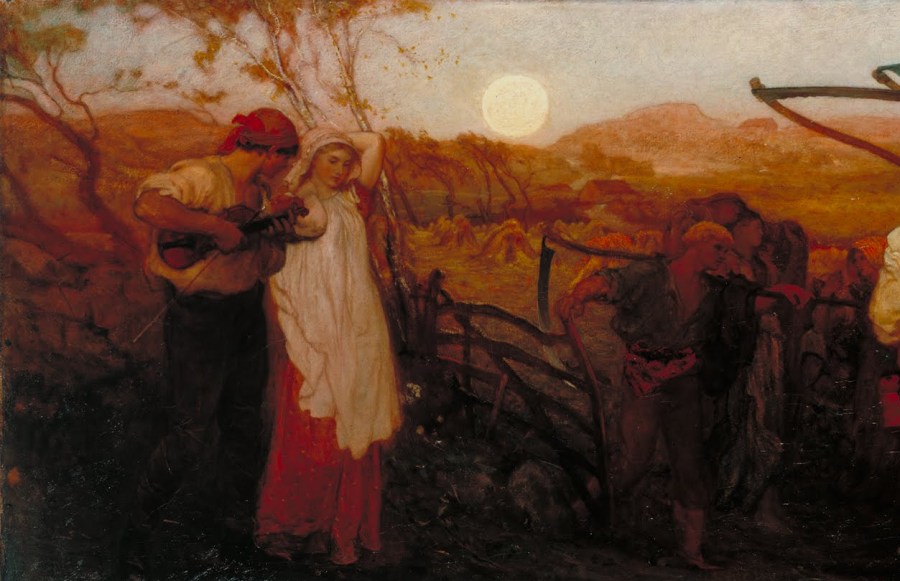
Artwork: Harvest Moon, George Hemming Mason, 1872

Loosen My Lips

I try to sing this song // I, I try to stand up // But I can’t find my feet // I try, I try to speak up // But only in you I’m complete // Gloria, in te domine, Gloria, exultate // Gloria, Gloria // Oh Lord, loosen my lips

Gloria, U2, 1981

With Lent approaching, I want to suggest that one way we can examine our daily habits is within the context of Paul’s exhortation to the church in Thessalonica.

Brothers and sisters, we ask you to respect those who are working with you, leading you, and instructing you.Think of them highly with love because of their work. Live in peace with each other. Brothers and sisters, we urge you to warn those who are disorderly. Comfort the discouraged. Help the weak. Be patient with everyone. Make sure no one repays a wrong with a wrong, but always pursue the good for each other and everyone else. Rejoice always. Pray continually. Give thanks in every situation because this is God’s will for you in Christ Jesus. Don’t suppress the Spirit. Don’t brush off Spirit-inspired messages, but examine everything carefully and hang on to what is good. Avoid every kind of evil.  (1 Thessalonians 5.12- 22, CEB)

As infants, we begin to learn our mother tongue without any formal grammatical instruction. As one person has observed, by the time we are three or four, we are putting nouns, verbs and prepositions together in intricate sentences much like baby birds that learn to fly without studying aerodynamics. The same is true of a “mother tongue of behavior.” We watch how those in our personal lives and community behave and model our behavior accordingly.

Learning to speak Christian and Christian behavior is no different. In this passage, Paul is giving us some of the guidelines that we must incorporate if we are ever to be fluent. They are not “rules” or “laws” per se, but the ways in which the Holy Spirit leads the greater community in behaviors that contribute to our Christian fluency. To be Christian fluent is to have a responsibility to look out for the needs of others; to encourage, to give comfort, to assist the weak and to actively go after that which is good for all. And like any new behavior, it is best formed by practicing new habits: the habits of rejoicing always, praying continually and giving thanks in all circumstances.

Gloria, in te domine, Gloria, exultate – Glory in You, Lord / Glory, exalt [Him]” Lord, loosen my lips

Rejoice always: perhaps easier said than done, but we try. Give thanks: we know that’s we should do and how we should live. Pray continually: I suspect that’s a bit harder challenge. Am I supposed to go through life on my knees with my hands clasped and eyes closed in a form of self-imposed blindness? No, that is not what the God of life wants us to do and nor is Paul suggesting a posture. Paul is talking about a guiding behavorial principle. We are supposed to be people who twenty-four hours a day, seven days a week, three hundred and sixty five days a year, are open, receptive and responsive to what God is doing in our lives and we are to do everything we can to keep the lines of communication open.

Gloria, in te domine, Gloria, exultate – Glory in You, Lord / Glory, exalt [Him]” Lord, loosen my lips.

Our prayer is continual when we believe that God  is with us all the time, trusting in God’s love and care, knowing that God is working for good in our lives, regardless of what is happening. Continual prayer is not about delivering complex, lengthy, and eloquent dissertations to the Lord every minute of the day. Continual prayer happens in the short conversations, the moments however brief, when we thank God for the many blessings that surround us: the beauty of a new day, the food on our tables, the warmth of our homes, the hands held, the hugs given and the hugs received. Continual prayer happens when we give God credit for the nice surprises and the times of tears, asking God for guidance when we feel confused or lost. Continual prayer happens when we recognize and pursue the needs of the stranger, widow, and the orphan.

Gloria, in te domine, Gloria, exultate – Glory in You, Lord / Glory, exalt [Him]”

Notice that Paul has placed continual prayer between rejoicing and thanksgiving. Continual prayer is the bridge between the two, the essential bridge that unites the twin poles of Christian living. When we pray continually, realizing God’s presence, we can rejoice always and give thanks in all circumstances. Pray continually- an important step in becoming fluent in Christian and most importantly, it is God’s will for you in Jesus Christ.

Gloria, in te domine, Gloria, exultate – Glory in You, Lord / Glory, exalt [Him]” Lord, loosen my lips

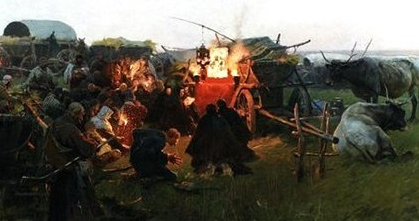
Artwork: Brandt, Jozef. Prayer in the Steppe, from Art in the Christian Tradition, a project of the Vanderbilt Divinity Library, Nashville, TN. http://diglib.library.vanderbilt.edu/act-imagelink.pl?RC=56475 [retrieved February 5, 2021]. Original source: https://commons.wikimedia.org/wiki/File:Brandt_Prayer_in_the_steppe.jpg

To the Ends of the Earth

“Imagine no possessions// I wonder if you can// No need for greed or hunger// A brotherhood of man// Imagine all the people sharing all the world, you// You may say I’m a dreamer// But I’m not the only one// I hope someday you’ll join us// And the world will be as one.”

Imagine, John Lennon

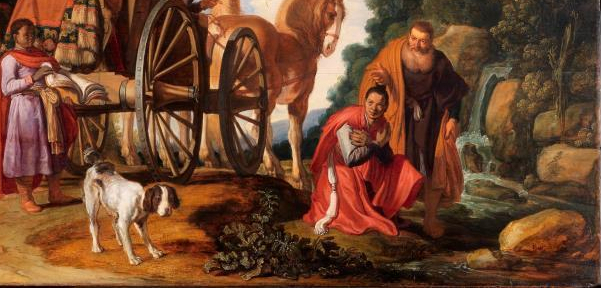
Cover art: Baptism of the Eunuch, Pieter Lastman, 1623

Then an angel of the Lord spoke to Philip saying: “Rise up and go along south on the way going down from Jerusalem to Gaza.” This is a desert. 27 And rising up he went. And behold a man, an Ethiopian eunuch, a power of [the] Candace, queen of the Ethiopians, in charge of all her treasure. He had come to Jerusalem to worship  28 and he was returning; sitting in his chariot, he was reading the prophet Isaiah.29Then the Spirit said to Philip, “Go up and join this chariot” 30 Philip ran up and heard him reading the prophet Isaiah. He asked, “Do you understand what you are reading?” 31And he said, “How can I, unless someone guides me?” And he invited Philip to come up and sit with him.’ 32 Now the passage of the scripture which he was reading was this: “As a sheep led to the slaughter or a lamb before its shearer is dumb, so he opens not his mouth: 33 In his humiliation justice was denied him. Who can describe his generation? For his life is taken up from the earth.” 34 And the eunuch said to Philip, “About whom, pray, does the prophet say this, about himself or about someone else?”35 Then Philip opened his mouth, and beginning with this scripture he told him the good news of Jesus.36 And as they went along the road they came to some water, and the eunuch said, “See, here is water! What is to prevent my being baptized?”  38 And he commanded the chariot to stop, and they both went down into the water, Philip and the eunuch, and he baptized him. 39 And when they came up out of the water, the Spirit of the Lord caught up Philip; and the eunuch saw him no more, and went on his way rejoicing. 40 But Philip was found at Azotus, and passing on he preached the gospel to all the towns till he came to Caesarea. (Acts 8.26-40, translation is by the author)

Philip and the Ethiopian eunuch is one of my favorites from the book of the Acts of the Apostles. It is a rich story of a biblical character that embodies the multifaceted differences of race, class, gender, religion and sexuality: differences that are the source of a great deal of discomfort, division and debate 2,000 years after Luke wrote about them.

I believe it was Rev. Dr. Martin Luther King Jr. who noted that Sunday morning is the most segregated hour in America. We are Easter people, yet we have given in to the seductions all around us to create a reduced community customized to our preferences, retreating into the gated community of sectarianism: a society of bigotry, discrimination, and hatred arising from attaching importance to perceived differences between ourselves in race, religion, economic status, and politics and so on.

Looking through the lens of strife and tension created by an insidious and ignorant insistence on sectarianism, it strikes me that as Christians, we have not done a very good job of living into the community of Christ that we proclaim we are baptized into. John tells us that Word was made flesh – the Greek word is ‘sarx’ –  human flesh, no mention of color or race – human, like you and I. There is no distinction. There is no longer Jew or Greek; no distinctions based upon race, color or creed. There is one new humanity.

Yet we seem as far as the east is from the west from truly embodying what Luke is showing us here. Why should any of us care about a eunuch from 2,000 years ago? Why should we people of God care about divisions based on race, gender, sexual orientation and class in our church and society? Why do I care- and I do care very deeply. Because God has told us that He cares. The crucifixion shows just how much.

Our pericope is a reminder to us today that we are to live in community. But how to define that community is the challenge in front of us. Our Ethiopian is a very different man. He is black, of questionable theology and an ambiguous gender and sexual orientation. He is, however an earnest seeker who reaches out and is graciously included into the actions of God. Philip’s courage to heed the Holy Spirit is something that our church needs as the debate surrounding homosexual marriage, insidious racism and the inclusion of the LBGT community rages on.

The parallels are all too obvious as Luke has shown in Philip’s challenge to the guardians of right religion in Jerusalem. When we give a banquet, Christ tells us to invite the poor, the crippled, the lame, and the blind: the types of people that the Pharisees considered “unclean” and under God’s curse; the types of people we Pharisee’s of today call gay, lesbian, transgender, bisexual, Black, Hispanic, Hindu, Asian and whatever other judgment a label can make. Empowered by the Spirit, the gospel message draws us in to send us out with the good news for all nations. As with the entire book of Acts, the purpose of this story is about carrying the gospel to all nations, carrying the gospel to the ends of the earth and Luke leaves no doubt as to who is directing Philip and his evangelism. My question for the church, for all of us that claim the label Christian, are we following what the Spirit showed us so long ago? Who are we inviting to the banquet? We are being challenged in this story to rethink many parameters, to rethink what community means, to rethink what the ends of the earth may look like. I suggest that Luke gave us a pretty good idea in Philip and the Eunuch. Sadly, we still have a long way to go.

Patience

To touch is to heal // To hurt is to steal // If you want to kiss the sky //Better learn how to kneel (on your knees boy!)

from Mysterious Ways by U2, 1991
artwork – “The Patient Job,” by Gerard Seghers, Public domain, via Wikimedia Commons

Therefore, brothers and sisters, you must be patient as you wait for the coming of the Lord. Consider the farmer who waits patiently for the coming of rain in the fall and spring, looking forward to the precious fruit of the earth. You also must wait patiently, strengthening your resolve, because the coming of the Lord is near. Don’t complain about each other, brothers and sisters, so that you won’t be judged. Look! The judge is standing at the door!” James 5.7-9 CEB

I had my tonsils removed at the age of nine. It had been a long, miserable winter of measles, chicken pox, strep throat and measles again. Laying in my hospital bed, I was in a lot of pain and I couldn’t wait for mom to arrive and take me home. I kept seeing reflections of people coming down the hallway in the glass on the open door, each time hoping it was her. As the minutes turned into hours, the disappointment mounted along with the anxiety. What if she wasn’t coming? What if something happened? What if she forgot? Well, she did arrive and at the time that was appointed, though it wasn’t soon enough for me. If only I had known more patience. Of course she was coming: moms do not forget.

As we get the season of Advent underway, we join with our sisters and brothers in Christ that have been praying for centuries for the promised return of Jesus. And like them, we need to learn the valuable lesson of patience. Easier said than done when the curse of Amazon Prime has done a pretty good job of eliminating any need of it. A hasty, impatient spirit is simply another form of pride, another form of human arrogance that presumes it knows God’s timetable better than God. James knows that and he is imploring us to do otherwise. That we are being commanded to be patient and that patience is one of the important aspects of the work of the spirit in our lives, tells us just how precious this gift is for us.

This is not an easy time for something that does not come easily to us. Like the nine year old boy anxiously waiting in his hospital room, I suspect that many Christians may share similar anxieties. We live in a world that too often seems broken beyond our capacity to understand, and now,  during this time of Covid, when we are far too isolated from friends, family and community, those anxieties are all the more acute. Fear and anxiety are the breeding ground for the arguments and polarization with which we are sadly too familiar. Be patient. Patience with the “other” is the hallmark of humility and a fruit of the spirit. Be patient, James writes. “You have heard of the endurance of Job. And you have seen what the Lord has accomplished, for the Lord is full of compassion and mercy” (5.11, CEB). Be patient. The Lord has promised, the Lord is coming and the Lord does not forget.

Help

I begin to realize // Magic in my life //See it manifest in oh, so many ways // Every day is gettin’ better and better // I want to be daily walking close

It gets stronger when you get the feelin’ // When you get it down in your soul // And it makes you feel good // And it makes you feel whole

When the spirit moves you // And it fills you through and through // Every morning and at the break of day // Oh, did ye get healed?

“Did Ye Get Healed” Van Morrison, 1987

Many have called the 16th chapter of John, the ‘Spirit Sermon’ – it has the most emphatic, concentrated teaching of all four gospels about the work of the Holy Spirit thru the church for the world. This chapter and the two that preceded it, contain a beautiful sermon delivered by Christ after the celebration of the Last Supper and on the very threshold of his suffering and departure from the disciples. In this last evening before his death, Jesus tries to show the disciples, two elements of reality that are difficult to hold together: he is going away, yet he will not leave them alone.

 I’m not entirely certain, but I believe it was Karl Barth who once said something about the Trinity along the lines of before there was time, there was already love and relationships. And when time is no more, there will still be love and relationships. Relationships are vital. They are the antidote to isolation and despair. Relationships our source of comfort and guidance when the going gets so tough that it is difficult to keep going. 

And so it is for the intrepid disciples, that group from the F Troop of 1st century Palestine: they are now getting it straight from Jesus about his immanent departure and the going is going to get tough. They are upset and confused. In the preceding chapters, Jesus had alerted his band of merry men that he would be with them only a little longer and now they have lots of questions. Where are you going? How can we follow you if we don’t have a map and why does it have to be a secret? Lots of changes loom on the horizon for the disciples and they are confused, and very likely, a bit frightened. Jesus promises that they will not be left alone through it all. He will send the Advocate.

From verse 7: Nevertheless, I tell you the truth: it is to your advantage that I go away, for if I do not go away, the Advocate will not come to you; but if I go, I will send him to you.

Jesus’ departure, like anyone’s departure, means less of the departed’s presence – simple enough – but here’s the surprise – the departure of Jesus also means a very surprising more – the departed’s presence in another form. It is a going that becomes a coming.

The advocate – ho paraklētos –  the Greek literally means the “one called alongside” to help in tough situations like, court appearances to give true , helpful and encouraging testimony and support. Luther’s German translation is “der troster” – the truster, the encourager, the one who encourages trust,  who will take what is Jesus’ and declare it to us – all that the Father has is Jesus’ and the truster will take what is Jesus’ and declare it to you – to us – the people of God, the ekklēsia, the church.

An advocate –  the truster – the paraclete – the Holy spirit has the special mission to bring Jesus, who is the truth in person, to us. The Spirit will show the church what the world gets wrong in its three key assumptions: what the world is wrong about wrong, about what is right and about who has won. The Spirit will guide the church by the full truth into a full relevance with the fullness of Christ at its core.

The Spirit will teach what the world is most wrong about wrong – about sin – “because they do not believe in me” (verse 9). We all have some good ideas about what is wrong in the world and the evil realities that come with those wrongs. I bet we could come up with quite a long list: war, hunger, racism, gun violence and our list would not be wrong as these things are very wrong indeed. But Jesus is saying that list doesn’t go deep enough, far enough and strangely, it is not singular enough.

Jesus says that the church’s teaching, preaching and living through the Spirit’s led inspiration, will show that the root wrong in the world is the failure to believe in Christ – “they do not believe in me”- Jesus. If the world does not believe that Jesus is the great God’s personal visitor to earth,  is indeed the greatest of all wrongs.  The sum total of all evil in the world flows out from this one basic evil. The Spirit’s first and introductory teaching to we the people of God, the church, in our confrontation with the world – a world that is very much inside each one of us in the church –  is that sin, that which is most wrong is the rejection of Jesus. Our pluralist society sees believing in Jesus as a matter of your personal taste that has no bearing on my personal taste. It holds this view rather than the fundamental issue that relationship to Jesus is a sin or righteousness, life or death matter of truth. The Paraklete, the Advocate, the Spirit will move us, the church, to live, preach, and teach Jesus in this urgent evangelical way,  to bring the world, both inside and outside the church, to its senses and we to our center: Jesus.

So what is really right? From verse 10 – it is “about righteousness, because I am going to the Father and you will see me no longer…”

I know that we can come up with a wonderful list of all sorts of things that are right and true: justice, beauty, love, children, grandchildren, friends, a beautiful sunrise. Yet John’s gospel is showing us that the Spirit will challenge us once again, to show us that we miss the point of Jesus’ career being the most right thing to ever happen in human history. Going to the Father is shorthand for Jesus declaring that I came to die and rise this weekend; to obediently experience the Father’s mission for me in the world. It is a mission that leads to death on the cross and resurrection in atonement for the sins of the world: a mission that conquers death and meaningless. This a mission that is the most important, helpful and right deed that has ever been done.

Significantly though, it is the Church’s living by faith, not by sight that completes the picture. You will see me no longer – You believe Thomas because you have seen me:but blessed are those who have not seen me and still believe (20.29).

So the most profound wrong in the world is not believing in Jesus and the most profoundly right thing that has ever happened is Jesus career and the Church’s continuing faith in Jesus and his mission – despite his present invisibility – a faith made possible through the work of the Holy Spirit. 

And who wins? It is about “judgment, because the ruler of this world has been condemned.” Too often in life, it looks like Satan, the forces of evil, are the winners. The good things happen to bad people and bad things happen to good people deal. From the cross through the holocaust to terrorism, racism, corruption and sleaze, it is the ruler of the world that seems to win the good-evil contests. Jesus tells us here that no, the ruler of the world has already lost and it will be the Holy spirit that will encourage the Church, to live, to preach, and teach, that the victory has been won and that the Lord has risen and reigns in spite of all appearances to the contrary. God wins – and that’s where we come in.

Jesus tells the disciples ahead of time so that they may believe and John’s gospel was written so that we may believe. Wanting to trust the Lord is a form of trusting him, wanting to love others is the seed of loving others. Jesus both gives us this wanting and then takes up this wanting into himself and, by the Spirit, transforms our wanting, into real doing, whether we think or believe, that we are doing enough. It is a peacefulness that expresses trust. There is no need for fear and anxiety when we take up the cross to follow the Lamb as he goes forward to confront the ruler of the world. Led by the Spirit, we follow the way that Jesus goes, which is the way he is, and receive the promise of abiding with us, now and forever. As the events of the immediate and distant future unfold,  we Easter people, the people who follow Jesus, are able to trust that the One who loved us enough to send the Son who sends the Spirit, who still loves us and still seeks to dwell with us.

We know that we are not orphaned.

We are the children of the living God.

Darkness

What if God was one of us? // Just a slob like one of us // Just a stranger on the bus // Tryin’ to make his way home? // If God had a face what would it look like? // And would you want to see if, seeing meant // That you would have to believe in things like heaven // And in Jesus and the saints, and all the prophets?

“What if God was One of Us,” written by Eric Bazilian, 1995, recorded by Joan Osborne.

We live in a world that is in constant search for love and wholeness in the things that are not; a fruitless search whose result is despair, isolation – an isolation now intensified by Covid-19. The silent darkness that has enshrouded many of our lives may seem overwhelming, the storms and trials all-consuming. I have heard many in recent days question, lament really, at their inability to find Jesus in their lives: a lament that makes the darkness all the darker. Given the tribal warfare of our time, it is quite plausible that we wouldn’t recognize Jesus if we stepped over him, let alone recognize him when we do pass on to glory.

Yes, yes, you say, we know that Jesus reveals himself in the Word and in creation, but if we listen a bit more closely, we find that Jesus is telling us to look elsewhere for his presence: “Then the king will reply to them, ‘I assure you that when you have done it for one of the least of these brothers and sisters of mine, you have done it for me.’ (Matt. 25.40).

When we learn to look for Christ in other people, we learn to recognize him and when we learn to recognize him, we find the light for our dark moments.

Photo by Cameron Casey on Pexels.com

Look for Jesus in the poor that populate our food pantry lines. Look for Jesus in the lonesome and embittered that need a kind word. Look for Jesus in those who have lost jobs in businesses that Covid has destroyed and desperately plea for help. Look for Jesus in those that need  medicines we don’t have to cure the disease we do not yet understand. Look for Jesus in the sick and dying as they pray for healing and comfort. Look for Jesus in the homeless, the lost and the addicted that need new direction. Look for Jesus in the essential workers that are not paid like ones that are essential. Look for Jesus in those that provide food for the pantries. Look for Jesus in the grocery store clerk. Look for Jesus in the first repsonders and frontline workers that risk their own lives for others. Look for Jesus in those that give you the kind word. Look for Jesus in those who seek to comfort you and give you new direction. Look for Jesus in school teachers that instill knowledge in our children. Look for Jesus in the one who simply listens, giving space for the pain and lament in your life. Look for Jesus – he is in that person in the mirror.

Jesus is everywhere: in his Word, in creation, in other people and in you as well. When the gloom descends upon you, when the chaos of life in the age of Covid overwhelms you, when you think you are simply done, remember Jesus words to his frightened disciples that thought they were about to drown:  “Just then he spoke to them, “Be encouraged! It’s me. Don’t be afraid.” (Mark 6.50). Jesus, in good times and the bad, is always present. When you learn to see him, you will find the light that the darkness will not and cannot ever overcome.

Don’t fear, for I have redeemed you; I have called you by name; you are mine. When you pass through the waters, I will be with you; when through the rivers, they won’t sweep over you.When you walk through the fire, you won’t be scorched and flame won’t burn you. I am the Lord your God, the holy one of Israel, your savior.

Isaiah 43.1-3

DONE?

I waited patiently for the Lord// He inclined and heard my cry// He brought me up out of the pit// Out of the mire and clay// I will sing, sing a new song// I will sing, sing a new song

“40”, by U2. (Songwriters Adam Clayton, David Evans, Laurence Mullen, Paul David Hewson)

A very dear, dear friend recently checked in to lament the fatigue of Covid and our tribal politics. She was done. Done. The lament of Psalm 13: “How long O Lord?” The psalms are a great tonic any day, but very much so this day. Done.

As the songbook of the Bible, the Psalter is the grammar that forms our faithful speech for worship and prayer which then sets the pattern for how we interact with all of life. Calvin, as he so often does, said it best: “Moreover although The Psalms are replete with all the precepts which serve to frame our life to every part of holiness, piety, and righteousness, yet they will principally teach and train us to bear the cross; and the bearing of the cross is a genuine proof of our obedience, since by doing this, we renounce the guidance of our own affections and submit ourselves entirely to God, leaving him to govern us, and to dispose of our life according to his will, so that the afflictions which are the bitterest and most severe to our nature, become sweet to us, because they proceed from him.” (from John Calvin, “Commentary on Psalms – Volume 1). Indeed.

A couple of years ago, my pastor was preaching through the Psalter, teaching and leading the congregation into a deeper, transformative experience with God’s prayer book. He sought out stories from his flock to bring understanding and tangibility to words that might seem distant and abstract. I was one he asked to reflect upon Psalm 30 and I thought that I would share those comments with you in prayerful hope that if you are also “done,” you may turn to the psalms for the renewal and the hope that lays within.

~

Psalm 30

A psalm. A song for the temple dedication. Of David.

I exalt you, Lord, because you pulled me up; you didn’t let my enemies celebrate over me. Lord, my God, I cried out to you for help, and you healed me. Lord, you brought me up from the grave, brought me back to life from among those going down to the pit.

You who are faithful to the Lord, sing praises to him; give thanks to his holy name! His anger lasts for only a second, but his favor lasts a lifetime. Weeping may stay all night, but by morning, joy!

When I was comfortable, I said, “I will never stumble.”  Because it pleased you, Lord, you made me a strong mountain.

But then you hid your presence. I was terrified. I cried out to you, Lord. I begged my Lord for mercy: “What is to be gained by my spilled blood, by my going down into the pit? Does dust thank you? Does it proclaim your faithfulness? Lord, listen and have mercy on me! Lord, be my helper!”

You changed my mourning into dancing. You took off my funeral clothes         and dressed me up in joy so that my whole being might sing praises to you and never stop. Lord, my God, I will give thanks to you forever.

~

“This morning I can stand here and sincerely proclaim these verses from the 30th psalm:

I exalt you, Lord, because you pulled me up; you didn’t let my enemies celebrate over me. Lord, my God, I cried out to you for help, and you healed me. Lord, you brought me up from the grave, brought me back to life from among those going down to the pit.

That has not always been the case. As a young lad of nine, I remember being mesmerized by the preaching of Rev. Dick Morledge, Senior Pastor of the 1st Presbyterian Church of Bakerstown, Pennsylvania and I found myself thinking – that’s what I want to do: it’s where I want to stand. Roughly ten years later during my junior year at NYU, my father was passing through the city on his way to business in some far eastern destination and we had the chance to grab a steak in the Oak Room Bar at the Plaza Hotel. Our conversation danced around lots of things (I hadn’t been home in almost a year), but at one point he kept saying I belonged in ministry, meaning the pulpit. Instead, in the words of one my favorite modern psalmists, Joni Mitchell, I chose to go chasing after golden Reggie with the apple of temptation and a diamond snake wrapped around my arm.

When I was comfortable, I said, “I will never stumble.” And when you fast forward 20+ years from that dinner, I was indeed standing very comfortably, but not on a strong mountain built by the Lord. It was on a mountain of self-righteousness, greed and pride: a mountain of quicksand.

But then you hid your presence. I was terrified. The sands of that mountain began to crumble and wash away with the miscarriage of twins, the death of our daughter Sarah and several more miscarriages. The blessing of Skylar was followed by another miscarriage and then the miscarriage of career judgment and the miscarriage of my soul. I didn’t simply stumble: it was a full-fledged face plant onto the sidewalk of hell. The Lord finally got the attention of this thick headed Swede via the Honorable DeBevoise.

I cried out to you, Lord. I begged my Lord for mercy:“What is to be gained by my spilled blood, by my going down into the pit? I cried out –  turning to the psalms in particular for words in prayer that I could not form. From Psalm 3: “Lord I have so many enemies” to Psalm 13, “How long will you forget me Lord” to Psalm 23 and Psalm 46’s sense of presence and reassurance; to Psalm 64’s call for the destruction of those many enemies. I prayed the psalms of lament and despair – 17, 28, 31, 59, 61, 77, 102 as well as Psalms 25, 86, 119 and 123, asking for guidance and instruction. In Psalms 62, and the psalms of ascents, I prayed for a desire to trust the Lord more. And I prayed for restoration in Psalms 85, 106, 107 and 137. I prayed as our psalmist does this morning: “Lord listen and have mercy on me! Lord be my helper”

And he did – His anger lasts for only a second, but his favor lasts a lifetime. Weeping may stay all night, but by morning, joy! Our Lord God answered those prayers sending Beth and Skylar and I many angels – several saints individually from this church and all of you sitting here this morning, as well as many who are no longer with us. Our chapter of the body of Christ reached out and because it pleased you, Lord, you made me a strong mountain. His sheepdogs – you know those two from Psalm 23  – goodness and mercy – nipped at my heels hard enough to get me to turn around and gave me a second chance to listen to the voice that has been calling me for more than 50 years.

I have been restored and now stand on a strong mountain. I have been restored to community and restored in my soul; called now to seminary and a life of witness to God’s great mercy and power. I was given the chance to taste and see God’s bounty: blessings that money and materiality will never accomplish. They are blessings that are true and available to all that call his name. They are blessings that we share with our community at large when we go out from here and be the light in everything we say, in everything we do and in everything that we are. Love is not a program and it is not a duty: it is the food and drink of resurrection people and as resurrection people, when we share that food with all we meet, great things happen. As someone that has been fed in this way, I can testify as our psalmist does –   You have changed my mourning into dancing; you took off my funeral clothes and dressed me up in joy so that my soul may praise you and not be silent.  O Lord my God, I will give thanks to you forever. You who are faithful to the Lord sing praises to him and give thanks to his holy name.

Done. Amen.

“Whenever the Psalter is abandoned, an incomparable treasure is lost for the Christian church. With its recovery will come unexpected power –

Dietrich Bonhoeffer

Standing on One Foot

I, I’m a new day rising // I’m a brand new sky // To hang the stars upon tonight // I am a little divided// Do I stay or run away// And leave it all behind? // It’s times like these you learn to live again// It’s times like these you give and give again // It’s times like these you learn to love again// It’s times like these time and time again.

Times Like These, Foo Fighters, (songwriters: Nate Mendel, Dave Grohl, Taylor Hawkins, Chris Shiflett), 2002.

Times like these. Indeed. I recently came across some notes from a series of lectures on the Babylonian exile and in them, Edwin Muir’s poem, One Foot in Eden (1956). It had been a while since I last read it and as I did so again, I found it striking many chords.

One foot in Eden still, I stand
And look across the other land.
The world's great day is growing late,
Yet strange these fields that we have planted
So long with crops of love and hate.
Time's handiworks by time are haunted,
And nothing now can separate
The corn and tares compactly grown.
The armorial weed in stillness bound
About the stalk; these are our own.
Evil and good stand thick around
In fields of charity and sin
Where we shall lead our harvest in.

Yet still from Eden springs the root
As clean as on the starting day.
Time takes the foliage and the fruit
And burns the archetypal leaf
To shapes of terror and of grief
Scattered along the winter way.
But famished field and blackened tree
Bear flowers in Eden never known.
Blossoms of grief and charity
Bloom in these darkened fields alone.
What had Eden ever to say
Of hope and faith and pity and love
Until was buried all its day
And memory found its treasure trove?
Strange blessings never in Paradise
Fall from these beclouded skies.
 

One Foot in Eden, Edwin Muir, 1956

I have written many times about the darkness that envelopes our lives – racism, violence, feckless politicians, ravaging unemployment and rising food insecurities paint a picture of bleakness and despair that we may be hard stretched to find a comparative experience.

And equally hard stretched to deal with.

It’s what makes me appreciate the story of the Babylonian exile all the more. You can get a good idea of it’s devastation in the book of Lamentations where you will read some of the most brutal and compelling writing about human pain and suffering that emerged from the ashes and ruins of Jerusalem. The psalms are no slouch in this department either.  Daughter Babylon, you destroyer, a blessing on the one who pays you back the very deed you did to us! A blessing on the one who seizes your children and smashes them against the rock! (Psalm137.8-9). That is deep anger born of a cavernous despair.

Israel’s story became especially poignant as I read through the horrors of the darkness and despair of the exile only to see hope and faith spring out of the ashes of destruction. If there was ever a time for Israel to not hope, it had to be then. Yet, the exiles did return and laid the foundation for a new temple and renewed life. The flowers of hope and faith, like the fire poppies that spring up after a wild fire, blossomed in dark valleys and burned fields.

As I witness a world that seems to be falling apart in madness with each passing day of violence and ever growing fear mongering, I am reminded by these horrors that we, like Israel, are in exile still, angry and isolated.

But yet, hope blossoms.

From Muir – “One foot in Eden still, I stand // And look across the other land. The world’s great day is growing late // Yet strange these fields that we have planted// So long with crops of love and hate // Time’s handiworks by time are haunted, // And nothing now can separate // The corn and tares compactly grown.”

Crops of love and hate tightly interwoven. Joy and tears coexisting. We have glimpses of how things ought to be only to have to struggle with the way things are. It’s no wonder that our feet stumble and slip.

But like our returning exiles, we too have seen the foundation of the new temple laid. Unlike the exiles though, our foundation is built in, on, and with material against which the gates of hell cannot prevail – Jesus Christ. Muir speaks to our hope in Christ, of the now but not yet: But famished field and blackened tree //Bear flowers in Eden never known.// Blossoms of grief and charity // Bloom in these darkened fields alone.// What had Eden ever to say // Of hope and faith and pity and love // Until was buried all its day// And memory found its treasure trove? // Strange blessings never in Paradise// Fall from these beclouded skies.”

As Easter people, we stand with one foot in Eden: the dawning kingdom of God. We are filled with enduring hope for the return of the greatest gift that ever was. We stand and blossom, fed and supported by our faith in that hope. Strange blessings? Perhaps. But blessings that call for singing a new song.

I waited patiently for the Lord // He inclined and heard my cry// He brought me up out of the pit // Out of the mire and clay// I will sing, sing a new song // I will sing, sing a new song // How long to sing this song // How long to sing this song // How long, how long, how long // How long, to sing this song// He set my feet upon a rock // And made my footsteps firm // Many will see // Many will see and fear // I will sing, sing a new song // I will sing, sing a new song.

40, U2 (songwriters: Adam Clayton, David Evans, Laurence Mullen, Paul David Hewson), 1983