Friday Failures

After this, when Jesus knew that all was now finished, he said (in order to fulfil the scripture), ‘I am thirsty.’ A jar full of sour wine was standing there. So they put a sponge full of the wine on a branch of hyssop and held it to his mouth. When Jesus had received the wine, he said, ‘It is finished.’ Then he bowed his head and gave up his spirit. John 19.28-30, NRSV

Good Friday – talk about a dark day in the history of the world! Crucified on Golgotha Hill, everyone thought Jesus was a complete failure. Just another flash in the pan of wanna-be’s. His disciples, who had given up everything to follow him three years before, felt cheated, bitter, and depressed and they had abandoned him. Of course, things didn’t end there. Friday’s failure had turned to glory on Sunday morning. The Cross emerged triumphant from the empty tomb. What seemed like sure-fire failure Friday afternoon became on Sunday the greatest historical event the world has ever known: the Lord is risen, indeed!  There is no stone strong enough, no tomb deep enough, no death deadly enough, to keep Christ and his believers entombed.

It’s something we seem to easily forget though. I don’t think a single one of us has escaped a sense of devastation or failure at some point in our lives and sadly, many folks never get over it. They dwell on problems instead of solutions, death instead of life, tragedy instead of triumph. The power of the resurrection has escaped them and they never experience the life intended by their creator.

“Failure” is a horribly debilitating word. If it were left up to me, I’d re-jigger things in our world that would make church something no one wanted to do without, take all of the calories out of pecan pie and put them in turnips, and erase “failure” from every language under the sun.

If you find yourself feeling demoralized by your apparent failures, take heart in knowing that there is no such thing in God’s sight if you have done your best to turn to him. I’m not invoking a Pelagianistic heresy – that if you do your best, God will do the rest. That denies everything Paul said about grace alone. When you turn to God with your heart and soul, your imperfect life will reflect the light of success that Good Friday’s failure created, even though you may trip and fall along the way.

Don’t let Friday failures cripple you. The incarnation and finally, the resurrection, affirmed that we humans are good, warts and all. A sincere faith in the triumph of the cross on a dark Friday afternoon may be the very thing which sets you off in a thrilling fresh direction tomorrow. God didn’t come in the flesh to love the loveable or to improve the improvable. God has a greater plan for you that you can ever imagine. He came to raise the dead. “For surely I know the plans I have for you, says the Lord, plans for your welfare and not for harm, to give you a future with hope.” Jeremiah 29.11, NRSV

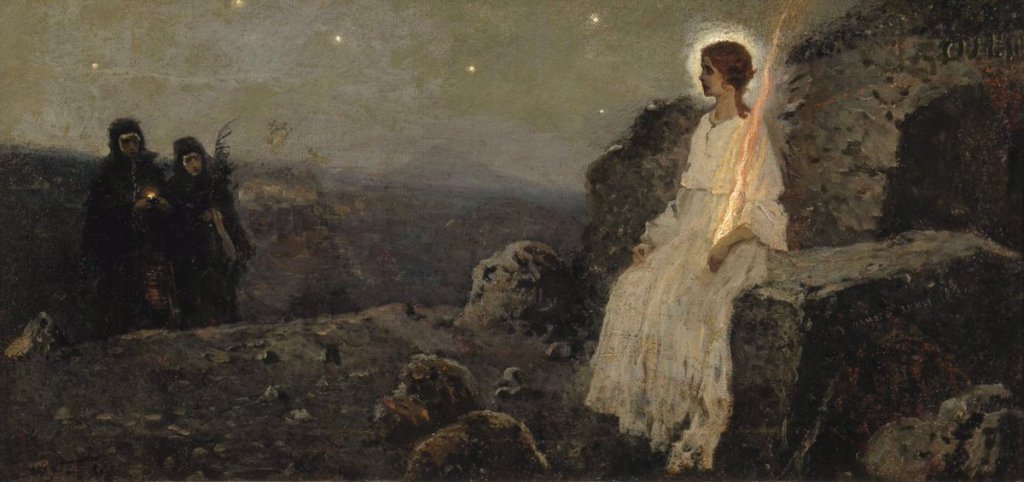
Artwork: Mikhail Nesterov, The Empty Tomb, 1889.

He Means It

The greatest among you will be your servant. All who exalt themselves will be humbled, and all who humble themselves will be exalted. Matthew 23.11-12, NRSV

Servanthood –  such a beautiful ideal, such a lofty goal. Jesus exemplified the life of servanthood and he calls us to live as he did. I pretty sure that all of us agree with the principle of servanthood, but when push comes to shove and it gets down to the specifics, I wonder how many of us take it seriously? Servanthood – oh that’s for the other guy; that’s for the minister, as if there is some kind of exception for the laity. “You mean, with my position, my salary, my skill set, I have to be a servant to that so-and-so? You mean I have to wait upon others when it should be me that is waited on? I have to pick up after everybody?” Yup! That’s what Jesus means and he means what he says, whether we like it or not. Make no mistake – Jesus is not talking about high-flying, glamorous,  prestigious jobs. He’s talking about jobs that are as menial as they come – sometimes messy, sometimes thankless – like washing a shopping cart person’s filthy feet.

Pride is usually what gets in the way – it’s the huge barrier reef with the great white sharks of our egos swimming around it, ready at all times to devour any notion of seeing others as worthy at our expense. Our human nature makes us think we are just a little bit above everyone else and we should be treated that way. Instead of seeing what we can do for others, we expect others to do things for us. Scripture has lots of warnings that pride is deceptive and dangerous: for those who exult themselves will be humbled by God himself. I love the  way Obadiah says it: “Your proud heart has deceived you, you that live in the clefts of the rock, whose dwelling is in the heights. You say in your heart, ‘Who will bring me down to the ground?’ Though you soar aloft like the eagle, though your nest is set among the stars, from there I will bring you down, says the Lord.” (Obadiah, 3,4, NRSV) If you think you are high above everyone else, invincible, set among the stars and too good for servanthood – watch out!

Greatness in the Kingdom comes in serving, so check your ego and choose to live as a humble servant of Jesus Christ. As Jesus said, he came not to be served, but to serve. He means it! And if it’s good enough for God, it’s certainly more than good enough for you.

The Reluctant Preacher

When you're down and troubled // And you need some loving care // And nothing, nothing is going right // Close your eyes and think of me // And soon I will be there // To brighten up even your darkest night. // You just call out my name // and you know wherever I am // I'll come running // To see you again // Winter, spring, summer or fall // All you have to do is call // And I'll be there // You've got a friend.   
“You’ve Got a Friend” by Carol King, 1971

The Book of Jonah is a whale of a tale – pun intended. Sometimes though, we get so caught up in the details of the fish that we miss the meat of the message. Jesus spoke of Jonah as a real person, and I think this reluctant Old Testament preacher has a couple of things to teach us.

We cannot hide from God. It is possible to run from God – I did it for 40 plus years. It is impossible to outrun him though. Jonah didn’t fool God for a New York minute by boarding that ship to Tarshish and hiding in its lowest levels. God was right there. In trying to escape his calling, Jonah brought trouble upon himself and others. Those poor sailors were thrown into a monstruous storm and while they valiantly fought to save him, they probably were still burdened by guilt when they had to toss Jonah overboard.

God gives second chances. If we ask for forgiveness, God will give us another shot at things. Jonah was saved when he called for help – “Waters have grasped me to the point of death; the deep surrounds me. Seaweed is wrapped around my head at the base of the undersea mountains. I have sunk down to the underworld; its bars held me with no end in sight. But you brought me out of the pit.” (2.5-6, CEB) That was a pretty deep place to be drowning in and yet, God rescued him. We are never beyond the hope of a new start with God’s help.

We may be unhappy with God’s will. Jonah preached an eight word sermon: “Forty days more and Nineveh will be overthrown.” His sermon worked! The entire city of 120,000 people repented. Yet, Jonah had the chutzpah to be disappointed and unhappy. He got angry! Many of us pray for God’s will expecting to be thrilled about it, but danger, danger, Will Robinson. Where did we ever get that idea from? God’s will is unlikely to make us happy, because to obey God’s will requires us sacrifice our will and that is never easy to do.

We all have a bit of Jonah in us – some more than others – but at the end of the day, we are Jonah on more occasions than we might care to admit. Like Jonah, we often find out the hard way that we can never get away from God, no matter how long, how hard, and  how fast we run trying to escape the calling and responsibility that he places on us. Save your energy instead for doing God’s will, whether you like it or not at the moment. In the end, you’ll be glad that you did.

Just as Jonah was in the whale’s belly for three days and three nights, so the Human One will be in the heart of the earth for three days and three nights. (Matthew 12.40, CEB)

  • Artwork: Jonah, lunette painting in the Cybo-Soderini Chapel in Santa Maria del Popolo by Pieter van Lint, c. 1636. Inscription on the tablet: “Tollite me, et [mittite in mare]” which means “Pick me up and throw me into the sea”

PRAY

If there’s one thing I want you to do especially for me // Then it’s something that everybody needs…// Each night before you go to bed, my baby, // Whisper a little prayer for me, my baby, And tell all the stars above – This is dedicated to the one I love.

Dedicated to the One I Love, written by Lowman Pauling and Ralp Bass, 1957

I haven’t posted in what seems like forever – I think September of 2021 was the last time. Taking a stab at self-defense, the fall of 2021 into the spring of 2022 was a whirlwind of busyness and distraction as I was juggling three jobs – property manager for my home church, managing our food panty and serving, albeit part time, the good people of a local church as their interim minister. It was crazy, exhausting, and at times, maddeningly frustrating, as I struggled to write a sermon on Saturday, lead worship on Sunday, spend that afternoon writing next Sunday’s service – it was due Monday to meet bulletin production deadlines imposed by the administrative requirements dictated by a limited budget. Then Monday morning rolled around and…well, I hope you get the picture. It was a blessed time. No, really….it truly was.

But that is all changing. I have resigned from my role as a sexton and food pantry director to accept a full time position as the interim minister of a church around the corner from my home. God has asked me to help a congregation whose long time pastor recently departed. It is a congregation in mourning and one that is very anxious as it navigates the uncertainties that comes from transition. I am excited to embrace the tasks that  await and I am under no illusion that the challenges are very real and very difficult. But since it is God that has asked, then I know that God is in this and that’s the only comfort I need.

I suspect that too many of us often lose sight of God’s presence as we struggle with the uncertainties and pain that is part of our daily lives. The pandemic has been a very difficult period for all of us and the clergy have not gone unscathed: the pastorate is hurting as well. It was in that context that I delivered the homily that follows to a gathering of the ministers and elders from a group of churches in my neck of the woods. And while my audience may have been the ordained, in a manner of speaking, all disciples of Christ are “ordained,” so I thought I’d share with all of you what I had to offer to them…

~

At a recent ordination service, while we were waiting for things to get underway, one of our pastors shared a story with a few of us from his ordination. As hands were laid on him, the minister at the time kept pressing down on his shoulders to impress upon him the weight of what being ordained felt like – the understanding that we are being, like the sailors of old, tied to the mast, so as not to be washed overboard by the raging seas of life in which we pastors embark daily.

And those seas are raging. Eugene Peterson, in Working the Angles, describes this in terms of wreckage – wrecked bodies, wrecked families, wrecked marriages, wrecked friendships and so on. It is into and through that wreckage that our ordination calls us to step – to walk into the ruins and witness to the gospel of Jesus Christ.

I might be the newbie on the block, but I have lived in the back stair cases of the house long enough to appreciate how difficult and exhausting this work can be. Pastoral burnout is at record levels. If I remember correctly, it was in acknowledgement of this, that the Lilly folks created grants that underwrote sabbaticals this past year.

Jeremiah knew fatigue. Jeremiah knew burnout. Early in his career, he wants to throw in the towel and walk away from the wreckage that surrounded him and the persecutions that challenged him: Lord, he prays- “So drag them away, and butcher them like sheep. Prepare them for the slaughterhouse” (12:3, CEB). That is one tired, angry and burned out dude!

Hey Jeremiah, I ordained you, the Lord tells him. Before I created you in the womb, I picked you out, set you apart as a prophet to the nations. I anointed you to run with horses, and you are tired out by the foot runners? Are you going to quit when you discover that there is more to this work than a 9-5, dinner and television life style? It’s tough stuff that I ordained you to do, but do not forget you are an iron pillar and bronze wall because I am with you. You can do it with me at your side.

I have no idea how long it took Jeremiah to respond, but we know he did – “From the thirteenth year of Judah’s King Josiah, Amon’s son, to this very day—twenty-three years—the Lord’s word has come to me. I have delivered it to you repeatedly, although you wouldn’t listen” (25:3, CEB). He sticks to it – he is still at it for 23 years, in spite of death threats, moments of despair and discouragement, being whipped in a stockade, thrown into a well, and daily ridiculed, his message ignored because he doesn’t buy into the lifestyle, the fads and whims of the secular life that was rotting away around him.

How did he find the courage? How did he find the deep abiding faith to live fully into what God was calling him to do? How did he meet the challenge to run with horses? Persistence. Every morning, every afternoon, every evening he awaited to hear the word of the Lord. He prayed.

Prayer was the action that Jeremiah rooted his entire day with. For 23 years he prayed to hear the word of the Lord and for 23 years, he heard it. He heard it because for Jeremiah, it wasn’t faith in prayer – it was faith in God. It wasn’t a technique that he used as a way to get things done: his were not prayers of oops, wow, gimme and thanks. Prayer for Jeremiah was a way of coming to God in faith and trust. Scared, worn out, lonely, hurt angry, discouraged, Jeremiah came to prayer with the desire to listen to God firsthand, to speak to God first hand because God had primacy in and over his life.

But what did Jeremiah’s prayer look like? How did he pray? I am indebted to a section from Peterson’s work, Run with the Horses, for his terrific exposition of chapter 15 of Jeremiah for the following.

Jeremiah prays his fear – You understand, Lord!  Remember me and act on my behalf…(15:15, CEB) You got me into this stuff and I’m counting on you to see me through it.

He prays his loneliness – When your words turned up, I feasted on them; and they became my joy, the delight of my heart, because I belong to you,  Lord God of heavenly forces. I didn’t join the festive occasions; I took no delight in them. I sat alone because your hand was upon me (15:16-17, CEB). Jeremiah lived the truth – he delighted in receiving God’s word but when he turned around, no one else was there – they were on the golf course, at the shopping mall, watching television.

He prays his hurt – Why am I always in pain? Why is my wound incurable, so far beyond healing? (15:18a, CEB) He hurts because he cares – he cares about the flock that God has charged him with and their refusal to listen to the love of God that he preaches every Sunday, hurts.

He prays his anger – You have become for me as unreliable as a spring gone dry! (15:18b, CEB) The man who once preached that God was “the spring of living water” (2.13, CEB), now accuses him of deceit. You didn’t walk the talk, God.

We all have our moments of doubt, when the pits of despair seem insurmountable, when the dark nights of the soul is so black we can’t see our own fingers in front of us. Dealing with Peterson’s wreckage day after day is not an easy thing – we are only human. Pray your anger, pray your fear, pray your hurt, pray your loneliness. Pray your love. We need to hear and rehear God’s promises, made to us in our ordinations, over and over again. Simply carrying around some memory verses in our pockets isn’t enough. We need that daily encounter that comes in prayer. The world is changing all around us – changing faster and faster it seems – but God’s word never changes. In prayer, we encounter the word that renews and reaffirms and my prayer tonight is that Jeremiah’s example may be one that guides all of us as we try to run with the horses. Pray.

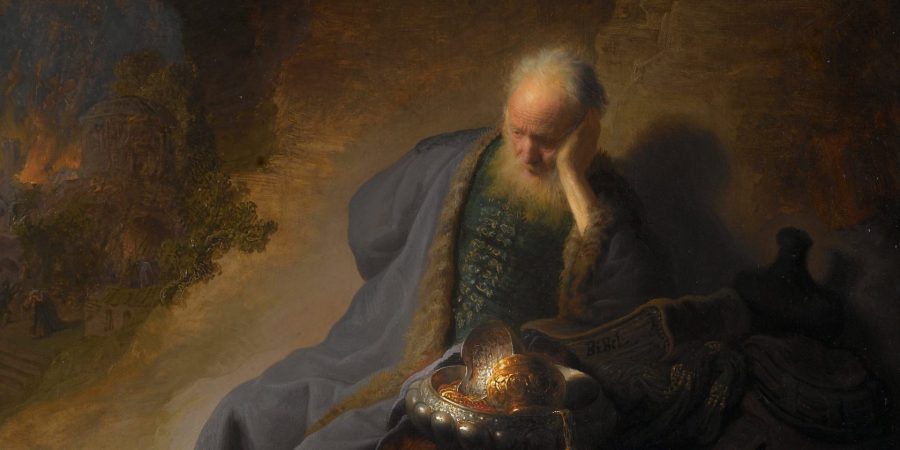
Artwork: “Jeremiah Lamenting the Destruction of Jerusalem,” Rembrandt, 1603, Public Domain
Teach Us to Pray

I was born // I was born to sing for you // I didn’t have a choice but to lift you up // And sing whatever song you wanted me to // I give you back my voice // From the womb my first cry, it was a joyful noise …

from the song  “Magnificent,” Bono & The Edge (Guitarist), May 2009

The disciples in Luke’s gospel confronts us with one of the extraordinary weaknesses in most of our lives – the need to pray. Life is a messy, busy affair. It is easy to fall victim to its distractions whether they be sports, alcohol and drugs, material consumption and its never ending shopping sprees, the allure of making it up the corporate ladder and so on. We are people that are always moving our buckets to the fountains of our efforts instead of to the springs of God’s grace and in the end, we never just “be”: instead we invest our identities in our own accomplishments ending up with so much harness, we can’t see the horse. We need prayer.

Jesus was praying in a certain place. When he had finished, one of his disciples said, ‘Lord, teach us to pray.”

Our intrepid crew of 12 didn’t get things right very often, but here is one time I think they really nailed it. The disciples had repeatedly witnessed Jesus in prayer and recognized that they were in the presence of  one who knew the reality of prayer and knew the deep difference it made in life. They also realized how far removed they were from what they were witnessing. They were coming to see how significant and how central prayer needed to be in their lives and that alas, it was not so.

First, they knew Jesus to be a man of prayer and for Jesus, prayer was the way of life, a way of continual communication with God, his Father. They knew that sometimes he prayed all night long. There is a popular conception of Jesus being a social activist, placing emphasis on deeds, engaging in revolutionary action. All true. But Jesus was not a political activist that relied on human power to accomplish his purpose. He was at first and always, a man of prayer whose power came from those prayers. His prayers showed the necessity of prayer and demonstrated that he could do nothing without God and by extension, that we can do nothing without Christ. Do you remember the scene in Mark 9 when the our intrepid twelve failed to cast out the demon in the epileptic boy? “Why couldn’t we throw this spirit out?” they asked Jesus. Jesus answered: “throwing this kind of spirit out requires prayer.” We cannot conquer the moral and spiritual crises of our day by human effort. As Zechariah learned during the rebuilding of the temple, it would be accomplished “Neither by power, nor by strength, but by my spirit, says the Lord of heavenly forces.” We need to heed that message as well. No one can be brought to new life in Christ without prayer.

A second behavior the disciples witnessed was that from the beginning, Jesus prayed before every major crisis that he faced: he prayed at his baptism, at the beginning of his public ministry and he prayed when the Galileans wanted to make him king. He went into the wilderness to pray and prayed all night before choosing the 12. He prayed at the Transfiguration and he prayed in Gethsemane on his way to his death.  Prayer is the activity that should be front and center when we are faced with major decisions and problems. We need to pray in sickness as well as in health.

A third thing they saw was that Jesus prayed alone. And in case you missed him doing so, he taught us that as well – “Whenever you go to pray, go into your closet and pray in private and the Father who sees in private will reward you.…” Solitude is important – it’s not out of shame or embarrassment, but it’s to avoid interruptions. We gather in worship and pray – it is audible and corporate, but being alone with God in prayer is the ultimate test for the reality of prayer in our lives.

Finally, the fourth thing they noticed is how Jesus continually expressed his gratitude for the blessings in his life. He thanked God for hearing him when Lazarus was raised, he gave thanks for the loaf and fish before breaking it and feeding 5 thousand. Why do Christians need to pray asks question # 116 in the Heidelberg Catechism? “Because prayer is the chief part of thankfulness which God requires of us and because God gives His grace and Holy Spirit only to those who earnestly and without ceasing ask them of Him, and render thanks unto Him for them”

“I was born to sing, I was born to sing for you…” Lord teach us to pray

Artwork: Christ’s Prayer on Oelber, by Carlo Crivelli, 1468

PRE-RECORDED

I listen to the wind, To the wind of my soul // Where I’ll end up, well, I think // Only God really knows…

The Wind, Cat Stevens, 1971

Over the past few months, several readers have posed a variation on the following question: “I looked up ‘Reformed’ in the encyclopedia. It said it was a branch of Christianity that strongly emphasized predestination. If, as we read in Luke 14, that all are invited to the table, how can we believe in predestination?” As the old Saturday Night Live skit would say – discuss! So let me share with you a conversation that I had with my daughter on this often sticky wicket.

Well I must say Skylar, that you raise a question that many before you, and many that will come after you, have puzzled over as well. Admittedly, this can be a difficult doctrine to understand, perhaps even one that provokes anger in some, but the short answer to your question is yes, we do believe it. I hope that I can help you to understand why, by helping you better understand what it means. The term “predestination’ otherwise known as the doctrine of election, originates in the work of St. Augustine, who was the Bishop of Hippo in North Africa from 396 C.E. until his death in 430 C.E. It was John Calvin who more fully developed Augustine’s thoughts in his seminal work, The Institutes of the Christian Religion.We call predestination, God’s eternal decree, by which he compacted with himself what he willed to become of each man. For all are not in equal condtion; rather, eternal life is foreordained for some, eternal damnation for others. Therefore, as any man has been created to one or the other of these ends, we speak of him as predestined to life or death” (Institutes of Christian Religion :Two Volumes, ed. John Thomas MacNeill, trans. Ford Lewis Battles, II.21.5).

I will admit that the notion of election has always created some tension within me at times as well, and I know that it is one that continues to have its friction and tension points with our current culture that firmly believes, in Babel like fashion, that we can be whatever we decide to be. As Calvin says himself: “A baffling question this seems to many. For they think nothing more inconsistent than that out of the common multitude of men some should be predestined to salvation, others to destruction.” (Institutes, II.21.1) Baffling might be a bit of an understatement.

All of this is very interesting to consider given that the concept of election has its roots in scripture and is not new to Augustine or Calvin or anyone else, for that matter. Think of that foundational teaching that we in the Reformed tradition adhere to: ‘sola scriptura,’ by scripture alone. Augustine and Calvin did not simply dream this doctrine up in a self-righteous undertaking. There are countless places in scripture where we meet elements of election: Cain’s offering vs Abel’s; Isaac over Ishmael, Jacob and Esau; David over Saul and so forth. The psalms and the prophets are rfie with language noting God’s choice of some over others: e.g. 33.12; 65.4; 105.6, 42-43 to cite a few).

Perhaps the classic articulation of election is witnessed in the book of John, chapter six, when Jesus states “No one can come to me unless drawn by the Father who sent me; and I will raise that person up on the last day…” Skylar, please, please take note of what Jesus says – ‘‘unless drawn by the Father.” Because God loves us first, it is only through the grace of God that we are drawn to God to begin with. Paul makes note of this in his letter to the Ephesians: “…just as he chose us in Christ before the foundation of the world to be holy and blameless before him in love. He destined us for adoption as his children through Jesus Christ, according to the good pleasure of his will..” (Ephesians 1.4-5, NRSV). Our status before God and our relationship with God is utterly and completely dependent upon the grace of God and God’s pre-determining action. We have nothing whatsoever to do with it.

As children of the enlightenment, post enlightenment, modern, postmodern – whatever label you might want to place on the philosophical influences that have shaped our western culture and worldviews, we think and conclude that we are. The notion that the self cannot determine its fate, especially given said fate was set prior to being formed in the womb, is a concept that not only grates against everything we have been taught and indoctrinated with regarding merit and work, it is one that is impossible to get our limited capacities in a position to understand. In the 139th psalm, the writer sums this up pretty well for me and I hope this helps you as well:

…O Lord, you have searched me and known me. You know when I sit down and when I rise up; you discern my thoughts from far away. You search out my path and my lying down, and are acquainted with all my ways. Even before a word is on my tongue, O Lord, you know it completely. You hem me in, behind and before, and lay your hand upon me. Such knowledge is too wonderful for me; it is so high that I cannot attain it… For it was you who formed my inward parts; you knit me together in my mother’s womb…My frame was not hidden from you, when I was being made in secret, intricately woven in the depths of the earth. Your eyes beheld my unformed substance. In your book were written all the days that were formed for me, when none of them as yet existed. How weighty to me are your thoughts, O God! How vast is the sum of them!

Scripture is quite clear – God has known us before we are and written all of our days in God’s book before our days were upon us. Yes, we believe in predestination because God tells us that is it so.

Feet in Your Shoes

You have brains in your head// You have feet in your shoes// You can steer yourself any direction you choose// You’re on your own// And you know what you know// And YOU are the one who’ll decide where to go//…So…be your name Buxbaum or Bixby or Bray // or Mordecai Ali Van Allen O’Shea,// you’re off to Great Places // Today is your day// Your mountain is waiting // So…get on your way!

Oh The Places You Will Go, Dr. Seuss

I recently posted a piece regarding identity within the context of Matthew 28, aka, the Great Commision(See Route 66, March 7, 2021). I want to take another run at something else that I found arresting while dwelling in the words found there.

There is a question that  begins in nursery school and morphs into one that chases us almost all of our lives – “What do you do?” What do you do is one of the first questions that comes up at any cocktail or dinner party when we meet new folks. What do you do? Not who are you, but what do you do? I’m a lawyer, I’m a teacher, I’m dog catcher, a plumber, baker and a candle stick maker. We claim our identity and that of others in a job description as if that is the sum total of who we are.

Easter is upon us and as we prepare to bask in its glow, the question of what do we do and how that doing reflects who we are, become very critical questions for us to reconsider in the light of the risen Christ who has called us to follow him. The call of Christ is a call to be something more profound than what our secular career choices claim to say about our identity and it is a challenge to the subconscious desires that drive us to believe that the good life is found in another genuflection at the altar of the shopping mall.

We are called to an identity that is something far greater and enduring.  Jesus calls us to be the people of God.

Now the eleven disciples went to Galilee, to the mountain where Jesus told them to go. When they saw him, they worshipped him, but some doubted. Jesus came near and spoke to them, “I’ve received all authority in heaven and on earth. Therefore, go and make disciples of all nations, baptizing them in the name of the Father and of the Son and of the Holy Spirit, teaching them to obey everything that I’ve commanded you. Look, I myself will be with you every day until the end of this present age.”  

Perhaps you noticed this: Now the eleven disciples went to Galilee

Eleven is an odd number- odd literally and symbolically. It is not the perfect twelve, nor is it the typical biblical reference of seven for completion and or wholeness. It’s incomplete; it’s less than perfect; it’s flawed or blemished in some fashion. As my late father might say, there is a hitch in its giddy up. Eleven disciples – Matthew has Jesus sending an imperfect bunch into the world to do his perfect work.

But it gets more interesting…

They worshipped him, but some doubted – Some doubted. We really don’t know if they all doubted or just a few, the Greek is ambiguous at best. But how can they worship Christ if they have doubts? And how could any of these eleven, having just seen the risen Jesus, doubted at all? I find the notion that the disciples who worship and yet doubted as evangelical and deeply profound from a theological and spiritual level.

Just as Jesus was led up by the Spirit into the wilderness to be tempted by the devil, so we Christians live in a war between the spirit of worship and the spirit of doubt: the spirit of worship as God’s people and the spirit of the world’s people, Amazon Prime. Jesus doesn’t correct, exorcise or otherwise attack this doubt, choosing instead, to quietly ignore it as if it is normal. By his great commission, Jesus is teaching that the disciples will win their war on doubt by following his command. Albert Schweitzer once said – “Follow him and you will know Him.”  Doubt is part of our human imperfections this side of the resurrection and Matthew’s good news is that doubt and worship can, and do, coexist. Doubting worshippers are Jesus’ material in mission – Blessed are the poor in spirit, for theirs is the kingdom of heaven – blessed are those who worship the risen Lord and who still struggle with their doubt.

And it is these imperfect people – you and I – that Christ promises to always be with. The great commission – the great commission to be – to be disciples of Jesus, united to him in the waters of baptism by the power of the Spirit, making us the very people of God.

“You have feet in your shoes for the direction you choose.” So, whether you chose to be a teacher, a custodian, a butcher, a baker, or candle stick maker, do whatever it is that you chose to do as the person of God that you are. Bring the light, love and truth of Christ to everyone that you meet, in everything you say, and in everything that you are. Go and be.

Mirror, mirror, where's the crystal palace? 
But I only can see myself 
Skating around the truth who I am. 

Winter, Tori Amos

Route 66

If you ever plan to motor west // Travel my way, take the highway that is best // Get your kicks on route sixty-six // It winds from Chicago to LA // More than two thousand miles all the way. // Get your kicks on route sixty-six // Now you go through saint looey // Joplin, Missouri // and Oklahoma City is mighty pretty // You see Amarillo // Gallup,  New Mexico // Flagstaff, Arizona // Don’t forget Winona // Kingman, Barstow, San Bernardino. // Won’t you get hip to this timely tip

Route 66, Booby Troup, 1946

Recently, as I marked another trip around the sun, my wife, somewhat sardonically, noted that I had transitioned from being the speed limit to that of a US Highway – Route 66. Funny, lady my Beth.

In this case, I could find some solace in knowing that this is, and has been, a highway memorialized in song by Bobby Troup in 1946 and covered by some of our greatest artists for many decades. Great song…But that and a dollar will get me a plain bagel in the morning.

It did get me thinking about routes, roadways, roads and all of the iterations of meaning they can take. In particular, a route can be a means of access – the route to the bagel store. As a transitive verb, route can mean a diversion in a specified direction. Or it can convey a ‘way’ or ‘course,’ as in the road to peace – or the road to life.

Where have I heard that before?

“Don’t be troubled. Trust in God. Trust also in me. My Father’s house has room to spare. If that weren’t the case, would I have told you that I’m going to prepare a place for you? When I go to prepare a place for you, I will return and take you to be with me so that where I am you will be too. You know the way to the place I’m going.” Thomas asked, “Lord, we don’t know where you are going. How can we know the way?” Jesus answered, “I am the way, the truth, and the life. No one comes to the Father except through me.

Jesus is the route we follow to reach the Father and he has invited us to be the routes to him.

In Matthew 28 we read:  Jesus came near and spoke to them, “I’ve received all authority in heaven and on earth. Therefore, go and make disciples of all nations, baptizing them in the name of the Father and of the Son and of the Holy Spirit, teaching them to obey everything that I’ve commanded you. Look, I myself will be with you every day until the end of this present age.”

This is the great commission and it begins with an astonishing claim:

All authority has been given to me, so go out there, baptize and disciple.

Jesus has been given universal authority and the disciples have now been given universal marching orders to bring all nations to the school of Jesus. Can you hear him? I keep getting the picture of the platoon leader exhorting the troops to get up, move out. It’s time to disciple; it’s time to baptize; it’s time to teach. But this is much more than an order to get moving. The great commission is an invitation to be disciples of Jesus, united to him in the waters of baptism by the power of the Spirit, and part of the God’s great work of renewal. The great commission is about becoming the gathered people of God so we can  do these things for the life of the world.

Baptize

It’s Christian evangelism. The thunderclap shattering the grave on Easter morning was not simply an announcement that your ticket to heaven was getting punched. It was not about a flight from the decaying world so you can flit around on fluffy clouds having a private party somewhere far away. No. It was the dawn of new creation, the renewal of all things. In baptism, we are joined with Jesus by the power of the Spirit and through our baptism, God has extended an invitation to us to have the cosmic renewal that was begun in Jesus, happen in our lives. We also are to extend that invitation.

Disciple

Most importantly, being part of Team Jesus is the means by which cosmic renewal happens through our lives as well. It happens when our character, our very ethic, is clothed in the values of the kingdom, when our way of being is an effortless and automatic extension of sincere love of other that brings justice to the disenfranchised, healing for the sick, and comfort for those who mourn. That’s being a disciple and the pathway for the discipleship of others. So get out out there and invite someone to travel with you as their route to the only road that matters.

Heartburn

When we were strangers // I watched you from afar // When we were lovers // I loved you with all my heart // But now it’s gettin’ late // And the moon is climbin’ high // I want to celebrate // See it shinin’ in your eye // Because I’m still in love with you // I want to see you dance again // Because I’m still in love with you // On this harvest moon

Harvest Moon, Neil Young, 1992

Harvest moons. The moon that is so named for shining ever so brightly in the season of waning fertility, the crops have been harvested and the long, dark winter is about to set in. Neil Young has succinctly captured something about life, love, and marriage that resonates with me. It is a picture of mature love that can flourish in marriage. But more than half the time, those “I do’s” are lost in a sea of despair and recriminations that end in divorce. I was one.

1 Corinthians 7.10-16 gives me heartburn: and in varying degrees, so does Mark 10, Matthew 5 and 19, Luke 16, and Roman 7.1-3. To be condemned to a lifetime of misery that a wrong marriage brings strikes me as antithetical to our initial directive to be fruitful and multiply. The fact remains, that life in a marriage gone bad is anything but fruitful. It is a life that has died in more ways than one.   

Beth and I knew this first hand. We both were in hellish, dead end marriages when we met. We were blessed by God to have found each other after many years of near misses, and yet we seem to stand in condemnation of the gospel: “And I say to you, whoever divorces his wife, except for unchastity, and marries another commits adultery”(Matt. 19.9, NRSV). We are adulterers even though we never cheated in the conventional understanding of that word. As I said – heartburn.

In The Moral Vision of the New Testament, Richard Hays has done some notable work with this subject that has helped me a bit and for those that might be having a similar case of indigestion, I want to share what I found.

Hays speaks of marriage within the framework of cross, community and new creation, a perspective that brings the “logic of the New Testament’s rigorous teaching against divorce comes clearly into focus” (p. 376). The covenant of marriage is, as Hays points, one that is rooted in the love that goes beyond the “rush of mutual joy, beyond the romance of “warm spring evenings and roses,” and should be rooted rather, in the love of the cross” (p.375). He goes on to critique the ease with which divorce occurs in our individualistic and therapeutic culture. It is very serious business, this covenanting stuff and I think Hays’ critique is worthy. Yes, marriage is hard. Perhaps our premarital counseling skills need some improving. Just sayin’….

So while I stewed, and as the acid of guilt, anger and frustration was rising into my throat, I was grateful that Hays, citing the canonical witness – “I Paul, not the Lord” – notes this: “I would take the New Testament’s hermeneutical process of discerning exceptions to the rule of Jesus’ teaching to be instructive about the process of moral deliberation in the church on this matter” (p.372). Ok then…there’s hope?

As someone who escaped (and I mean that in every sense of the word) a 13 year marriage of physical abuse and psychological devastation, it’s good to see the possibility of a scripturally grounded hermeneutic which acknowledges circumstances that, at least in my limited view, are antithetical to love and life and the very objective of marriage. I cannot accept that ‘better or worse’ means putting your life at risk and if that’s what Jesus meant, then I want my “Job” hearing.

So, having risen from the smoky ruins of hell to now be in a marriage that is long past warm spring evenings; a marriage that loves nothing better than doing the evening dishes together; a marriage that has endured the loss of a child, the loss of our house, the loss of every penny, the loss of my freedom and then some; a marriage that has produced a beautiful daughter who is following the Lord’s footsteps as she blossoms into adulthood; a marriage rooted in the practice of love that testifies to the presence and love of God. If that is a marriage that makes me an adulterer, then guilty as charged and I will sing God’s praise as I dance with the love of my life under the harvest moon.

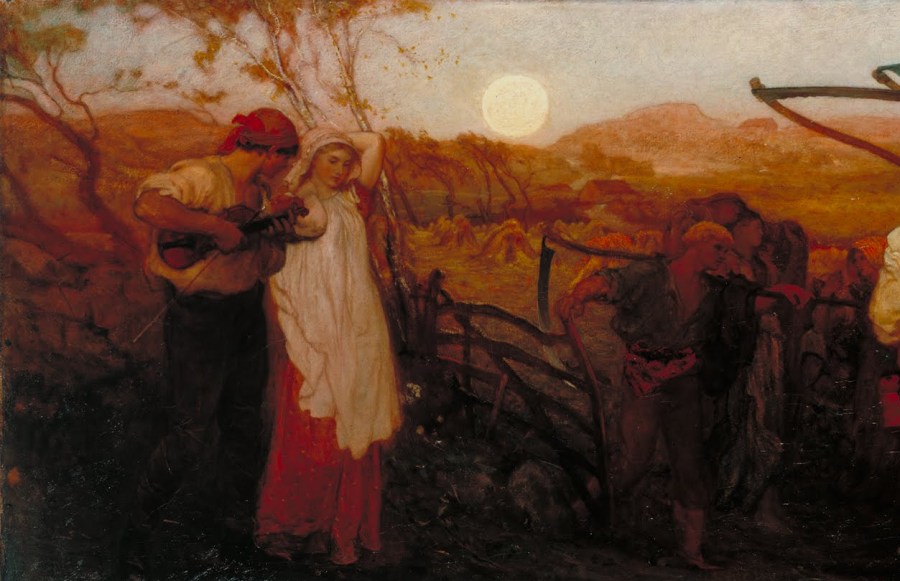
Artwork: Harvest Moon, George Hemming Mason, 1872

Loosen My Lips

I try to sing this song // I, I try to stand up // But I can’t find my feet // I try, I try to speak up // But only in you I’m complete // Gloria, in te domine, Gloria, exultate // Gloria, Gloria // Oh Lord, loosen my lips

Gloria, U2, 1981

With Lent approaching, I want to suggest that one way we can examine our daily habits is within the context of Paul’s exhortation to the church in Thessalonica.

Brothers and sisters, we ask you to respect those who are working with you, leading you, and instructing you.Think of them highly with love because of their work. Live in peace with each other. Brothers and sisters, we urge you to warn those who are disorderly. Comfort the discouraged. Help the weak. Be patient with everyone. Make sure no one repays a wrong with a wrong, but always pursue the good for each other and everyone else. Rejoice always. Pray continually. Give thanks in every situation because this is God’s will for you in Christ Jesus. Don’t suppress the Spirit. Don’t brush off Spirit-inspired messages, but examine everything carefully and hang on to what is good. Avoid every kind of evil.  (1 Thessalonians 5.12- 22, CEB)

As infants, we begin to learn our mother tongue without any formal grammatical instruction. As one person has observed, by the time we are three or four, we are putting nouns, verbs and prepositions together in intricate sentences much like baby birds that learn to fly without studying aerodynamics. The same is true of a “mother tongue of behavior.” We watch how those in our personal lives and community behave and model our behavior accordingly.

Learning to speak Christian and Christian behavior is no different. In this passage, Paul is giving us some of the guidelines that we must incorporate if we are ever to be fluent. They are not “rules” or “laws” per se, but the ways in which the Holy Spirit leads the greater community in behaviors that contribute to our Christian fluency. To be Christian fluent is to have a responsibility to look out for the needs of others; to encourage, to give comfort, to assist the weak and to actively go after that which is good for all. And like any new behavior, it is best formed by practicing new habits: the habits of rejoicing always, praying continually and giving thanks in all circumstances.

Gloria, in te domine, Gloria, exultate – Glory in You, Lord / Glory, exalt [Him]” Lord, loosen my lips

Rejoice always: perhaps easier said than done, but we try. Give thanks: we know that’s we should do and how we should live. Pray continually: I suspect that’s a bit harder challenge. Am I supposed to go through life on my knees with my hands clasped and eyes closed in a form of self-imposed blindness? No, that is not what the God of life wants us to do and nor is Paul suggesting a posture. Paul is talking about a guiding behavorial principle. We are supposed to be people who twenty-four hours a day, seven days a week, three hundred and sixty five days a year, are open, receptive and responsive to what God is doing in our lives and we are to do everything we can to keep the lines of communication open.

Gloria, in te domine, Gloria, exultate – Glory in You, Lord / Glory, exalt [Him]” Lord, loosen my lips.

Our prayer is continual when we believe that God  is with us all the time, trusting in God’s love and care, knowing that God is working for good in our lives, regardless of what is happening. Continual prayer is not about delivering complex, lengthy, and eloquent dissertations to the Lord every minute of the day. Continual prayer happens in the short conversations, the moments however brief, when we thank God for the many blessings that surround us: the beauty of a new day, the food on our tables, the warmth of our homes, the hands held, the hugs given and the hugs received. Continual prayer happens when we give God credit for the nice surprises and the times of tears, asking God for guidance when we feel confused or lost. Continual prayer happens when we recognize and pursue the needs of the stranger, widow, and the orphan.

Gloria, in te domine, Gloria, exultate – Glory in You, Lord / Glory, exalt [Him]”

Notice that Paul has placed continual prayer between rejoicing and thanksgiving. Continual prayer is the bridge between the two, the essential bridge that unites the twin poles of Christian living. When we pray continually, realizing God’s presence, we can rejoice always and give thanks in all circumstances. Pray continually- an important step in becoming fluent in Christian and most importantly, it is God’s will for you in Jesus Christ.

Gloria, in te domine, Gloria, exultate – Glory in You, Lord / Glory, exalt [Him]” Lord, loosen my lips

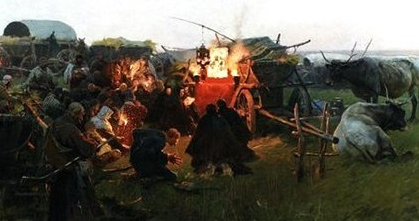
Artwork: Brandt, Jozef. Prayer in the Steppe, from Art in the Christian Tradition, a project of the Vanderbilt Divinity Library, Nashville, TN. http://diglib.library.vanderbilt.edu/act-imagelink.pl?RC=56475 [retrieved February 5, 2021]. Original source: https://commons.wikimedia.org/wiki/File:Brandt_Prayer_in_the_steppe.jpg