“Imagine no possessions// I wonder if you can// No need for greed or hunger// A brotherhood of man// Imagine all the people sharing all the world, you// You may say I’m a dreamer// But I’m not the only one// I hope someday you’ll join us// And the world will be as one.”
Imagine, John Lennon
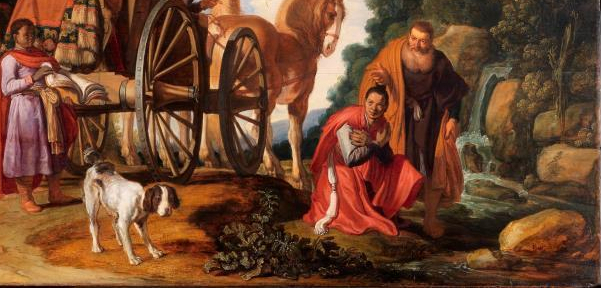
Cover art: Baptism of the Eunuch, Pieter Lastman, 1623
Then an angel of the Lord spoke to Philip saying: “Rise up and go along south on the way going down from Jerusalem to Gaza.” This is a desert. 27 And rising up he went. And behold a man, an Ethiopian eunuch, a power of [the] Candace, queen of the Ethiopians, in charge of all her treasure. He had come to Jerusalem to worship 28 and he was returning; sitting in his chariot, he was reading the prophet Isaiah.29Then the Spirit said to Philip, “Go up and join this chariot” 30 Philip ran up and heard him reading the prophet Isaiah. He asked, “Do you understand what you are reading?” 31And he said, “How can I, unless someone guides me?” And he invited Philip to come up and sit with him.’ 32 Now the passage of the scripture which he was reading was this: “As a sheep led to the slaughter or a lamb before its shearer is dumb, so he opens not his mouth: 33 In his humiliation justice was denied him. Who can describe his generation? For his life is taken up from the earth.” 34 And the eunuch said to Philip, “About whom, pray, does the prophet say this, about himself or about someone else?”35 Then Philip opened his mouth, and beginning with this scripture he told him the good news of Jesus.36 And as they went along the road they came to some water, and the eunuch said, “See, here is water! What is to prevent my being baptized?” 38 And he commanded the chariot to stop, and they both went down into the water, Philip and the eunuch, and he baptized him. 39 And when they came up out of the water, the Spirit of the Lord caught up Philip; and the eunuch saw him no more, and went on his way rejoicing. 40 But Philip was found at Azotus, and passing on he preached the gospel to all the towns till he came to Caesarea. (Acts 8.26-40, translation is by the author)
Philip and the Ethiopian eunuch is one of my favorites from the book of the Acts of the Apostles. It is a rich story of a biblical character that embodies the multifaceted differences of race, class, gender, religion and sexuality: differences that are the source of a great deal of discomfort, division and debate 2,000 years after Luke wrote about them.
I believe it was Rev. Dr. Martin Luther King Jr. who noted that Sunday morning is the most segregated hour in America. We are Easter people, yet we have given in to the seductions all around us to create a reduced community customized to our preferences, retreating into the gated community of sectarianism: a society of bigotry, discrimination, and hatred arising from attaching importance to perceived differences between ourselves in race, religion, economic status, and politics and so on.
Looking through the lens of strife and tension created by an insidious and ignorant insistence on sectarianism, it strikes me that as Christians, we have not done a very good job of living into the community of Christ that we proclaim we are baptized into. John tells us that Word was made flesh – the Greek word is ‘sarx’ – human flesh, no mention of color or race – human, like you and I. There is no distinction. There is no longer Jew or Greek; no distinctions based upon race, color or creed. There is one new humanity.
Yet we seem as far as the east is from the west from truly embodying what Luke is showing us here. Why should any of us care about a eunuch from 2,000 years ago? Why should we people of God care about divisions based on race, gender, sexual orientation and class in our church and society? Why do I care- and I do care very deeply. Because God has told us that He cares. The crucifixion shows just how much.
Our pericope is a reminder to us today that we are to live in community. But how to define that community is the challenge in front of us. Our Ethiopian is a very different man. He is black, of questionable theology and an ambiguous gender and sexual orientation. He is, however an earnest seeker who reaches out and is graciously included into the actions of God. Philip’s courage to heed the Holy Spirit is something that our church needs as the debate surrounding homosexual marriage, insidious racism and the inclusion of the LBGT community rages on.
The parallels are all too obvious as Luke has shown in Philip’s challenge to the guardians of right religion in Jerusalem. When we give a banquet, Christ tells us to invite the poor, the crippled, the lame, and the blind: the types of people that the Pharisees considered “unclean” and under God’s curse; the types of people we Pharisee’s of today call gay, lesbian, transgender, bisexual, Black, Hispanic, Hindu, Asian and whatever other judgment a label can make. Empowered by the Spirit, the gospel message draws us in to send us out with the good news for all nations. As with the entire book of Acts, the purpose of this story is about carrying the gospel to all nations, carrying the gospel to the ends of the earth and Luke leaves no doubt as to who is directing Philip and his evangelism. My question for the church, for all of us that claim the label Christian, are we following what the Spirit showed us so long ago? Who are we inviting to the banquet? We are being challenged in this story to rethink many parameters, to rethink what community means, to rethink what the ends of the earth may look like. I suggest that Luke gave us a pretty good idea in Philip and the Eunuch. Sadly, we still have a long way to go.
 A Prodigal's Periodical