Travel Plans?

Grace// She takes the blame// She covers the shame// Removes the stain// It could be her name// Grace// It’s the name for a girl// It’s also a thought that// Changed the world// And when she walks on the street// You can hear the strings// Grace finds goodness// In everything

Grace, from the album All That You Can’t Leave Behind, U2

The book of Jonah is perhaps one of the most familiar books of the minor prophets – after all, any Sunday school worth its salt includes the story of the great fish as part of its’ lesson plan at some point. The number of children’s books about the tale with the whale is countless, but I think too often, the lesson of Jonah is often missed and like the book of Job, this story is one that ends in a bit of a puzzle for many because of that.

Jonah is commanded by God to go to Nineveh, the ancient version of the ISIS caliphate, and warn them of their impending destruction unless they repent. Jonah would rather drink bleach and takes off in the other direction. It’s a downward spiral of futility that puts Jonah in a very precarious position. After all, I can’t think any place much darker and viler than the belly of a great fish – or the ISIS caliphate.

But to say this is a whale of a tale of a whale misses the point. While there may be some reason to commend the traditional view of equating Jonah and Jewish exclusivism, I believe that it is not the real point – it’s like the great fish – another red herring, no pun intended. After all, Jonah is not given a Jewish message of Yawehism – perhaps simply understood as the belief that ‘He Brings into Existence whatever Exists.’  Nor was Jonah’s message about Torah or monotheism for the pagan Ninevites. God commanded him to go and simply cry out “Forty days more, and Nineveh shall be overthrown!” (Verse 3.2). We need to look a little bit deeper. I hope that you come to see that Jonah is first and foremost a book about God’s love and care for his creation, his freedom to act graciously and the relationship between justice and mercy. It is a narrative that is clearly controlled by God with the intent of demonstrating these attributes.

Let’s look at an often very overlooked part of this story – the qiqayon, in Hebrew; the plant in English. I think it is the hinge on which this whole story turns. The plant is introduced in verse 4.6 and it is the use of the compound divine name that serves to signal that there is much more going on here.

The ‘Lord God’ is used to announce the presence and activity of the plant. The key to the plant’s significance lies in understanding its role in the two-fold function of ‘Lord’ – justice- and ‘God’- mercy: that is, to be a shade from adversity and to rescue Jonah from his morally wrong attitude as displayed in his anger. The plant serves to bring forth the overarching theme and purpose of the book of Jonah: God’s freedom to act graciously and the relationship between justice and mercy. Further, the plant, as demonstrated in the analogy that closes the book, serves to show that Jonah equates with Nineveh: God is putting Jonah in Nineveh’s shoes if you will.

Jonah has an impeding ‘evil’ just as Nineveh does. For Jonah, the evil comes in the form of the sun and the searing wind. In Nineveh’s case, it is their anticipated destruction as foretold by Jonah. Both Jonah and Nineveh embark on actions to prevent any evil from befalling them: Nineveh repents and Jonah builds a booth. An act of divine grace supplements both efforts: God changes his mind about Nineveh and he appoints, that is, he causes a plant to grow over Jonah for shade. The kicker is the worm and the gracious act of God being revoked: the plant dies. Jonah feels the full force of his evil and it brings to bear the futility of his own efforts to protect himself with the booth.

The point is that the plant serves, in this context, as an object lesson for Jonah. At the onset of chapter four, we see that Jonah is angry with God when he perceives that Nineveh’s repentance was not sufficiently sincere to warrant God’s grace. The Ninevites “believed God” but there was no sign of any real repentance such as a conversion to Judaism, perhaps. All that we see is that the Ninevites engaged in some superficial ritual and lamented. That was enough for God: God changed his mind about the calamity that he had said he would bring upon them; and he did not do it (3.10).

By putting Jonah in Nineveh’s shoes, God does to Jonah, what Jonah wanted God to do to Nineveh. Jonah’s anger in verse eight stems from God’s unmerited grace not working for him (Jonah) but it did work for Nineveh when it was also unmerited. The issue at hand was not what Jonah or Nineveh deserved or did not deserve, but more importantly whether Jonah’s efforts were capable of providing relief and we see that they were not. In his own mind, Jonah’s anger was warranted anger on deuteronomistic grounds -Nineveh deserved it. God had applied the verdict and Jonah delivered it. The function of the unpredictable plant served to show Jonah that his was a theology of selfishness. He did nothing to create the plant, grow it or otherwise. Likewise, his efforts with the booth were no more effective than the shallow acts of repentance made by Nineveh whose condition remained wretched. As the closing verses and analogy make very clear, God’s right to bestow grace cannot be limited by anyone’s narrow theology- it was about God’s sovereign right to do so. 

Jonah was never about unblemished, perfect faith, or a condemnation of the attitude of Jews toward Gentiles and Jewish exclusivism. If that were the case, then the book might very likely have been about urging Jews not to act like Jonah and respond as Nineveh responded.

Repentance is not capable of providing deliverance by its own virtue any more than Jonah’s booth being sufficient for relief. It can stir God’s compassion which Jonah realized and why he ran away in the first place.  In these acts of grace, God is not compromised because the sin is not forgiven: it is merely postponed. Forgiveness would come later.

So, as one of the gentlemen in my Saturday morning men’s bible study group inquired as we concluded our study of another book of scripture – what does all of this mean for John Doe? What do we see when we gaze into the mirror of the book of Jonah?

I would suggest that we see people of faith disgusted with the course of world history in many ways and bearing resentment against God’s seeming lack of activity and forbearance of the evil that the world is drowning in. So very often we witness ourselves expounding scripture and simultaneously throwing our hands up in despondent resignation – O Lord, please take my life from me, for it is better for me to die than to live (4.3). A few days of vacation -time in the pleasant shade – and all of our worries about the world and God drift away.  The joy of being under the unpredictable plant is witnessed in the new car, the pay raise, the shopping spree – that is until the worm attacks and the plant withers: the car breaks down, the children need new shoes, the rent is due and the pay check has been spent on food.

Do you have the right to be angry about the plant? (4.9).  Nineveh, like folks that love our new cars and vacations, is part of creation, the great city in which there are more than 120,000 people who cannot tell right from wrong and many animals are there also (4.11). God values all of his creation- just ask Job. As he tells Job,  “I can show you and I can explain it ad nauseum, but you’re not going to get it – just trust me.” Or in the question posed to Jonah: “Should I not be concerned for that great city Nineveh?” The open ended question at the close of Jonah is much like that of never directly addressing Job’s lament. While God does not answer or leaves us with a question, he is at the same time, seeking our trust and agreement to engage and further the journey from the now to the not yet of the kingdom. The worm induced loss of the shade of the plant is to awaken us to God’s compassion for his creation and our grasp of that. Jesus said as much about our loss induced anger, when he taught how the people of Nineveh would arise and condemn the current generation of Pharisees and Sadducees. God arrives at his goal to save “Nineveh” with the deliverance of Christ – a goal of compassion and mercy that conquers death. Grace. She walks the streets and finds beauty in everything. It is to this hope that we who claim to be Easter people, have been called. But whether or not the Lord arrives at his destination with us, depends on where we choose to travel – Tarshish or Nineveh.
The Irony of Blindness

Short people got no reason to live// They got little hands// And little eyes// And they walk around// Tellin’ great big lies// They got little noses// And tiny little teeth// They wear platform shoes// On their nasty little feet// Well, I don’t want no short people// Don’t want no short people// Don’t want no short people ‘Round here…

From the song “Short People” by Randy Newman, 1977

Short people – short on tolerance; short on humility; short in sight; short on love of neighbor. Bigotry, racism, hateful ignorance. Randy Newman’s ironic poke at racism and bigotry reminded me of another person persecuted for difference. I want to peek inside a story from Luke 19, verses 1-10 that most probably first heard about in a Sunday school song:

Zacchaeus was a wee, little man // And a wee, little man was he.// He climbed up in a sycamore tree // For the Lord he wanted to see.

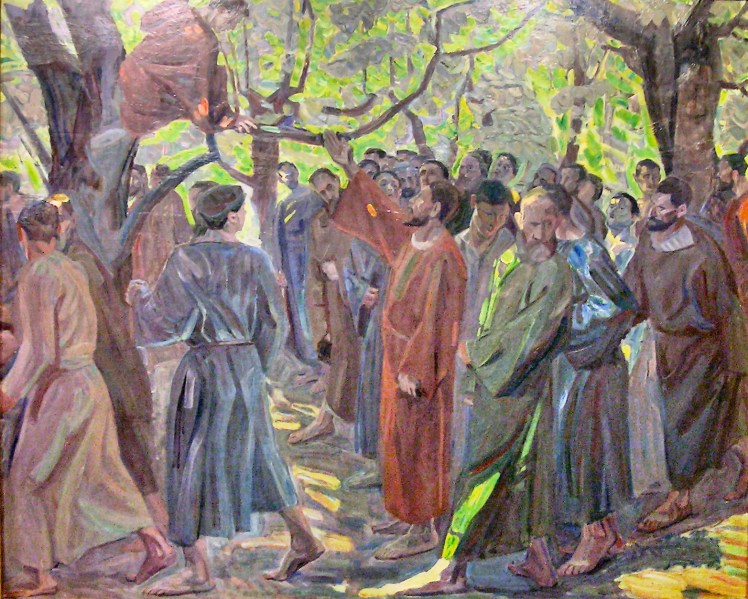
Jesus is on the road at Jericho, a wealthy city in the foothills leading to Jerusalem – it is the last leg of his journey to the temple, when he encounters Zacchaeus, the lead tax collector, a man universally despised, short in stature, which may very well be referring to his communal status as well as his height. Poor guy – he’s the one in the room everyone hates and he knows it. He has to run along the parade route behind the crowds in front of him – crowds that tighten their positions to keep him out. And there is little Zacchaeus, jumping up and down, trying to get a glimpse of Jesus, when he comes to the sycamore tree: a tree with low branches that made climbing easy and a tree loaded with large leaves that would hinder his presence from being detected by the crowd. A wealthy, grown man, clambering up a tree. What made him throw embarrassment, shame, and ridicule aside, not caring what people thought and what they might possibly see of his more private affairs?

He simply wanted to get a look at Jesus. After all, Jesus was a man that welcomed people like Zacchaeus. Jesus even has one of the guys from the Brotherhood of Tax Collectors local 106 in Galilee as one of his disciples. He must be an okay guy.

But Jesus spots him instead and tells him to come down.

The marginalized, the people on the wrong side of the crowds, the ones pushed off to the shoulder of the road, the ones blocked from participating in the community, the ones forced to climb a tree, are the ones who see most clearly. The blind beggar at the end of Luke 18 sees without eyes and Zacchaeus sees with his heart. And yet, the insiders, the disciples, the good white, evangelicals lining the roads telling others to go away, are the real blind ones. They don’t want those short people hanging around. The light of salvation is standing right in front of them and all they can see are their earthly expectations; all they can see is their own self-worth; all they can see are those who think and act like they do; all that they can see are their self-serving restrictions on who is in and who is out; all they see is a riddle; all they see is that they want to remain blind. It’s more comfortable and they grumble at anything that challenges them otherwise. Fake news.

The irony in all of this is that this is our story as well. This passage is not just some far removed happenstance on a dusty road in Palestine 2,000 years ago. It’s a story we continue to enact in varying degrees today, day after day. Zacchaeus was stereotyped and stigmatized by the blindness of the crowds much the same way we do grumbling about all of them: the opposite political party, immigrants, Muslims and their burquas, Jews and their yarmulkes, Hindus and their bindis, atheists, straight, the ‘nones’, the gay couple that just moved into the neighborhood, the transgender boy that wants to join the scouts and those Asian, black, and Hispanic people that seem to be everywhere and now the neighborhood just isn’t the same. We whisper about the couple getting divorced, the family dealing with an addicted member. We condemn the poor as lazy and self-seeking in their charity or the felon who must check a box for the rest of his or her life, condemning far too many to underemployment and marginality. Worse yet, we proclaim prisons as houses of correction where there is no effort to do so, insuring the condemnation of many to an endless cycle of poverty and prison. After all, I’m not like you: I must deserve it.

We stereotype and stigmatize all day long. The disciples did it when they failed to understand the plain language of Jesus, remaining in their stereotyped expectations of messianic deliverance, not bothering to lift the veils from their eyes to truly see what scripture and Jesus had been saying all along. And when we revel in our attitudes of exclusion and self-righteousness, we, like the disciples, miss the message of Jesus and the cross. The kingdoms of our making, the kingdoms of racial division, white privilege, political tribalism, violence, materialistic greed are antithetical to the kingdom of God, but we continue to build them because we are just too willingly blind to accept the hard truth of Christ and the cross.

Jesus emphatically states: “Zacchaeus, today salvation has come to your house, and I am coming over for dinner.” This is the nub of the scandal of Zacchaeus’s story: Jesus was coming over for dinner. It’s at the heart of the problem the crowds are having as they grumble – he eats with sinners and tax collectors! Dinner parties in the Greco-Roman era were the society balls and political fund raising dinners of their time. It was the place to see and be seen, to affirm at the very least, to promote at its best, or to diminish at its worst, the social standing of anyone. To be invited to a dinner party means you are part of the ‘in’ crowd, you are part of the family.

Yet, here’s the beautiful thing. You don’t go looking for Jesus, Jesus comes looking for you. And that’s the good news for you and I, the blind and the lost. The good news is that today salvation has come to all of us because the Human One has come to seek us out. Jesus says to all who believe in him, that today, he is coming into our houses, coming to we who are what we stereotype and stigmatize, we who are “them” – he is coming to have dinner with us. Jesus call us to the table – all of us – the sinner and tax collectors, the blind and the broken, to affirm our place as children of the living God, spared certain destruction by the unmerited gift of the cross, to sit as one family gathered around the gifts of God for the people of God.

Late in his song, Newman sings: Short People are just the same as you and I. All men are brothers until the day they die. Imago dei – we are all made in the image of God. Go into the world today and every day with unyielding gratitude and the overflowing joy of a people found with sight restored – one family –  not white, black, brown yellow, red, not Republican or Democrat, straight, gay or in-between, – one blessed family that has room for all: a family invited to the greatest dinner party of all time. Thanks be to God – Amen.

Masthead Artwork: By Niels Larsen Stevns – Own work (photo: Gunnar Bach Pedersen) (Randers Museum of Art, Randers, Denmark), Public Domain, https://commons.wikimedia.org/w/index.php?curid=1428023

Cataracts

I can see clearly now the rain is gone// I can see all obstacles in my way// Gone are the dark clouds that had me blind// It’s gonna be a bright (bright)// Bright (bright) sunshiny day

Johnny Nash, 1971

I recently had posted something about holy happenings that generated some discussion about my understanding of the location of God. Somehow, the conversation shifted to Israel’s understanding and whether I was challenged by its ancient perspective. In a word, no. For the ancient Israelites, the symbols of altar, tabernacle and temple functioned for them as images of God’s house and that God dwelled with his people there. As a Christian, I believe that their understanding of a living God, active in creation and dwelling with us was fully confirmed in Jesus Christ because all the fullness of God was pleased to live in him (Colossians 1.19).

That being said, I share the awareness of the psalmist’s regarding the presence of God everywhere: He loves righteousness and justice; the Lord’s faithful love fills the whole earth (Psalm 33.5); But your loyal love, Lord, extends to the skies; your faithfulness reaches the clouds. Your righteousness is like the strongest mountains; your justice is like the deepest sea. Lord, you save both humans and animals. (Psalm 36.5-6); Lord, the world is full of your faithful love! Teach me your statutes! (Psalm 119.6).

And when I stop to remove the cataracts, I find that I locate God in a myriad of places, not the least of which is in the lives of my wife, daughter and I. We are where we are, and who we are, as family and individuals because of God’s direction and blessings owing to the work of the Holy Spirit that has manifested itself in the help, support and love from Christian, Jew and Muslim alike, as we struggled through incredibly dark, dangerous times.

I find God’s presence in the laughter and song of the children of our nursery school and in the love and care that the small group of teachers and aides shower upon them. I may be “Mr. Keith’ to the little ones, but each and every one of them are God moments for me.

I witnessed God’s presence around the table of older men that met (pre Covid-19) regularly every Saturday morning to share coffee, lots of ‘fish’ stories and most importantly, his Word. I have observed the work of the Spirit in several of their lives; a transformation taking them deeper into their faith and scriptural understanding. I find God’s presence in the work of our food pantry and its many volunteers that assist 100 families a month as they struggle with food insecurities.

But the most breathtaking, awesome, overwhelming evidence of God’s presence is what I witness in my daughter’s testimony. Skylar recently unearthed the Anne Frank of her generation in a young woman that perished in the Columbine High School massacre. The woman’s story triggered reactions from my daughter that demonstrate the presence and deep love of God; an awareness that is challenging her, but so very, very importantly, showing her God’s work and presence in her life.

All of these are instances of the sacred for me: that is, where the material and the spiritual have, and do, intersect. As I said, once you remove the cataracts…

Sad Songs Say So Much

Guess there are times when we all need to share a little pain // And ironin’ out the rough spot Is the hardest part when memories remain // And it’s times like these when we all need to hear the radio // ‘Cause from the lips of some old singer // We can share the troubles we already know// Turn ’em on, turn ’em on // Turn on those sad songs // When all hope is gone (ah…) // Why don’t you tune in and turn them on? // They reach into your room, oh // Just feel their gentle touch // when all hope is gone // Sad songs say so much

“Sad Songs” Elton John and Bernie Taupin, 1984

But….all hope is not gone. I want to talk about something that I believe is overlooked, misunderstood, and sorely needed, perhaps no more so than in the age of Covid-19. We are hurting; one in three people are reporting anxiety issues; many are angry and all of us uncertain. As one person reported, it’s like being on an endless car ride with a drunk at the wheel.

I want to talk about lament.

Lament. It’s more than just venting. Lament is prayer, a passionate expression of grief or sorrow and it is something too many of us, the church included, find difficult to do. We have this silly notion that we cannot bring such expressions of anger, the desire for sweet revenge, and despair into our conversations with God: that we must somehow rid ourselves of such imperfections before God will be interested in hearing from us. Or that worship must always be upbeat, nothing but praise and joy- no ‘Debby downers’ allowed. And oh, then there is the unspoken true American religion of optimism and denial. Big boys don’t cry, so suck it up buttercup and get along with life. In the futile idealism that doesn’t match up with reality, we flat out refuse to acknowledge the darkness and evil realities of life in a way that honestly demonstrates our dependency on the Lord until we are wearied beyond belief. We cannot honestly face our anger and grief: we deceive ourselves and the truth is not in us (1 John 1.8).

Lament is healthy and it is one of the most theologically sound practices you can undertake to express the pain, sorrow and grief caused by the suffering in your life. Lament allows you to hallow your anguish in prayer, both communally and privately. Lament is our divine invitation to talk to and with God, about our pain. We are blessed to have a God that weeps with us and in God’s own tears, works to heal and restore us – think Lazarus. Lament has an important purpose and that is trust. We know that our sovereign God has the power to deliver: the tomb is empty.

And here’s the beautiful thing. We have been handed a road map for lament from God for exactly that purpose: the Bible. The Bible is filled with these songs of sorrow: the book of Lamentations weeps over the destruction of Jerusalem; Job reminds us that there are more pains and unanswered questions in heaven and earth than we can grasp; Jesus lamented in the final hours of his life. And then we have the Psalms, likely the single best prayer guide ever printed.

Formulated as human speech, the psalms are God’s words put directly into our mouths to give back to God.  

The Hebrew title for the Psalter is Tehillîm – the Book of Praises, seemingly a contradiction as lament makes up the bulk of the book. That is a point worth pondering and praying on. Lament calls for opening yourself up to God with honest speech and when you do, you begin to break the logjam, allowing your tears to drench your bed and make way for the joy and praise that comes from experiencing God’s healing presence.

Lament: it is protest, it is petition, and it is praise. It is gift.

Protest. Turn to God. How long will you forget me, Lord? Forever? How long will you hide your face from me? How long will I be left to my own wits, agony filling my heart? Daily? How long will my enemy keep defeating me? (Psalm 13.1-2). Humbly and honestly, identify the pain, the anger, the questions, and frustrations welling up inside.

Petition. Knock and state your case. Wallowing in sorrow leads to despair or denial. To seek God’s help with your pain is an act of hope and faith in God’s promises. Look at me! Answer me, Lord my God! Restore sight to my eyes! Otherwise, I’ll sleep the sleep of death, and my enemy will say, “I won!” My foes will rejoice over my downfall (Psalm 13.3-4).

Praise: The heart of the act of trust that lament is and where all roads lead: But I have trusted in your faithful love. My heart will rejoice in your salvation.Yes, I will sing to the Lord because he has been good to me (Psalm 13.5-6). This is language that renews our faithful commitment to trust in God as we journey through a broken world.

Many folks have found themselves and their circumstances in these prayers, myself included. What I discovered was that I found myself through them: an understanding of who I am, what I need and most importantly, I discovered the language to say it all to God. One of my favorite Irish poets caught this well:

Whenever God shines his light on me // Opens up my eyes so I can see // When I look up in the darkest night // And I know everything’s going to be alright // In deep confusion, in great despair// When I reach out for him he is there // When I am lonely as I can be // And I know that God shines his light on me. “Whenever God Shines His Light,” Van Morrison, 1989.

The lament psalms – more than a third of the psalter – they are praise in a minor key – the sad songs that say so much.

Note: There are many more than the following, but I offer a few suggestions to get started: Psalm 6, 11, 12, 13, 22, 23, 39, 40, 44, 46, 54, 62, 73, 88, 102, 109, 121, 137, 143.

Christian Assumptions

Surely his salvation is at hand for those who fear him, that his glory may dwell in our land. Steadfast love and faithfulness will meet; righteousness and peace will kiss each other. Faithfulness will spring up from the ground, and righteousness will look down from the sky. The Lord will give what is good, and our land will yield its increase.

Psalm 85.9-12

We all know what assume means…the old saw about making an ass out of u and me. There are many times we experience the truth of that as it really means to act on something as if it were fact when indeed it isn’t. But the flip side may be equally true and one that does not have such embedded cynicism. Yes, there are times when we must assume that something is true and allow that assumption to guide our actions. As a Christian, I believe that the Bible provides us with many things on which we can make assumptions; good, healthy, life giving assumptions that shape our walk today and tomorrow.

Assume God is working in your life right now.

God has created a unique plan for each one of our lives. By the power of the Spirit, God works in a particular fashion in particular people for God’s particular purposes. Bless the God and Father of our Lord Jesus Christ! He has blessed us in Christ with every spiritual blessing that comes from heaven… God destined us to be his adopted children through Jesus Christ because of his love. This was according to his goodwill and plan and to honor his glorious grace that he has given to us freely through the Son whom he loves…We have also received an inheritance in Christ. We were destined by the plan of God, who accomplishes everything according to his design. Ephesians 1.3, 5-6, 11

Assume the Lord has great things in store for you.

All of creation is groaning and suffering labor pains and, as the bumper sticker says, ‘stinky tuff happens.’ But with the resurrection, a cosmic shockwave has occurred. Death has been the tyrant, but in Christ, something new has happened: the good news of the created order being restored and all of us along with it. We cannot fathom God’s time or timing, but it is never too early or too late: It is always the right time. Have patience because endurance produces character and character produces hope: Then he looked up at his disciples and said: “Blessed are you who are poor, for yours is the kingdom of God. “Blessed are you who are hungry now, for you will be filled. “Blessed are you who weep now, for you will laugh.” Luke 6.20-12

Assume people love you.

Hah, you might be tempted to cry! I was born at night, but not last night! It’s easy to be cynical but, “I say unto you,” look upon everyone as made in the image. Expect good things from others. Be kind, honest, forgiving, and loving your neighbor as yourself. The people you meet could be new friends and not adversaries. I was hungry and you gave me food to eat. I was thirsty and you gave me a drink. I was a stranger and you welcomed me.I was naked and you gave me clothes to wear. I was sick and you took care of me. I was in prison and you visited me.’ “Then those who are righteous will reply to him, ‘Lord, when did we see you hungry and feed you, or thirsty and give you a drink?When did we see you as a stranger and welcome you, or naked and give you clothes to wear? When did we see you sick or in prison and visit you?’“Then the king will reply to them, ‘I assure you that when you have done it for one of the least of these brothers and sisters of mine, you have done it for me.’ Matthew 25.35-40

Assume your ideas come from the indwelling of Christ through whom you can do anything.

You can’t prove it, but you can believe it. Stop procrastinating – move forward with your inklings and discover the potential Christ has birthed within you. Take chances, go out on a limb. Be all you can be. Embrace kingdom work. Therefore, my beloved, be steadfast, immovable, always excelling in the work of the Lord, because you know that in the Lord your labor is not in vain (1 Corinthians 15.58). You are never more alive than when you run risks for the Lord of lords. Stop wasting time and energy on negativity and negative assumptions. It does nothing but fill you with hate, envy, anger, and disappointment. It is sad and depressing for you and everyone around you. The Bible proclaims a living God of steadfast love and faithfulness, of righteousness and peace, a God that will give you what is good. Believe this and give God a chance in your life and your outlook on life. God loves you. God gave his only Son for you. Cherish that love and assume that you are a special, beloved child of the King of kings and you will come to assume you are a fortunate, blessed person in God’s world.

See what love the Father has given us, that we should be called children of God; and that is what we are. 1 John 3.1

Photo by Nishant Das on Pexels.com